Distance Formula at Home: Measure a Doorway Diagonal
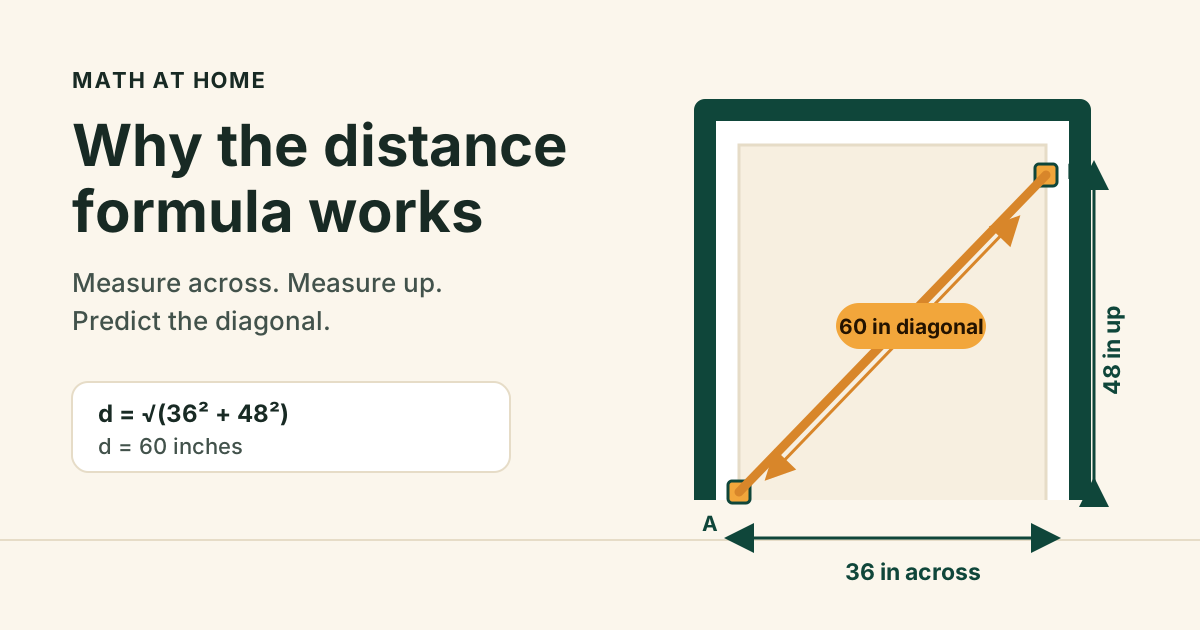
The distance math formula between two points is d = √((x₂ - x₁)² + (y₂ - y₁)²). It works because the horizontal and vertical changes form the two shorter sides of a right triangle, while the straight distance is its diagonal. A parent can make that idea visible by measuring across and up a doorway, predicting the diagonal, and checking it with the same tape measure.
What is the distance math formula?
The distance math formula finds the straight-line length between two points on a coordinate plane: d = √((x₂ - x₁)² + (y₂ - y₁)²). The two subtractions tell you how far the second point moved horizontally and vertically from the first point. Squaring, adding, and taking the square root turns those two moves into one diagonal distance.
This is Pythagorean mathematics written with coordinates. If the notation feels like too much at first, use distance = √(across² + up²). Bring the letters back after your child can point to each length on the doorway.
What do I need for the doorway activity?
The doorway activity needs a tape measure, two small pieces of painter's tape, paper, a pencil, and a calculator with a square-root key. Pick a doorway the family can leave alone for about 15 minutes. Keep both marks below shoulder height, and never stretch the tape across a doorway while someone is walking through it.
Use one unit for every measurement. Inches work well for the 36-by-48 example below; centimeters work just as well if every number stays in centimeters. The National Institute of Standards and Technology advises teachers to use measurement tools in hands-on activities and puts the point plainly: "Measurement involves doing." NIST is the United States measurement science agency, so its metric ruler teaching guidance is a primary source for the measurement practice used here.
How do we turn a doorway into a coordinate plane?
Turn the doorway into a coordinate plane by treating one lower inside corner as A = (0, 0), then describing a second mark by how far it is across and how far it is up. You do not need to draw axes on the wall.
- Put one piece of painter's tape at a lower inside corner of the doorway. Label it A on your paper.
- Measure horizontally to the opposite inside edge. Record the width instead of assuming the doorway is a standard size.
- From that opposite lower corner, measure upward and place the second piece of tape. Label it B.
- Write B as (width, height). A doorway with a 36-inch width and a mark 48 inches high gives B = (36, 48).
- Before measuring the diagonal, ask your child to predict whether it should be shorter than 48 inches, between 48 and 84 inches, or longer than 84 inches.
That estimate catches button-pushing mistakes before they settle onto the page. The diagonal must be longer than either leg, but shorter than walking 36 inches across and then 48 inches up, which totals 84 inches.
The official Common Core State Standards say fifth graders use two perpendicular axes and interpret an ordered pair as travel in one axis direction followed by travel in the other. That makes the grade 5 coordinate standard a sound foundation for this model. The standards place formal application of the Pythagorean theorem to coordinate distance in grade 8. Treat this as an early concrete preview; formal mastery comes later.
How do we calculate a 36-by-48 doorway distance?
Calculate the 36-by-48 doorway distance by subtracting the coordinates, squaring both changes, adding, and taking the square root. With A = (0, 0) and B = (36, 48), the work is:
d = √((36 - 0)² + (48 - 0)²)
d = √(36² + 48²)
d = √(1,296 + 2,304)
d = √3,600 = 60 inches
Now hold the tape at A and extend it straight to B. The prediction is 60 inches, or 5 feet. Let your child read the tape first, then put the calculation beside that measurement.
| Doorway quantity | Coordinate calculation | Worked value | What the child can point to |
|---|---|---|---|
| Horizontal change | 36 - 0 | 36 inches | Across the opening |
| Vertical change | 48 - 0 | 48 inches | Up the opposite side |
| Walk-around distance | 36 + 48 | 84 inches | Across, then up |
| Straight distance | √(36² + 48²) | 60 inches | Tape stretched from A to B |
This example uses a scaled 3-4-5 triangle because each side of 3, 4, and 5 was multiplied by 12. Your doorway may have a different width. Keep the real width, choose a safe height for B, and let the calculator handle a decimal answer.
Why does the distance formula work on the doorway?
The distance formula works on the doorway because the width, height, and diagonal form a right triangle. The door jamb and floor meet at a right angle. The Pythagorean theorem says the square of the diagonal equals the sum of the squares of the two perpendicular sides, so replacing those side lengths with coordinate differences gives the distance formula.
Have your child trace the route across 36, then up 48 with two fingers. That bent route supplies the triangle's legs. Stretching the tape from A to B supplies the hypotenuse. The formula names the relationship already sitting in the doorway.
For a smaller follow-up that focuses on drawing error, the two-diagonal envelope test uses both diagonals of one paper rectangle. It asks a different question: whether a hand-built rectangle is square enough for its two diagonals to agree.
How close should the tape measurement be to the formula?
The tape measurement should be close enough that your child can explain the gap using the tool and setup, not forced to match 60 inches exactly. Painter's-tape marks have width, a flexible tape can sag, trim may not be square, and the metal hook can shift slightly.
Record the first measurement before adjusting anything. Then check three things: Did the tape start at the same point? Was B really 48 inches above the lower corner? Was the diagonal pulled straight? Measure again and compare the two attempts.
NIST reports that a 6-foot tape used for buying and selling should be accurate within 1/32 inch under the cited standard. That controlled requirement applies to the tape. In this home activity, how the tape is held and read will usually create a larger gap than the printed marks do.
How can I keep a reward from replacing the explanation?
Keep a reward from replacing the explanation by tying completion to three visible actions: record both leg lengths, predict the diagonal, and explain why the formula uses squares. A ticket can acknowledge the finished reasoning. One exact tape reading alone does not show mastery.
Parent Prize Portal's tracked mock catalog lists the geometry default payout as 6 tickets and the word-problems default as 4 tickets, a difference of 2 tickets (6 - 4 = 2). Those source lines verify mock defaults that mirror a backend contract. They cannot establish that this doorway activity synced, that a child mastered distance, or that a two-ticket gap fits a particular family.
The math practice reward chart review shows how to reward a checkable process without paying for minutes alone. App evidence has a similar boundary: the parent dashboard test helps a parent separate recorded activity from what a child can explain away from the screen. If your current goal is fact fluency instead of geometry, use the math fact practice app guide for that different job.
What are the frequently asked questions about the distance formula for kids?
The most useful distance-formula questions for kids concern grade level, units, square roots, and what to do when the measurement does not match perfectly.
Is the distance formula the same as distance equals rate times time?
No. Distance equals rate times time finds how far something travels at a given rate for a given time. The coordinate distance formula finds the straight-line length between two points from their horizontal and vertical changes.
Can we use centimeters instead of inches?
Yes. Measure the width, height, and diagonal in centimeters, and the formula will return centimeters. Do not mix inches and centimeters in one calculation.
Does a fifth grader need to simplify square roots?
No. A fifth grader can use a calculator after building the squares and sum. The main goal is connecting across, up, and diagonal; formal radical simplification can wait.
What if our doorway does not make a whole-number diagonal?
Use the real measurements and round only at the end. Write both the calculator result and the tape reading, then discuss why they may differ slightly.