Introducing Coordinate Grids: Plotting Points Without the Panic
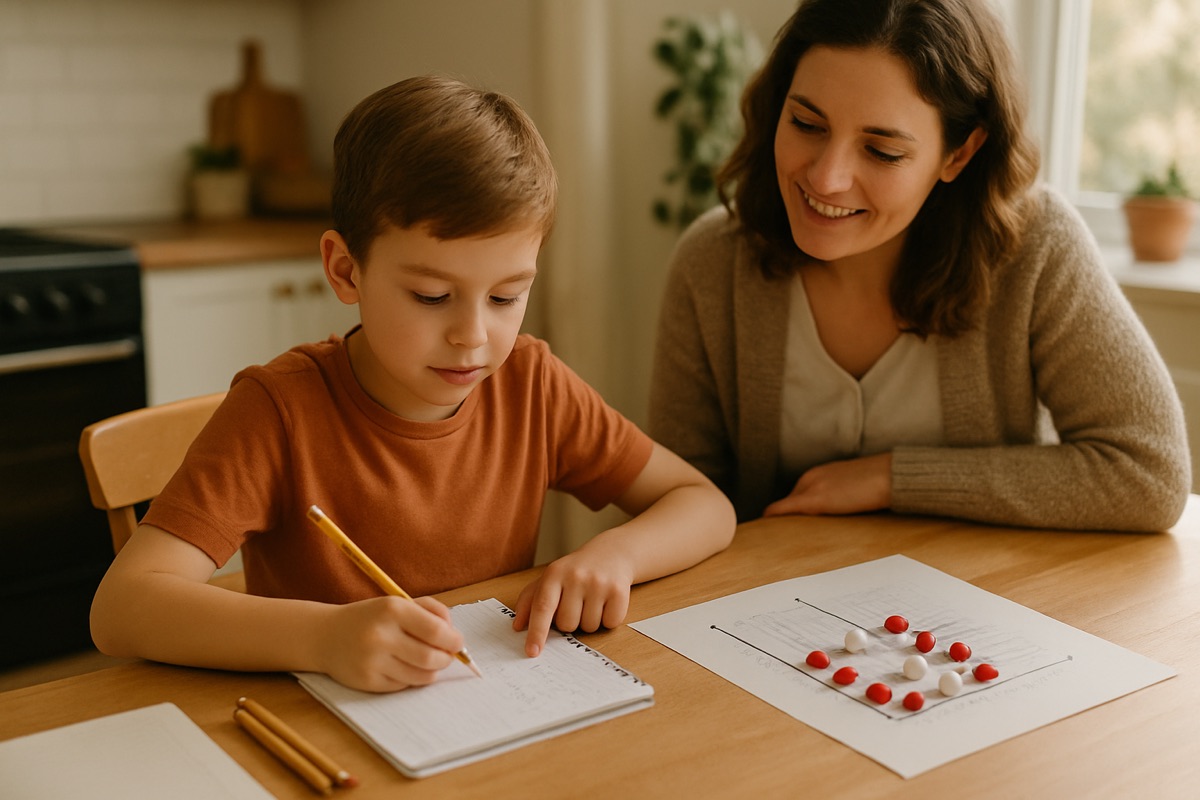
Consider an illustrative example: a child sees the ordered pair (3, 5) and asks which number tells them where to start. On a first-quadrant coordinate grid, trace the point from the origin together: three units right, then five units up. The example gives the two numbers a job before introducing more vocabulary.
Start with a treasure map rather than a list of new terms.
Every point is an address, not a mystery
For this introductory first-quadrant grid, think of a point as an address. Start at the origin, where both coordinates are zero. The first number tells you how far to move right along the horizontal x-axis. The second tells you how far to move up, parallel to the vertical y-axis. This across-then-up description uses nonnegative coordinates; grids with negative coordinates also include moves left or down.
Draw a simple city grid and put a little house at (4, 2). Narrate the moves while tracing them with two fingers: "Start at the origin. Walk four blocks to the right. Now go up two blocks." Giving the point a role, such as a house or buried treasure, provides a concrete location to check against the ordered pair.
The parentheses hold the two coordinates together as one ordered pair.
x before y, with an across-then-up prompt
When the two coordinates differ, swapping them changes the point. For (3, 3), swapping the equal coordinates gives the same point. A child might plot (3, 5) as if it were (5, 3). Ask the child to trace each pair on the same grid and compare the locations, rather than treating the alphabet rule as the whole explanation.
A movement prompt is one option for rehearsing the order:
- You have to walk into a building before you can climb the stairs. Across first, then up.
- The x-axis is the floor. You crawl before you climb.
- Say it as a rhyme if the kid likes rhymes: "Run across the hall, then climb the wall."
Invite the child to trace right, then up with a finger before plotting each point. The alphabet can be another prompt ("x comes before y, so x goes first"). Check the final location against both numbers; rehearsal is an aid, not proof that the point is correct.
Build the grid before you fill it in
Check the counting as well as the order. Starting at one instead of zero, or confusing grid spaces with the intersection points used for coordinates, can put a point one unit away from the intended location.
On graph paper, draw the two axes meeting at the origin. Label that intersection zero. Number the grid lines going right and up, keeping the spacing equal, then count the spaces from zero to each numbered line.
Use (0, 4) to check the meaning of zero: there is no sideways move, so the point stays on the y-axis and goes four units up. Ask the child to show that path before trying a pair with two nonzero numbers.
Make it a paper-grid game
For a game-based alternative to a list of points, adapt a paper version of Battleship to use ordered pairs.
Give two players separate paper grids with the same labels and scale, with a folder between them. Each player hides ships by marking intersection points, then the players take turns calling ordered pairs to search. Compare (2, 5) with (5, 2): the order changes the location. Reveal and check the marked points together so an incorrect call can be traced back to the numbers and counting.
For one child, draw a simple shape on a separate grid and read its corner points aloud. Have the child plot them and connect the dots, then compare both grids point by point. A recognisable picture provides a useful check, but it does not replace checking each coordinate. If using Math Prizes or another practice app, look for feedback that helps the child inspect the result rather than only a right-or-wrong mark.
When it still goes sideways, back up to the address
If a child keeps landing on a different point, pause the longer exercise and check one ordered pair together.
Before plotting, ask: "How far across, then how far up?" Have the child name the two moves, start at zero and trace them before marking the point. If the result differs, check the order, starting position and number of spaces separately.
Keep the next practice small: one address, one traced path and one checked point. A map or a paper game gives the coordinates a purpose while leaving room to stop, compare and correct a move.