Pythagorean Mathematics With a Ruler and Square Corner
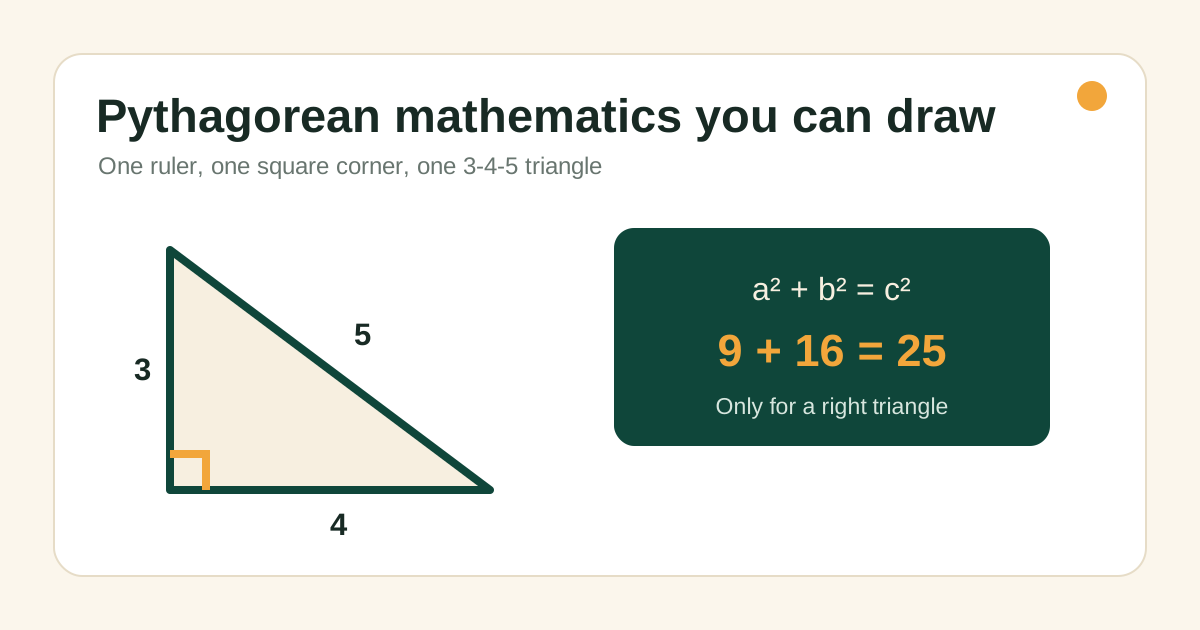
Pythagorean mathematics gives a rule for a right triangle: square the two shorter side lengths, add them, and the result equals the square of the longest side, written a² + b² = c². A parent can show it with a ruler, paper, and one square corner by drawing a 3-by-4 right triangle and checking its 5-unit diagonal. The Common Core State Standards place formal proof and application in grade 8, while upper-elementary work builds the needed ideas about multiplication, area, measurement, and right angles.
What is Pythagorean mathematics in plain English?
Pythagorean mathematics says that the areas of squares built on the two short sides of a right triangle add up to the area of the square built on its longest side. The rule works for right triangles, the ones with one 90-degree or square corner.
The letters do one small job:
- a and b are the two sides that meet at the square corner.
- c is the hypotenuse, the longest side, across from that corner.
PBS NOVA gives the same definition in its Pythagorean Puzzle: in a right triangle, the squares of the two sides add to the square of the hypotenuse. Here, "square" means multiplying a length by itself. The triangle can face any direction on the page.
How can I show the theorem with a ruler and square corner?
A parent can show the Pythagorean theorem by drawing one accurate 3-4-5 triangle and checking both the lengths and the square areas. You need paper, a ruler, a pencil, and the corner of an index card or another object you trust to be square.
- Draw a horizontal line 4 inches long.
- Put the index-card corner at the left endpoint. Draw a vertical line 3 inches long along its other edge.
- Connect the free ends of the 3-inch and 4-inch lines.
- Measure that diagonal. A careful drawing should be very close to 5 inches.
- Mark the small square at the 90-degree corner so nobody mistakes this for a rule about every triangle.
A measurement of 4.9 or 5.1 inches usually comes from pencil width, ruler placement, or corner alignment. Keep the imperfect measurement and calculate the exact value next.
| Triangle side | Length | Square of the length | Area to picture |
|---|---|---|---|
| Short leg | 3 | 3 x 3 | 9 square units |
| Long leg | 4 | 4 x 4 | 16 square units |
| Hypotenuse | 5 | 5 x 5 | 25 square units |
Add the first two square areas: 9 + 16 = 25. That matches the square on the 5-unit hypotenuse. The arithmetic checks the 3-4-5 example exactly even when a hand-drawn line is a millimeter off.
Why does the theorem use squares?
The Pythagorean theorem uses squares because it compares areas built from the three side lengths. A length of 3 makes a 3-by-3 square with area 9; a length of 4 makes area 16; a length of 5 makes area 25.
This is where multiplication facts stop feeling like a separate drill. A child who knows 3 x 3, 4 x 4, and 5 x 5 can see the geometry inside those facts. If square numbers are still slow, the multiplication facts guide gives a steadier practice route before adding a formula.
Stay with the picture before moving to square roots. Ask the child to point to the square corner and name the hypotenuse. Then ask why 9 plus 16 belongs together. These checks expose a swapped side faster than another page of calculations.
When does the Pythagorean theorem appear in school?
The Pythagorean theorem is formally taught and applied in grade 8 under the Common Core State Standards, after earlier grades build its pieces. The grade 4 geometry standards ask students to recognize right triangles, and grade 4 arithmetic includes multi-digit multiplication and area models.
In grade 8 geometry, the standards ask students to explain a proof, find unknown side lengths in right triangles, and use the theorem for distance on a coordinate grid. That sequence explains why an upper-elementary worksheet may show right angles, square numbers, area, or coordinate points without naming the theorem yet.
The grade number marks one curriculum sequence. State standards differ, schools arrange topics differently, and a child may meet an enrichment version earlier. The ruler activity works as a preview because it starts with a picture and an exact whole-number triangle.
How does the theorem become the distance math formula?
The Pythagorean theorem becomes the distance formula by treating horizontal change and vertical change as the two short sides of a right triangle. The straight line between the points is the hypotenuse.
Take the points (1, 1) and (4, 5). Moving from the first point to the second changes x by 3 and y by 4. Those moves form the same 3-4-5 triangle:
distance = √((4 - 1)² + (5 - 1)²) = √(3² + 4²) = √25 = 5
The Common Core grade 8 geometry standard names this exact use: applying the Pythagorean theorem to find the distance between two points in a coordinate system. A child who can draw the horizontal and vertical moves has a reason for the distance formula instead of one more line to memorize.
How does this fit Parent Prize Portal's math practice?
Parent Prize Portal's source shows how geometry is labeled in its local mock payout catalog. It cannot establish what a live child learned. Here is the full tracked geometry row from src/lib/mocks.js:
{ key: 'geometry', label: 'Geometry', default: 6, min_grade: 4 },
This source walkthrough shows that the mock payout catalog labels geometry, assigns a default value of 6, and sets min_grade to 4. That is all this product source establishes. It does not tell us whether a live child received six tickets, whether Math Prizes teaches the Pythagorean theorem, or whether practice led to mastery.
Use the portal report as a prompt to ask what the child saw. Then have the child rebuild one problem on paper. The productive screen-time guide explains why an explanation or transfer task tells you more than time on screen alone.
What should I ask after the ruler activity?
After the ruler activity, ask questions that make the child point, predict, and explain before calculating again. Four are enough:
- Which corner has to be 90 degrees?
- Which side is the hypotenuse, and how do you know?
- What do 9, 16, and 25 measure?
- Would the same equation work if I pushed the square corner wider?
For the last question, changing the angle also changes the diagonal. Once the corner moves away from 90 degrees, a² + b² = c² no longer describes that triangle. That boundary is part of knowing the theorem.
Frequently asked questions
What is the Pythagorean theorem formula?
The formula is a² + b² = c², where a and b meet at the right angle and c is the hypotenuse across from it.
Can I use the Pythagorean theorem on any triangle?
No. The familiar formula applies to right triangles. Check for a 90-degree angle before assigning the longest side to c and doing the arithmetic.
Is the distance formula different from the Pythagorean theorem?
The distance formula is a coordinate-grid use of the Pythagorean theorem. The horizontal and vertical changes are the legs, and the straight-line distance is the hypotenuse.
Was Ada Lovelace the mathematician behind the Pythagorean theorem?
No. Ada Lovelace was a 19th-century mathematician known for extensive notes on Charles Babbage's proposed Analytical Engine, according to the Computer History Museum. Her work belongs to the history of computing; it is separate from this right-triangle theorem.