Pythagorean Mathematics: The Envelope Diagonal Test
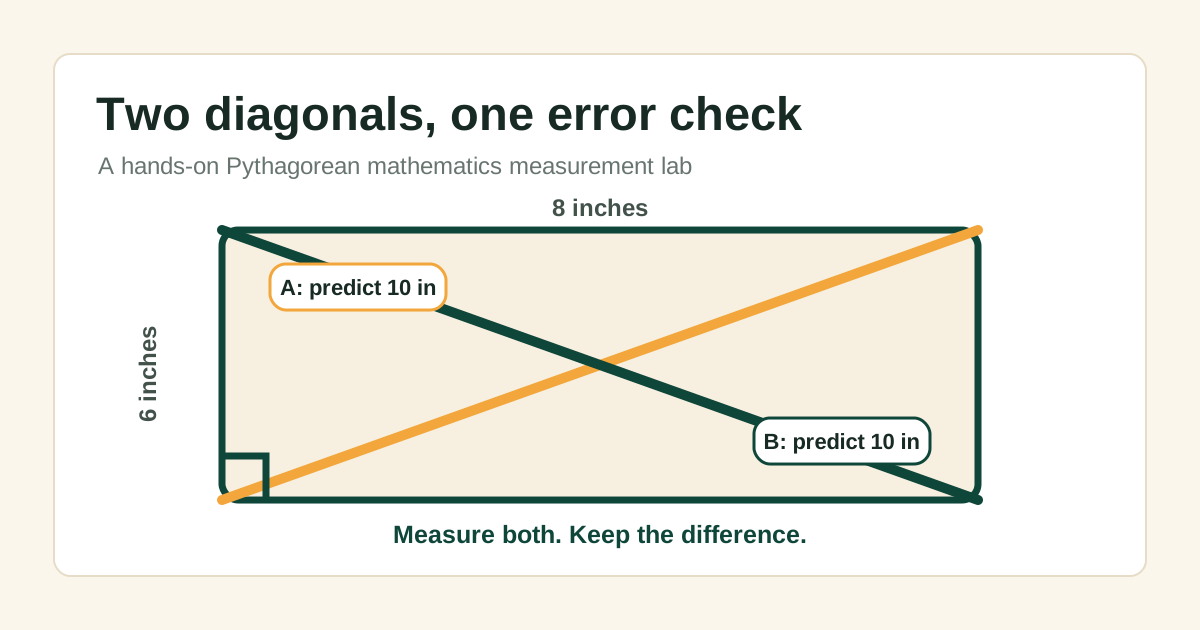
Pythagorean mathematics lets a child predict both diagonals of a rectangle from its width and height. For a 6-by-8-inch rectangle, 6² + 8² = 36 + 64 = 100, so each diagonal should be 10 inches. This ruler-and-corner lab compares the two real measurements; their difference helps a child find drawing error instead of rounding it away.
What is the two-diagonal envelope test?
The two-diagonal envelope test applies the Pythagorean theorem to a rectangle a child makes and measures. A large mailing envelope works, though taped paper or a cereal-box panel is fine. The finished shape supplies two right triangles with the same 6-inch height, 8-inch width, and predicted hypotenuse.
The second diagonal makes this activity different from a single-triangle demonstration. A child predicts the same value twice, measures two separate lines, and then studies the gap. That turns a wrong-looking answer into information about the drawing.
This is a follow-up to the site's ruler-and-square-corner Pythagorean guide. That guide draws one 3-by-4 triangle and measures its 5-unit side. This activity starts with a rectangle and treats the difference between its diagonals as evidence.
What materials do I need for the activity?
The envelope test needs paper or thin cardboard, a ruler, a pencil, and one rigid square corner. An index card, hardcover book, or clean sheet of printer paper can supply the corner. Avoid a phone case with rounded, flexible edges.
Use one unit throughout. Six by eight inches is large enough for ordinary ruler error to be visible without taking over the table. A centimeter version also works, but a thick pencil line occupies more of the smaller drawing.
The Institution of Engineering and Technology publishes a related classroom activity for ages 5-7 and 7-11 with a listed duration of 30-59 minutes. Its main activity uses a 3:4:5 string triangle to check whether objects are perpendicular to their base (IET Education). The IET is the professional engineering institution that published the teaching resource, so it is an appropriate primary source for that activity's age bands, timing, and method.
How do we build the 6-by-8 rectangle?
Build the rectangle from one trusted square corner, then mark both diagonals before measuring either one. Here is the sequence I used.
- Mark a starting point near one corner of the paper.
- Draw an 8-inch base from that point.
- Hold the square-corner object at the starting point and draw a 6-inch side.
- Use the same object to construct the other two corners and close the shape.
- Draw both corner-to-corner diagonals so they cross in the middle.
- Label the lines A and B. Write a prediction for each one before using the ruler.
Keeping the prediction covered until the drawing is finished helps. The child cannot quietly adjust a corner to make the ruler land on an answer already seen.
Why should both diagonals measure 10 inches?
Both diagonals should measure 10 inches because each one forms a 6-8-10 right triangle with one width and one height. The Pythagorean calculation is 6² + 8² = 36 + 64 = 100, followed by √100 = 10.
| Check | Diagonal A | Diagonal B | Difference |
|---|---|---|---|
| Prediction from 6² + 8² | 10 inches | 10 inches | 0 inches |
| First measurement | Write yours | Write yours | Larger minus smaller |
| After rebuilding one corner | Write yours | Write yours | Compare with the first gap |
The original computed result is the predicted gap: 10 - 10 = 0 inches. A real paper drawing may produce a small nonzero gap because pencil lines have width and rulers slip. Keep the raw measurements instead of editing them to match the prediction.
How do the two diagonals diagnose a measurement mistake?
The two diagonals diagnose a measurement mistake by producing two useful patterns. If A and B match each other but both miss 10, remeasure the 6-inch and 8-inch sides. If A and B differ, inspect the corners and parallel edges because the shape may be skewed.
Check whether the ruler began at zero and whether the square-corner object moved. Rebuild one suspect corner, then fill in the last row of the table. A smaller diagonal gap supports the corner diagnosis. An unchanged gap tells you to look at the side marks or the way the ruler was held.
Do not choose a universal tolerance and call every result inside it correct. The ruler's markings, pencil width, paper, and child's motor control all affect reasonable precision. Record what the tools can actually show.
What does the square corner control in this lab?
The square corner controls the 90-degree angle required by the Pythagorean theorem. The IET describes the theorem as the relationship in which the squares of the two sides of a right-angled triangle add to the square of its hypotenuse.
Move one top corner sideways while leaving the base in place. The shape becomes slanted, the diagonals separate, and the 6-8-10 prediction no longer describes both of them. That small sabotage makes the right-angle condition visible.
This measurement-error lab stops short of a formal proof. It gives a child one exact whole-number prediction, two observations, and a controlled change. The evidence supports what happened on the paper; it does not establish that every hand-drawn rectangle will measure exactly.
What does Parent Prize Portal source establish here?
Parent Prize Portal source establishes that Math Prizes includes practice controls, ticket payouts, topic mastery, and game records. The tracked app registry says:
{ id: 'math', source: 'math_prizes', name: 'Math Prizes', description: 'Practice controls, ticket payouts, topic mastery and game records.',
That exact line describes product areas. It does not say Math Prizes teaches this lab, record a live child completing it, or prove geometry mastery. The product connection stops where the repository evidence stops.
If a geometry activity appears in a parent report, ask the child to recreate one idea away from the screen. The productive screen-time math guide explains why a transfer task gives a parent a stronger check than minutes played alone.
How can I extend the activity without another worksheet?
Extend the activity by sliding one top corner sideways by half an inch without changing the base. Measure A and B again and compare the new gap with the original. The rectangle has become a slanted quadrilateral, so equal-looking side lengths no longer guarantee equal diagonals.
For a second round, rebuild the square corners and change one side length. Predict both diagonals before measuring. Most new answers will not be whole numbers, which gives the square-root key on a calculator a real job.
For a younger child, stop after naming the right angle, comparing A with B, and noticing that each diagonal is longer than either side. The calculation can wait. The measured shape gives later algebra something concrete to describe.
What are the frequently asked questions about Pythagorean mathematics at home?
Parents usually ask how exact the two measurements must be and how far to extend Pythagorean mathematics after the first diagonal comparison.
What is the Pythagorean theorem for kids?
It is a rule for right triangles: square the two sides that meet at the 90-degree corner, add those results, and you get the square of the longest side.
Why use a 6-by-8 rectangle?
Six, eight, and ten form a Pythagorean triple, so both predicted diagonals are whole numbers. The larger drawing also makes an ordinary ruler slip easier to notice.
What if the two diagonals differ by a little?
Write down the difference and check the tools before judging it. Rebuild one corner, measure again, and see whether the gap shrinks.
Is measuring one diagonal enough?
One diagonal checks the Pythagorean prediction. The second supplies an error signal because both diagonals of the intended rectangle should have the same length.