Why Memorizing Times Tables Isn't the Same as Understanding Multiplication
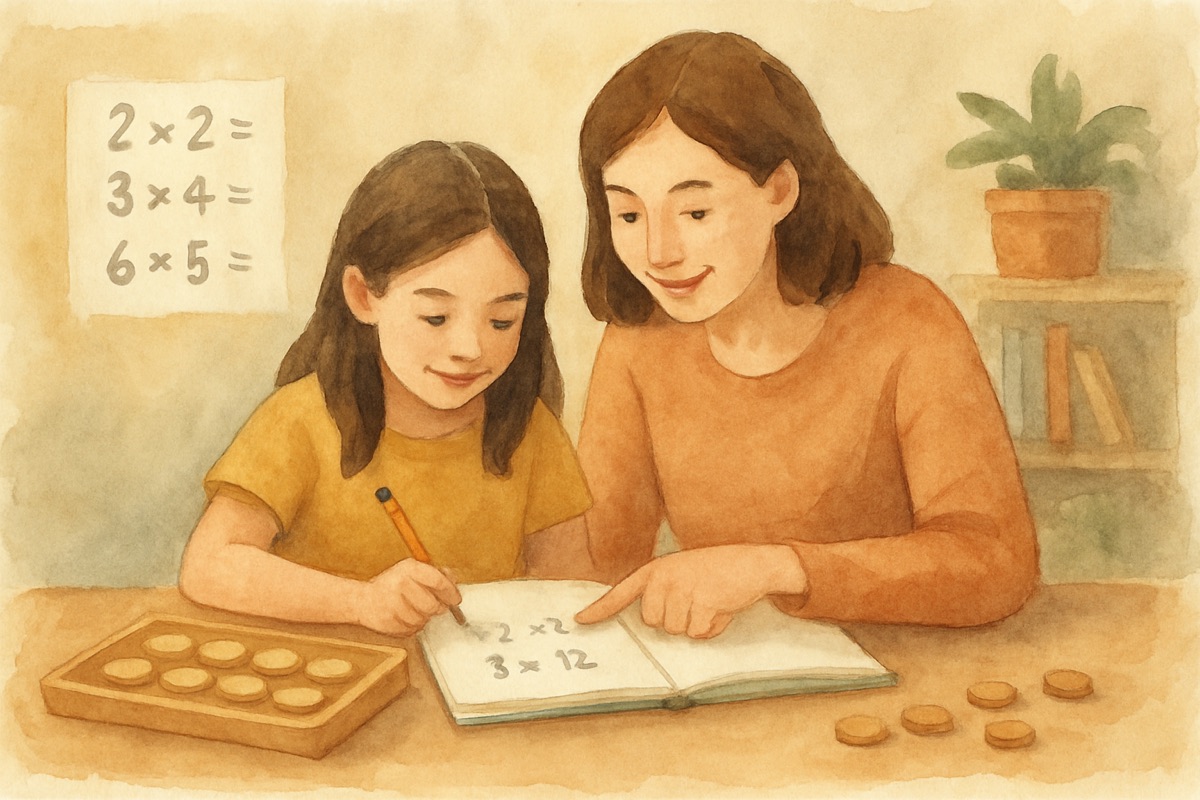
I had a third grader once, a sweet kid named Marcus, who could fire off the entire seven times table faster than I could write it on the board. Seven, fourteen, twenty-one, all the way up. Then I put a picture in front of him: four bags, six marbles in each bag, how many marbles total. He stared at it like I'd handed him a page in another language. He had the facts. He didn't have the idea underneath them. That gap, between understanding vs memorizing multiplication, is the thing I spend half of third grade trying to close.
Memorizing times tables is useful. I'm not one of those people who thinks drilling facts is a crime against childhood. But a memorized fact and an understood one are two different animals, and if a kid only has the first, it falls apart the second the problem stops looking like a flashcard.
Reciting is not the same as knowing
When Marcus said "seven times eight is fifty-six," he was doing something closer to singing a song lyric than doing math. The sounds came in order because he'd heard them in order a hundred times. Ask him what "seven times eight" actually described and he had nothing.
Here's the test I use. A kid who understands multiplication can answer "what does six times four mean?" out loud. Something like "six groups of four" or "four rows with six in each." A kid who only memorized will just repeat the answer, twenty-four, because to them the question and the answer are the same object. They don't see a question. They see a lookup.
Neither kid is failing. But one of them can grow, and the other one hits a wall around fourth grade when the problems get too big to have memorized.
Where memorization quietly breaks
The cracks don't show up during fact practice. They show up later, and by then it's easy to blame the new material instead of the missing foundation. Watch for these:
- Word problems. The kid knows every fact but can't tell whether a story wants you to multiply, add, or divide. Marcus and his marbles.
- Bigger numbers. Twelve times fifteen isn't in the times table. If you understand multiplication, you can break it apart. If you only memorized, you're stuck.
- Fractions and area. Half of a half being a quarter makes no sense if multiplication just means "the number you say after the other two numbers."
- Estimation. Ask a kid who understands whether nineteen times twenty-one is closer to four hundred or four thousand, and they'll reason it out. A memorizer has no idea, because they never learned that multiplication is about size.
A child can score perfectly on a timed facts quiz in October and be completely lost in a multiplication word problem in February. Same kid, same facts. The facts were never the problem.
What understanding actually looks like
Understanding multiplication means a kid can picture it more than one way. Six times four is six groups of four. It's also four groups of six (that's why the answer's the same, which blows their minds when it clicks). It's an array, six rows and four columns, like an egg carton or a window with panes. It's repeated addition, six plus six plus six plus six.
When a kid can move between those pictures, forgetting a fact stops being a catastrophe. Blank on seven times eight? Fine. You know seven times seven is forty-nine, add one more seven, fifty-six. That's not cheating and it's not slow, once it's practiced. That's what fluency is: the facts plus the ability to rebuild the ones you drop. Pure memorizers can't rebuild anything. When the fact is gone, it's just gone, and they freeze.
How to build the idea, not just the recall
You don't need a curriculum for this. You need real objects and a few good questions.
Grab whatever's on the counter. Grapes, coins, LEGO bricks, the little clementines in the bowl. Make groups. "Put out three plates. Give each plate four crackers. Before you count them all, how many do you think there are?" Let them build it and see it. The physical version of four times three teaches something the flashcard never will.
Then draw it. Arrays are the single best tool I know for this. Six dots across, four dots down. Now the kid can literally see that multiplication makes a rectangle, and that the rectangle is the same whether you count rows or columns. When they get to area in a couple of years, they'll already own the idea.
And keep asking "what does it mean" instead of only "what's the answer." When your kid says twenty-four, follow up with "twenty-four what?" Make them tie the number back to something real. Crackers, marbles, minutes. The number should always be a number of something.
Facts still matter, and here's how they fit
I want to be clear, because parents sometimes take "understanding matters" to mean "skip the drilling." Don't. A kid who understands multiplication but has to reconstruct every single fact from scratch is going to be exhausted and slow, and that slowness gets in the way when they're doing long division or algebra later. You want both. Understanding first, so the facts have somewhere to live, then enough repetition that the common facts come automatically.
The order matters. Build the idea, then automate the facts. When we built Math Prizes for our own kids, that's the sequence we tried to protect: tie the reward to real, correct work so the practice actually happens, but let the understanding come first through pictures and groups and talking it out. A reward for reciting sounds you don't understand just buys you a kid who's very fast at being confused.
The quick gut check
If you want to know where your kid actually stands, skip the quiz. Ask them to tell you a story where you'd need to do six times three. If they say something like "six friends each brought three cookies," they've got it. If they just say eighteen and look at you funny, that's your answer, and it's a good thing to find out now.
Marcus got there, by the way. It took about six weeks of grapes and drawings and me pestering him with "but what does it mean." One afternoon he looked at those four bags of marbles and just said "twenty-four" and then, without me asking, "because it's four sixes." That's the whole game right there. Not the number. The "because."