How I Know a Child Has Truly Mastered a Times Table (My Checklist)
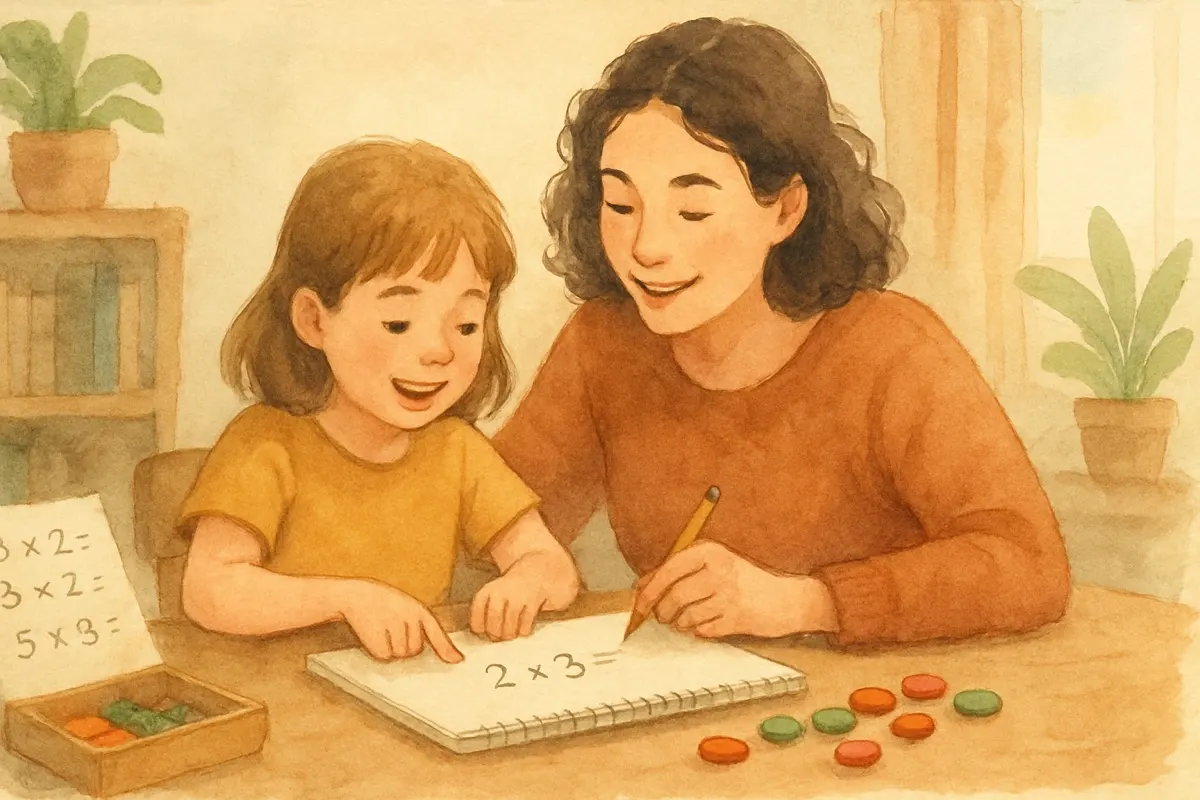
A kid in my class named Marcus got a perfect score on the six times table quiz one Friday. The following Wednesday I asked him, out of the blue, what six times seven was. He froze. Then he started whispering "six, twelve, eighteen" under his breath, counting up on his fingers. He had passed the test. He had not learned the sixes.
That gap is the whole thing. A quiz tells you a kid could produce the answers on a specific day, in a specific order, with the pressure of a grade behind them. It does not tell you whether the facts are actually theirs. So when a parent asks me how to know multiplication mastery in a way they can trust, I don't point at a grade. I run through a short checklist. Here it is.
Speed without the counting whisper
The first sign is simple. When you ask, the answer comes back fast, and you don't see the lips moving.
Counting up ("six, twelve, eighteen, twenty-four") is a fine strategy while a kid is still learning. It means they understand what multiplication is. But it is not fluency. A fluent kid hears "six times four" and says "twenty-four" the way they'd say their own age. There's no visible math happening in between.
A rough benchmark I use: about three seconds per fact, out of order, no visible counting. If a child needs six or eight seconds and you can see the gears turning, the fact is understood but not yet automatic. That's a real distinction, and it matters, because word problems and long division and fractions all sit on top of these facts. If the facts are slow, everything built on them gets slow too.
They can answer out of order
Here's a trick a lot of quizzes miss. Kids memorize the table as a chant. "Three, six, nine, twelve." If you always test them top to bottom, they can lean on the rhythm without knowing any single fact on its own.
So I jump around.
- I ask seven times eight, then two times eight, then five times eight.
- I ask the same fact twice, ten minutes apart, and see if it's still quick the second time.
- I ask the "hard" ones on their own: seven times eight, six times seven, eight times nine. Those three trip up almost everybody, so they're a good stress test.
If a child can only produce the answers by starting at the top and counting down the list, they've memorized a poem, not a set of facts. Real mastery survives being asked in random order.
They know it backward and sideways
This is the one that separates memorizing from understanding. A kid who has truly mastered the sevens knows that seven times eight is fifty-six. But they also know that fifty-six divided by seven is eight. And they know that if seven times eight is fifty-six, then eight times seven is also fifty-six, because you can flip the order and nothing changes.
That flexibility is the payoff. Multiplication and division are the same relationship looked at from two sides. When a kid owns a fact, they can walk into it from any direction. Try this: ask "what times six gives you forty-two?" A child who has the sixes down will get there quickly. A child who only memorized the forward direction has to run the whole table to find it.
You can build this on purpose. When you drill six times seven, also ask forty-two divided by six. Same fact, different door. Kids who practice both doors stop seeing division as a separate scary thing.
It holds up a week later, and under a little stress
The Friday quiz problem is really a timing problem. A fact you crammed Thursday night can absolutely show up Friday morning and be gone by the next week. Mastery means the fact is still there after a weekend, after a vacation, after you stopped drilling it.
So I check back. If a kid nailed the fours in April, I'll toss a four times seven at them in the middle of a science lesson in May and see what happens. The out-of-context, no-warning question is the honest one.
I also watch what happens under a small load. Can they still recall the fact while doing something else, like carrying it into a two-step problem? "There are 8 rows of chairs with 7 chairs in each row, and 5 chairs are broken. How many good chairs?" A kid with fluent sevens handles the fifty-six instantly and spends their brainpower on the "minus five" part. A kid who's still shaky on sevens burns all their focus on the multiplication and loses the thread of the actual problem.
What this looks like at your kitchen table
You don't need flashcards or an app to check any of this. You need about ninety seconds and a habit of asking at odd moments.
Some things that work at home:
- Ask one fact while you're pouring cereal. Out of order. No warning.
- Follow a forward question with the division version. "Six times seven? Good. Forty-two divided by six?"
- Come back to the same fact a few days later and see if it held.
- Slip a fact into a real situation. "We need 4 packs of 6 juice boxes. How many is that?"
If the answers come back quick, in any order, from any direction, and they stick around a week later, that table is learned. That's the finish line, not the quiz score.
One more thing worth saying. When a kid does hit real mastery, notice it out loud. Not because they got a good grade, but because they can now do something they genuinely couldn't do a month ago. Any reward, whether it's a high five or points in whatever app they use, ought to be tied to that real progress and not to how many problems they cranked through. Marcus, by the way, owned his sixes by June. I asked him six times seven in the lunch line and he said "forty-two" without even looking up. That's what it looks like when it's really theirs.