Fact Families: One Card, Four Facts, Way Less Memorizing
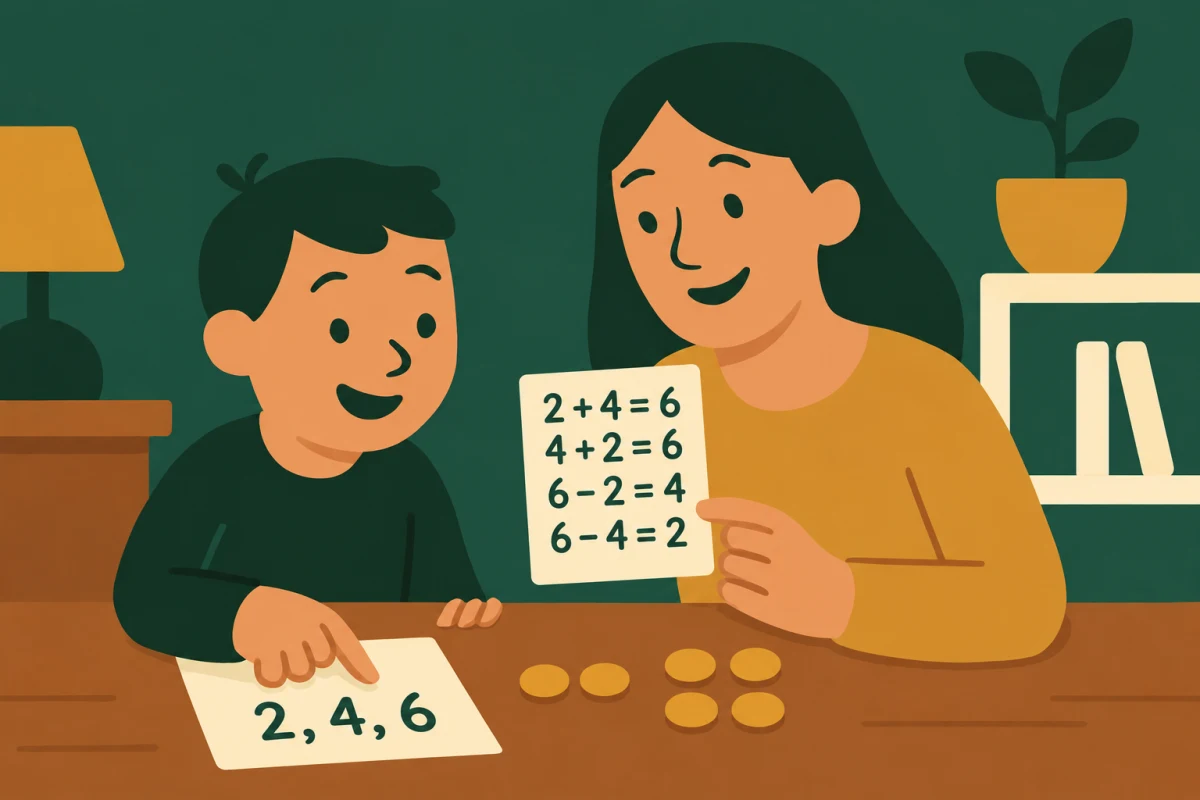
A third grader named Micah once told me he had "already learned" 8 plus 5 but hadn't "gotten to" 13 minus 5 yet. In his head these were two unrelated facts, sitting in different drawers, each needing its own trip to memorize. He had no idea they were the same three numbers wearing different clothes. That gap is exactly what fact families math is built to close.
The whole idea is this. Three numbers that go together produce four facts, not one. Take 5, 8, and 13. You get 5 plus 8 equals 13, 8 plus 5 equals 13, 13 minus 8 equals 5, and 13 minus 5 equals 8. Learn the relationship once and you get all four for free. That's a lot less to cram, and it's built on understanding instead of raw repetition.
Why four facts hide inside one relationship
Addition and subtraction are the same operation looked at from two directions. Kids don't see that on their own. To a six-year-old, adding is putting together and subtracting is taking away, and those feel like opposite jobs.
A fact family makes the connection visible. You put the three numbers in front of them and ask what they can make. When Micah finally saw that 13 minus 5 was just asking "what got added to 5 to reach 13," his face did that thing I live for. He'd been carrying twice the load he needed to.
The same works for multiplication and division. The family 4, 6, and 24 gives you 4 times 6, 6 times 4, 24 divided by 6, and 24 divided by 4. A kid who knows their times tables but panics at division is usually missing this one link.
The triangle card that does the work
The tool I reach for is a plain index card folded or drawn into a triangle. Put the largest number at the top corner and the two smaller numbers at the bottom corners. That's the whole thing. You can make a stack of these in ten minutes at the kitchen table.
Here's why the shape matters. You cover one corner with your thumb and ask your child for the missing number. Cover the top, and it's an addition question. Cover a bottom corner, and it's subtraction. Same card, same three numbers, but the kid has to move between the operations instead of treating them as separate.
- Cover the 13 (top): "5 and 8, what's the total?"
- Cover the 8 (bottom): "13, take away 5, what's left?"
- Cover the 5 (bottom): "13, take away 8, what's left?"
- Then flip the order and ask 8 plus 5.
One card, four questions, and the child keeps bumping into the fact that these numbers belong together. That repetition is doing something. It's not the mindless kind where you copy the same fact twenty times.
How to actually run it at home
Start small. Pick three or four families a week, not a whole deck. I usually begin with families that share a friendly number, like anything that makes 10, because those show up constantly and give kids an early win.
Do it in short bursts. Five minutes while dinner cooks beats a forced twenty-minute session that ends in tears. Let your kid quiz you sometimes, and get one wrong on purpose so they can catch it, because explaining why you're wrong is where the real thinking happens.
Watch for the moment they stop counting on fingers and just know a family. That's the goal. Not speed for its own sake, but the fact becoming automatic because they understand it, so their brain is free for the harder problem underneath. When a fourth grader is doing long division, you do not want them stalling to figure out 56 divided by 8. That should be reflex by then, and fact families are how it gets there.
When memorizing still has a place
I'm not against knowing facts cold. A kid who has to reconstruct 7 times 8 every single time will drown in longer problems. Fluency matters. What I'm against is treating each fact as an isolated thing to be drilled in a vacuum, because that's slow, it's boring, and it teaches nothing about how numbers work.
Fact families give you the best of both. The understanding comes first, then the automatic recall follows, because you've practiced the relationship from every angle. If you use an app to keep facts sharp between sessions, look for one that groups facts by family rather than firing random flashcards at your kid. We built fact families into Math Prizes for exactly that reason, so the practice reinforces the connection instead of scattering it.
Try this tonight. Grab three numbers your child already half-knows, draw the triangle, and cover a corner. Watch how fast four facts turn into one idea. That's the whole trick, and it holds up all the way through the math they'll do for years.