What to Say When Your Kid Cries Over Math Homework
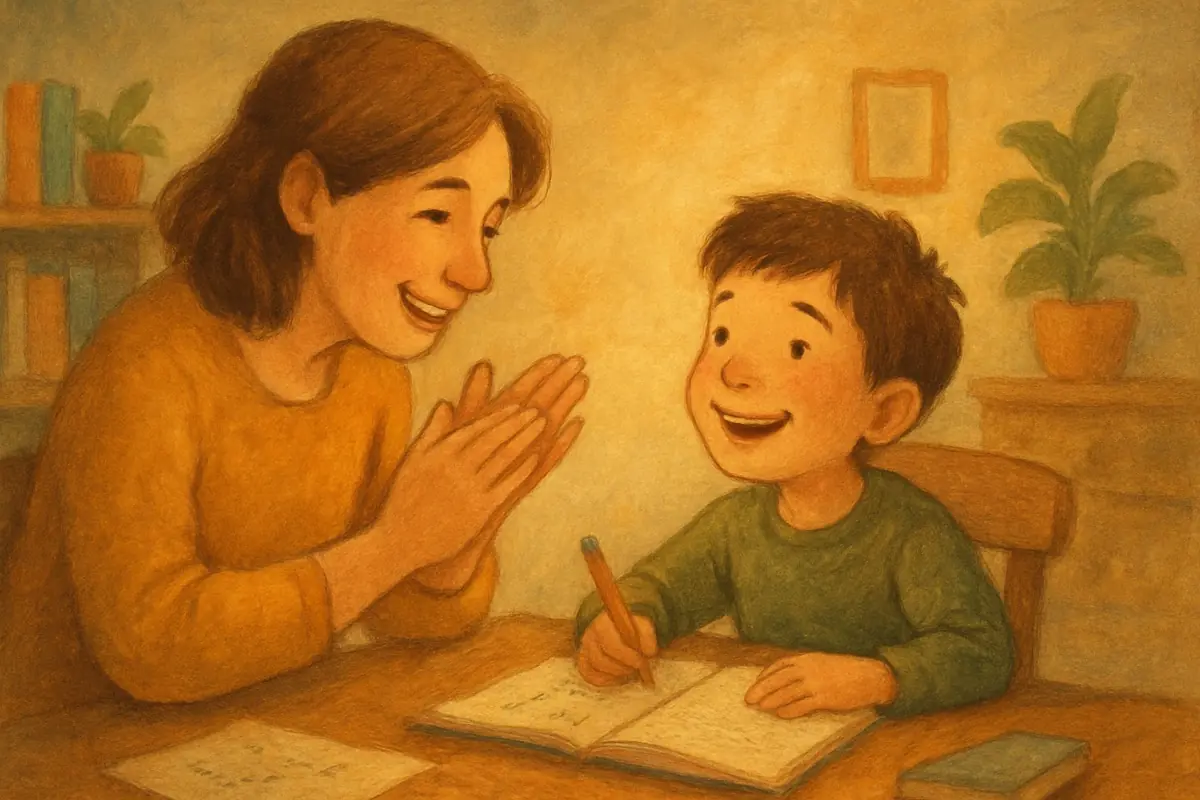
It's 7:40 on a Tuesday. The worksheet has four problems left. Your kid is crying, the pencil is somewhere under the table, and you're trying to sound calm while your own patience burns down to the wick. I've sat across from that exact moment more times than I can count, both as the teacher and, at home, as the mom holding the tissue. So when I say I know what a child crying during math homework help session feels like, I mean it from both chairs.
Here's what I've learned about what to say, what to skip, and how to get everyone to bedtime with the relationship intact.
First, stop the math
You cannot reason with a flooded brain, and a crying kid is a flooded brain. The part that does subtraction has effectively gone offline. Pushing through "just these last four" almost always makes it worse, because now the child is failing at the thing that's already scaring them, in front of the person whose opinion matters most.
So the first move is to take the math off the table, literally. Turn the paper over. Say something like, "Okay, we're taking a break. The math will still be here in five minutes and so will I." That last piece matters. You're telling them the problem is temporary and that you're not going anywhere. A kid in tears is often more afraid of your reaction than the fractions.
Then just sit with them for a minute. You don't have to fix anything yet. You're waiting for the storm to pass so an actual person comes back to the table.
Words that help
When they've settled enough to hear you, the goal is to name the feeling and shrink the problem. A few things that reliably land:
- "This one's tough. It makes sense that you're frustrated." Naming it tells them the feeling is allowed, which oddly makes it smaller.
- "You don't have to get it right, right now. We're just figuring it out together." This takes the performance out of it.
- "Show me the part where it stopped making sense." This turns a wall into a specific spot, and specific spots have fixes.
- "I used to hate this kind too." If it's true, say it. Kids are enormously relieved to hear an adult wasn't magically good at everything.
Notice that none of these are about the answer. That's on purpose. When a kid melts down, the message they need first is that they're okay and you're on their side. The math comes second, and it comes easier once that's settled.
Words that quietly make it worse
Most of us reach for these with good intentions. I've used every one of them and regretted it.
- "It's easy, just focus." If it were easy they wouldn't be crying. This tells them something is wrong with them, not the problem.
- "You did this yesterday." True, maybe, but it lands as an accusation. Yesterday's brain and tonight's brain are different weather.
- "Stop crying and we'll be done faster." You're now negotiating with the tears, which teaches the tears to stick around.
- "Let me just show you." Grabbing the pencil and doing it for them ends the crying but skips the learning, and they know it.
The theme is that these all put the child on defense. A kid who feels judged digs in. A kid who feels understood loosens up. You're aiming for loose.
Getting back into the actual math
Once the tears are done, don't jump straight back to problem four. Back up to something they can do. Find a similar problem they already got right, or make up an easy one out loud. "What's 10 take away 3?" Let them win one. That small success reminds the brain that it's capable, which is exactly the thing that shut off a few minutes ago.
Then move to the hard one, and change your job. Stop being the answer key and start being the question asker. "What do you think the first step is?" "What does this number tell us?" If they're stuck, give one nudge, not the whole solution. The point isn't to finish the worksheet tonight. It's for your kid to feel their own brain work through something that scared them. That feeling is what actually builds confidence, and it's worth more than a completed page.
Real understanding, not a race to be done, is what carries a child through next year and the year after. A kid who grinds out answers in a panic just to make the crying stop learns that math is something to survive. A kid who works through one hard problem calmly learns that hard is temporary. Only one of those helps in fourth grade.
When to just call it a night
Sometimes there's no getting back to it, and that's fine. If the break didn't work and everyone's fried, write a short note to the teacher. Something like, "We spent 30 solid minutes and hit a wall, so we stopped." Any teacher worth their salt would rather see that than a tear-stained page finished at 9pm by an exhausted parent.
Stopping is not giving up. It's protecting two things that matter more than one homework grade, which are your kid's belief that they can do math and your relationship with them. Both take a long time to build and one bad night to dent.
The math homework will come back tomorrow. It always does. But the child who learns that a hard night ends with a parent on their side, not a parent keeping score, walks back to the table the next day a little braver. That's the win. The worksheet's just paper.