How to Celebrate Effort When the Answer Is Still Wrong
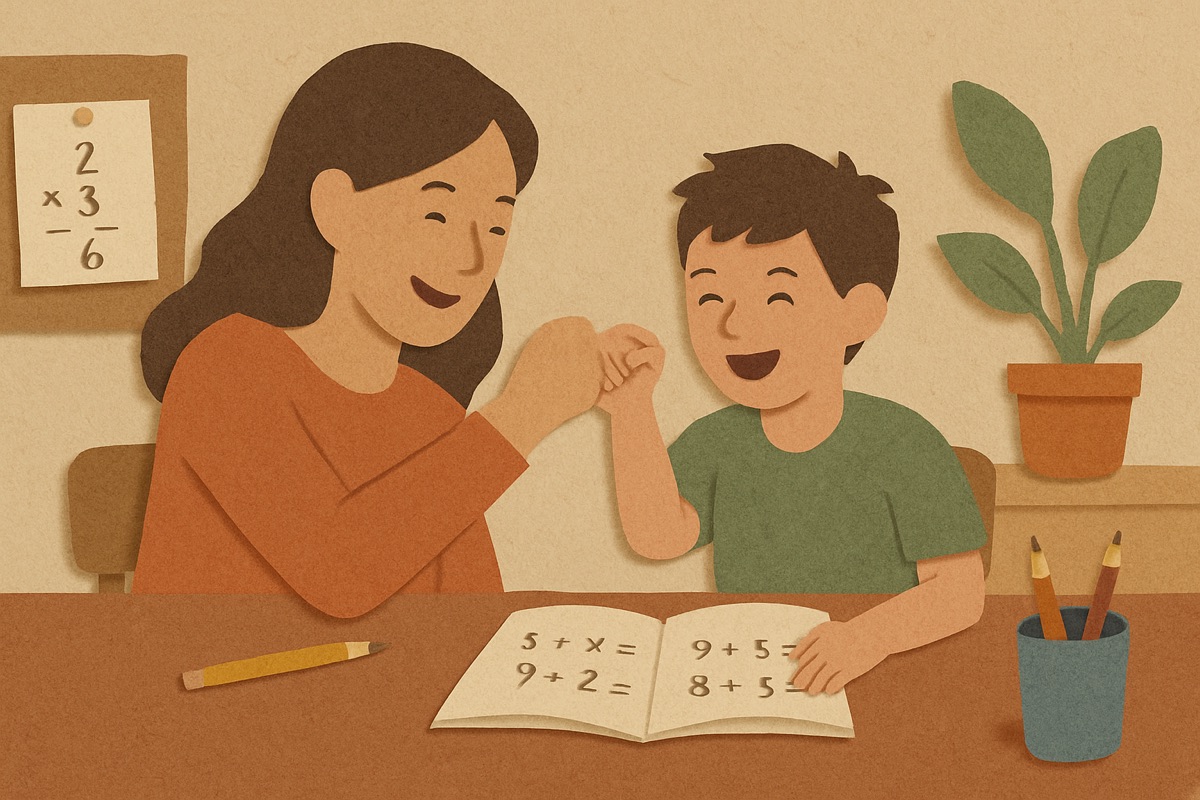
A girl in my class, second grade, worked a subtraction problem three different ways and landed on the wrong number all three times. She wrote 52 - 27 and got 35. Her steps were careful. Her handwriting was neat. She lined up the columns and everything. And the answer was still wrong.
Her mom, at conferences, told me she didn't know what to say when this happened at home. If she said "great job," it felt like a lie. If she said "that's wrong, try again," the kid deflated. That gap is the whole problem with praising effort over results for kids. Most advice tells you to do it and then leaves you standing there with a wrong answer and no script.
Why "good job" stops working
Kids are not stupid. A five-year-old can tell the difference between real approval and the automatic "good job" you say without looking up from your phone. By second or third grade, blanket praise reads as noise. Worse, when you praise a right answer as if the child is smart, you accidentally teach them that being smart means getting things right the first time. So the next time something is hard, they read the struggle as proof they aren't smart, and they quit.
That's the trap. Praise aimed at the result trains kids to avoid anything they might get wrong. Praise aimed at the effort trains them to keep going when things get hard. But the second kind only works if the effort is actually there. You can't praise effort that didn't happen. Kids can smell that too.
Praise the thing that was actually true
Here's the move I use, and it works because it's honest. Find the true thing and name it specifically. Not "you're so smart." Not even a vague "good effort." Point at the real behavior you saw.
With the girl who got 35, I could honestly say: "You tried three different ways. Most kids stop after one." That was true. Her persistence was real, even though her answer wasn't. Naming it did two jobs at once. It rewarded the thing I want more of, and it kept the door open to fixing the actual math.
Specific true statements sound like:
- "You didn't give up when the first way didn't work."
- "You showed all your steps, so now we can find exactly where it went sideways."
- "You asked a question instead of guessing. That's how mathematicians work."
- "You caught your own mistake. That's harder than getting it right the first time."
Every one of those can be true even when the final number is wrong. That's the point. You're not celebrating the wrong answer. You're celebrating the thing that will eventually produce right answers.
Then, separately, deal with the wrong answer
This is where a lot of parents get stuck. They think praising effort means ignoring the mistake. It doesn't. A wrong answer left uncorrected just becomes a wrong thing the kid now believes. You have to close the loop. The trick is to make the correction feel like a shared investigation instead of a verdict.
So after the honest praise, I go hunting with them. "Okay, you got 35. Let's walk back through and see where the numbers went." With that subtraction problem, we found it in about a minute. She had borrowed correctly but then subtracted the wrong pair in the ones column. She saw it herself. When a kid finds their own error, they remember it far longer than any correction you hand them.
Notice the order. Praise the real effort first. Then fix the math together, as a team. If you flip the order and lead with "that's wrong," the kid stops listening before you get to the useful part. Their brain is busy feeling bad.
Watch out for fake effort
There's a failure mode nobody warns you about. If you only ever praise effort, some kids learn to perform effort. They sigh loudly, erase dramatically, announce that this is SO hard, and produce almost nothing. They've figured out that looking like they're trying gets the reward.
Real understanding has to stay the goal. Effort is the path, not the prize. So I keep my praise tied to specific actions, not to the general vibe of struggling. "You wrote out your steps" is a real action. "You worked so hard" can be praising a performance. When I see a kid grinding through the same worksheet over and over with no thinking, I don't cheer that. Repetition without understanding isn't effort worth celebrating. It's just time passing.
The best rewards, the ones I've seen actually change how a kid feels about math, are tied to real progress. A concept that clicked. A type of problem that used to cause tears and now doesn't. That's worth making a fuss about. Ten completed pages of the same easy thing is not.
What this sounds like at your kitchen table
Say your kid brings home a math page with four wrong out of ten. Old instinct: circle the wrong ones, sigh, make them redo it. Try this instead.
Look at the six they got right and say something true about the method, not just the count. Then pick one of the wrong ones and say, "Show me how you thought about this one." Listen. Nine times out of ten, they'll spot their own slip halfway through explaining it. When they do, that's your moment: "See, you just found it yourself." That's the sentence that builds a kid who isn't afraid of being wrong.
The girl who got 35 is the reason I believe in this. By spring she was the kid who raised her hand and said "wait, I think I messed up" without any shame at all. She got there because being wrong stopped feeling like a character flaw and started feeling like a normal part of doing hard things. That's the whole game. Not protecting kids from wrong answers, but teaching them that a wrong answer with real thinking behind it is worth something. Because it is.