What to Do the Night Before a Math Test Without Cramming
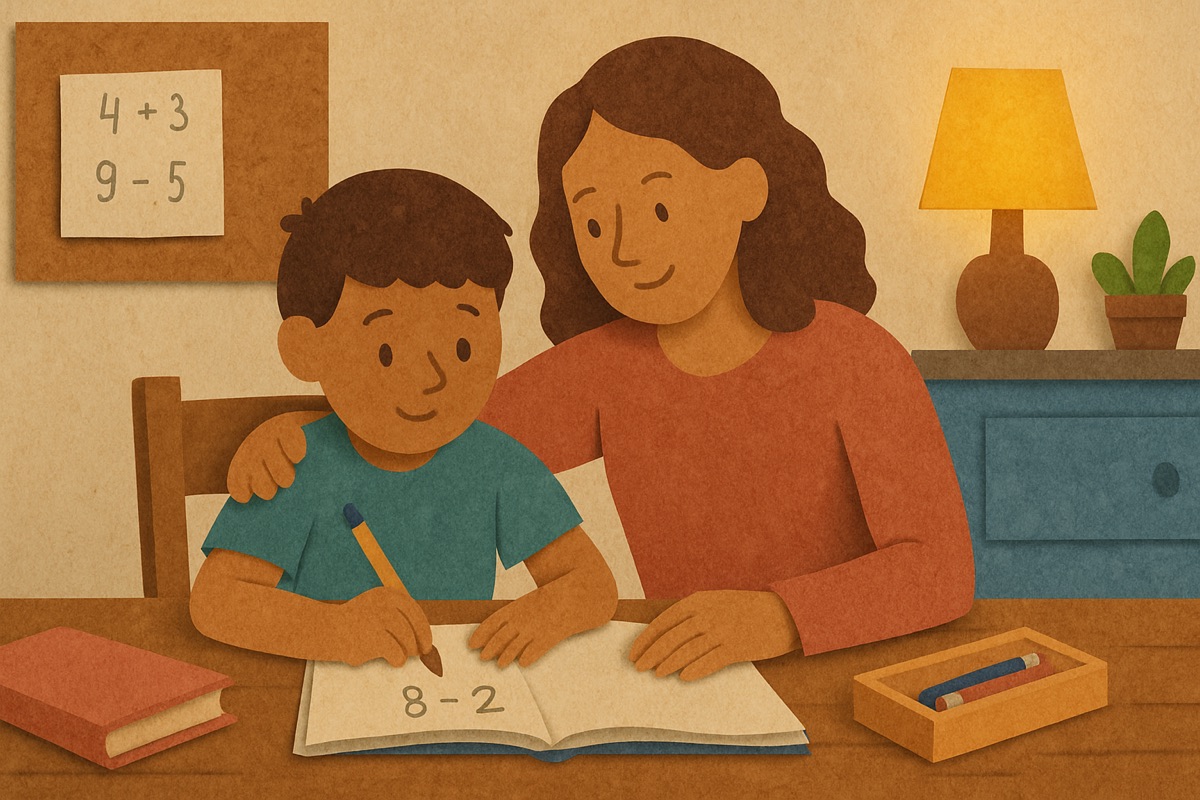
It's 8pm on a Wednesday. The math test is tomorrow. Your kid drags out a crumpled review sheet, half of it wrong, and you feel that pull to sit down and drill every problem until bedtime. Don't. I've graded the tests that come after those nights, and cramming the night before a math test almost never shows up as a better score. It shows up as a tired, rattled kid who blanks on the first problem.
If you want to help your child study for a math test the night before, the job is smaller than you think. You're not teaching anything new at this point. The learning either happened over the last two weeks or it didn't, and one panicked evening won't close a real gap. What you can do is help your kid walk in calm, clear on what they know, and honest about the one or two things they don't. That's it, and it's plenty.
Why cramming makes it worse
Math is different from a spelling list. You can jam twenty spelling words into short-term memory overnight and spit them back the next morning. Math needs working memory, the mental scratch space where a kid holds numbers while they manipulate them. And here's the problem: fatigue and stress both eat working memory. So the very thing you're trying to build up, you're tearing down by keeping a kid up late and stressed.
I once had a strong student bomb a fractions test she absolutely knew. Her mom told me later they'd stayed up past ten "going over everything." She walked in exhausted and convinced she was behind. The knowledge was in there. She just couldn't reach it. That night of cramming didn't add anything. It subtracted.
The 30-minute plan
Half an hour, done well, beats two hours of grinding. Here's how I'd spend it.
- Ask what's on it (5 min). Have your kid tell you the topics out loud. "Multiplying two-digit numbers, word problems, and, um, area I think." Naming the material is itself a review, and it surfaces what they're fuzzy on.
- Do three or four problems, not thirty (15 min). Pick a couple your kid feels good about and one they're shaky on. The point isn't volume. It's to confirm the method is there and to catch a broken step early.
- Find the one weak spot (5 min). Ask, "Which kind of problem do you hope isn't on there?" That answer is gold. That's the thing to look at, not the stuff they already own.
- Stop and pack the bag (5 min). Sharpened pencils, calculator if allowed, review sheet in the folder. A kid who isn't scrambling for supplies in the morning starts the day calmer.
Notice what's not on this list: redoing the entire packet, watching a video for a brand-new method, or reworking every problem they got wrong all week. If a kid is missing something big and fundamental the night before, the fix is talking to the teacher, not a midnight bootcamp.
Sleep is the real study tool
I'm serious about this, and I know it sounds like a cop-out. A full night of sleep does more for math performance than a second hour of review. Sleep is when the brain consolidates the stuff practiced during the week, filing it so it's easier to grab under pressure. A kid who trades an hour of sleep for an hour of drilling usually comes out behind on both.
So set a hard stop. When the 30 minutes are up, math is closed for the night. Do something that lets the brain downshift. A book, a shower, a dumb show, whatever gets the shoulders to drop. Then bed at the normal time, not later because "there's a test tomorrow." The test tomorrow is exactly why bedtime matters more, not less.
What to say in the morning
The morning-of talk matters more than parents realize, and most of us get it slightly wrong. "You've got this, you're so smart" sounds supportive but it quietly raises the stakes, because now a bad grade means you're not smart. Aim lower and truer. Something like, "You practiced this stuff. Read each problem twice, and if one's hard, skip it and come back." You're handing them a plan, not a pep rally.
One specific tip worth passing along: tell your kid it's fine to skip a stumper and return to it. So many kids freeze on problem three and never reach the eight easy ones after it. Permission to move on can save a whole test. I've watched confident kids tank a test purely because they refused to leave a hard problem and ran out of time.
And if your kid is genuinely anxious, name it plainly. "Feeling nervous before a test is normal, it doesn't mean you're not ready." Nerves that get treated as a red flag turn into panic. Nerves that get treated as ordinary tend to settle down on their own.
The bigger fix isn't at night
If the night before a math test is regularly a crisis at your house, the real problem lives earlier in the calendar. A kid who's studied a little all along doesn't need a frantic evening. The night-before plan I described only works because it assumes the learning already happened. If it didn't, no evening ritual can fake it.
So after this test, when the pressure's off, that's the moment to set up ten minutes of low-key practice a few nights a week. Small and steady, tied to actually understanding the material rather than just surviving the next quiz. Do that for a month and the night before a test stops being an event at all. It becomes just another Wednesday, three easy problems and an early bedtime, which is exactly how it should feel.