How to Help When You Are Bad at Math Yourself
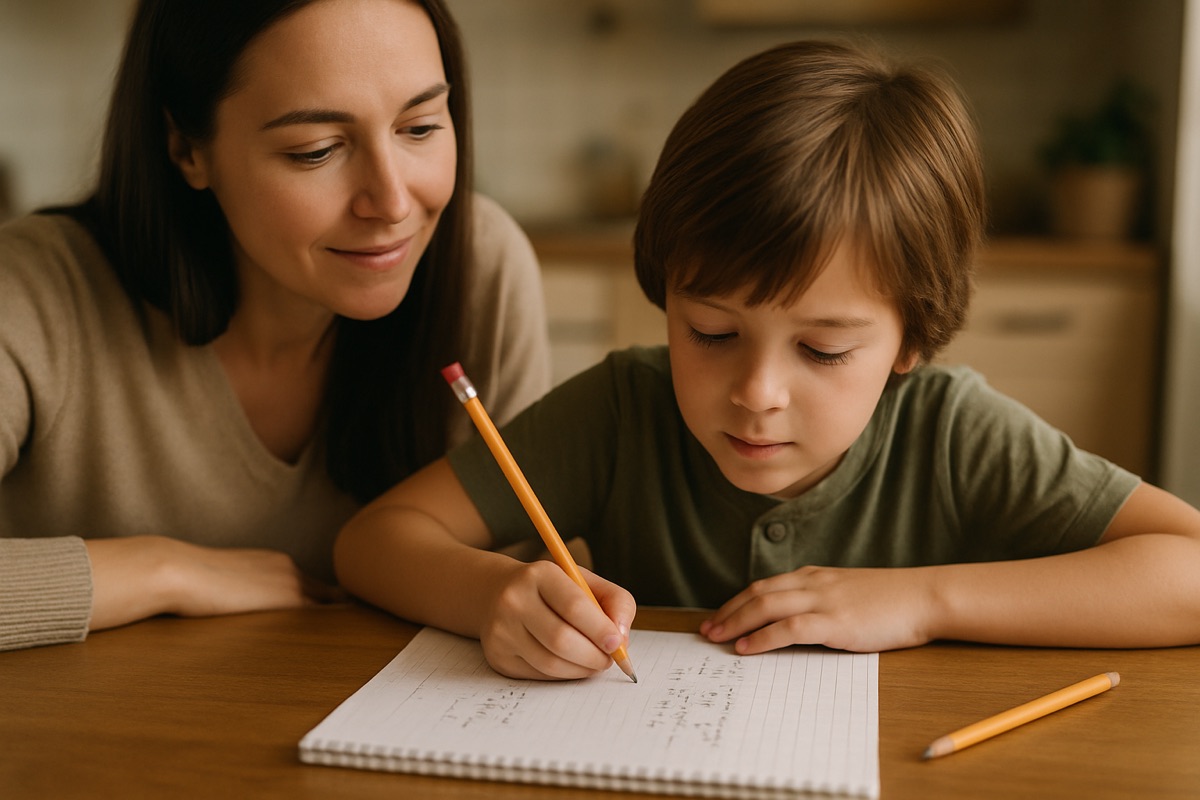
A dad once told me, at a conference, that he couldn't help his daughter with her fourth grade math because he "never got math" himself. He said it the way people apologize. Then he mentioned that whenever her homework came out, he'd wave it off and say, "Ask your mom, I'm hopeless with numbers." He thought he was being honest. What his daughter was actually learning, night after night, was that math is a thing some people just can't do, and that quitting is what you do when it gets hard.
That is the real issue when you want to help kids with math when you are bad at math yourself. The danger is not your rusty long division. It is the story you tell about math in front of your kid without noticing you are telling it.
Your attitude does more than your answers
Kids absorb how you feel about math long before they care whether you can solve the problem. When you sigh, roll your eyes, or say "I hate this stuff," you are teaching a lesson, and it lands harder than anything on the worksheet. Researchers have a name for this. It's called math anxiety transfer, and it shows up most when a nervous parent tries to help. The help itself can make the kid more anxious.
The fix is not fake enthusiasm. Kids can smell that. It's neutrality. You do not have to love math. You just have to stop announcing that you hate it. "Let's take a look" is a completely different message than "ugh, math." One says this is a thing we figure out. The other says this is a thing that beats us.
You are not the answer key, and that is fine
Here is the part that takes the pressure off. Your job is not to be the person who knows the answer. Modern math homework often looks nothing like what you learned anyway. If your kid brings home a "number bond" or an "area model" for multiplication, and you have no idea what those are, that is normal. You were taught a different method, and yours was not wrong. It's just not the one the teacher wants right now.
So do not teach your old way over the top of the new one. That is the single most common thing I have to untangle. A kid learns the area model at school, comes home, and a well-meaning parent says "no no, do it the way I do it," and now the kid has two half-understood methods colliding in her head. She ends up more confused than if nobody had helped. When you don't recognize the method, the honest move is to say so and look at it together.
What to actually do at the table
You can be genuinely useful without knowing how to solve the problem. Most of helping is not math. Try these:
- Ask her to teach you. "Show me how your teacher did this one." A kid who can explain a problem understands it. A kid who can't just found the exact spot she is stuck.
- Read the problem out loud together. A shocking number of "math" mistakes are reading mistakes. She missed the word "each" or "not."
- Find one worked example. Her notebook, the textbook, or the top of the worksheet usually has one solved problem. Compare it to the one she is stuck on, step by step.
- Ask "what's the very next step?" instead of solving it. You are keeping her moving, not doing it for her.
- Call it when you are both stuck. "Let's circle this one and ask your teacher tomorrow" is a good answer, not a failure.
Notice that none of those require you to be good at math. They require you to be calm and curious, which you can absolutely fake even on a bad night.
Let the kid do the struggling
There is a strong pull, when you feel out of your depth, to just get the homework over with. So you take the pencil and finish it. Please don't. The struggle is where the learning happens. A kid who watches a parent solve the problem learns that the answer appears when an adult shows up, which is the opposite of what you want.
I had a third grader whose homework was always immaculate and who could not do a single problem on a quiz. His mom, trying to help, had been walking him through every answer at home. He learned to nod along. He never learned to think. Real understanding comes from wrestling with the problem, getting it a little wrong, and fixing it. Copying a correct answer, even a parent's correct answer, skips the only part that matters.
So sit near her. Keep her company. Hand her the confidence to try. But leave the pencil in her hand, and let her get a few wrong. Wrong answers that she worked through are worth more than right answers you gave her.
Point the hard stuff somewhere useful
Some nights you will hit a wall together, and that is fine. Being bad at math does not mean you have to solve every problem. It means you need to know where to send the ones you can't.
- The teacher. A short note saying "we got stuck on problems 4 through 6" is exactly the feedback a teacher wants. It tells her what to reteach.
- A worked example online. Search the exact skill, like "third grade area model multiplication," and watch a two-minute clip together. You learning alongside your kid is a great thing for her to see.
- A practice tool that explains steps, not just checks answers. If you lean on an app, pick one that shows the working when a kid gets stuck, so it teaches instead of just grading.
The thing your kid needs to see is that when math gets hard, you look for a way through instead of giving up. That lesson has nothing to do with whether you can factor a number, and it is the one that sticks.
The dad from the conference started saying "let's figure it out" instead of "ask your mom." He still could not do fourth grade math. His daughter got better at it anyway, partly because she stopped hearing, every single night, that people in her family just aren't math people. You do not have to be good at math to give your kid that. You just have to stop telling her the opposite.