The Words to Say When Your Kid Says I Am Bad at Math
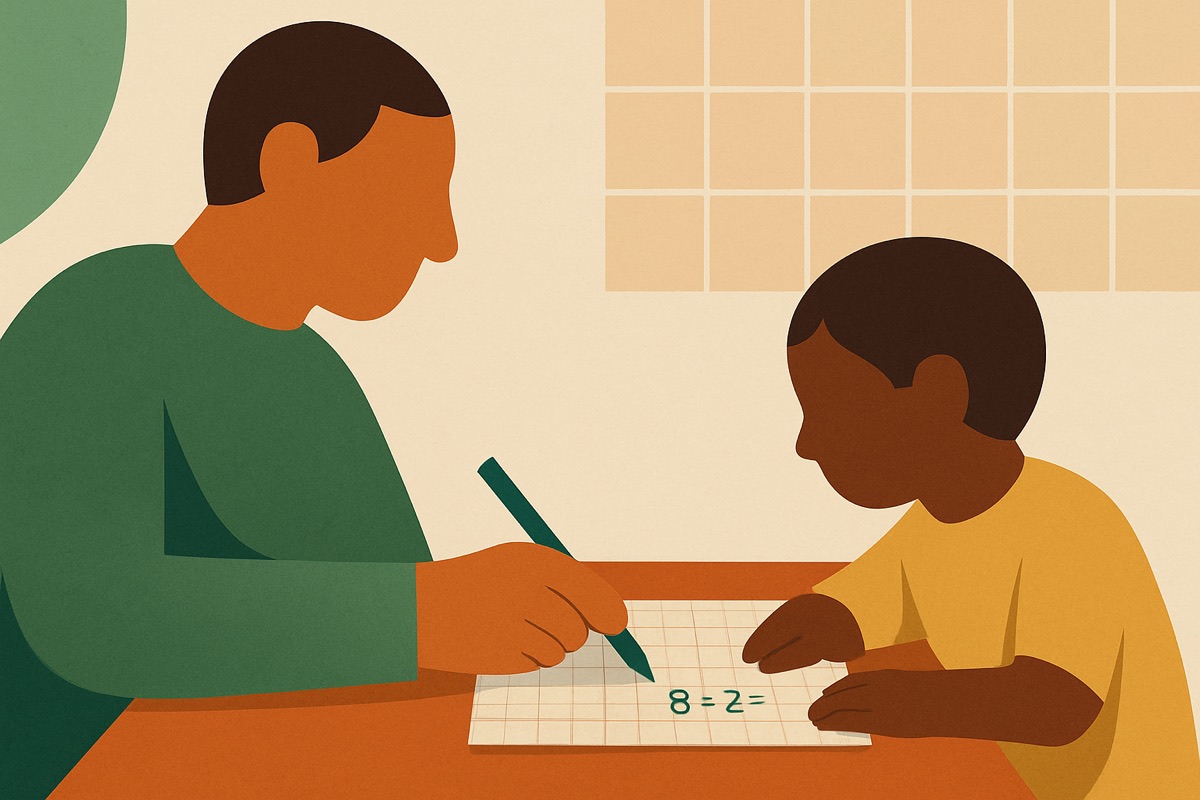
The pencil goes down and the sentence comes out
I had a fourth grader named Marcus who used to slide his paper an inch away from himself right before he gave up. Not shove it. Just slide it, real quiet, like he was disowning it. Then he'd say, "I'm just bad at math." He said it flat, the way you'd tell someone your shoe size. It wasn't a cry for help. It was a verdict he'd already handed down on himself, and he wanted me to stop arguing.
If you're a parent trying to figure out what to say when your child says they're bad at math, I want to start with the thing that took me years in the classroom to learn. The worst response is the fast one. When a kid says that sentence, most of us jump in with "No you're not, you're so smart!" It's loving and it's automatic and it lands like a lie. The kid just told you how they feel, and you told them they're wrong to feel it. So they say it louder next time, or they stop telling you at all.
Don't argue the feeling, get underneath it
Here's what actually works, and it's slower than you want it to be. When your kid says they're bad at math, don't debate the claim. Get curious about the moment that produced it.
Nine times out of ten, "I'm bad at math" doesn't mean "I lack mathematical ability." It means one of a few very specific, very fixable things:
- I got the last three problems wrong and I feel dumb.
- This is taking longer than my friend takes and I noticed.
- I don't understand this ONE step and I don't know how to say that.
- I'm tired and hungry and it's 6:45 and I want to be done.
Notice that none of those are permanent. But the kid has bundled all of it into one heavy sentence because "I'm bad at math" is easier to say than "I don't get how borrowing works when there's a zero in the middle."
So the words I'd give you are these: "Okay. Which part is the part that's bugging you?" Or, "Show me the exact problem where it stopped making sense." You're not disagreeing. You're narrowing. You're taking a giant, hopeless feeling and shrinking it down to one problem on one line, which is a size a kid can actually deal with.
Trade "you're smart" for "you're not done yet"
There's a real difference between praising the kid and praising the work, and kids can smell which one you're doing.
"You're so smart" is a trap, even though it feels like a compliment. It tells a kid that math is about being a certain kind of person, and if this problem is hard, maybe they're not that kind of person after all. That's exactly the mindset that made Marcus slide his paper away.
What you want to point at instead is effort and progress you can actually see. Try things like:
- "You didn't know how to do that kind of problem in September, and now you do."
- "That was a hard one and you stuck with it for four whole minutes. That's the part I care about."
- "You're not bad at math. You just haven't practiced this exact thing enough times yet."
That last one is my favorite because it's true, and kids know it's true. Nobody is born knowing that eight times seven is fifty-six. You get there by seeing it, forgetting it, seeing it again, and getting it wrong a bunch of times in between. When a kid understands that math is a thing you build instead of a thing you are, the whole conversation changes.
The line I actually say out loud
Here's the exact script I've used a hundred times, and you can steal it word for word.
Kid: "I'm bad at math."
You: "You're not bad at math. You're stuck on this one, and stuck is normal. Stuck just means we found the edge of what you know so far. Let's go stand on the edge together."
It sounds a little corny written down. Say it anyway. The point of "the edge of what you know" is that it reframes being stuck as information instead of failure. Getting to the edge is how you find out where the next thing to learn is. That's not a consolation prize. That's the actual job.
And then you have to do the second half, which is sit down and work the one problem with them. Not do it for them. Not lecture. Just be next to them while they take one more crack at it, and say "yep" when they get a step right so they can feel the ground under their feet again.
Watch what happens after they get one right
There's a moment right after a kid solves the thing they swore they couldn't do. Their face does something. It's small, sort of a surprised half-smile, and if you're paying attention you can catch it. That's the moment to say the boring, unglamorous truth: "See? You could do it. You just needed to slow down on the one part."
Do not oversell it. Do not throw a parade for a single subtraction problem, because kids know when the praise is bigger than the thing they did, and it makes the praise worth less. Keep it honest and proportional. The goal isn't to make math feel like a party. The goal is to make "stuck" feel survivable, so the next time they hit a wall they don't reach straight for "I'm bad at this."
This is also why I'm careful about rewards that pay out for just grinding through pages. A kid can fill in twenty problems, understand none of them, and walk away more convinced they're bad at math, not less. Whatever you use at home, whether it's a sticker chart or a game like Math Prizes or just a fist bump, tie the good feeling to the moment they figured something out, not to the sheer volume of paper they got through. Understanding is the thing you're rewarding. Everything else is busywork wearing a costume.
The long game
Marcus stopped sliding his paper away sometime around March. Not because I convinced him he was a genius, because I didn't and he wasn't. He stopped because he'd been stuck a hundred times by then and unstuck ninety of them, and somewhere in there his own evidence started to outweigh the story in his head.
That's really all you're doing when your child says they're bad at math. You're helping them build a bigger pile of evidence, one solved problem at a time, until the pile gets tall enough to argue with. You won't win it in one night. But you can win the next ten minutes, and that's usually enough to keep them at the table.