Echidna Family Guide: From Egg to Independent Puggle
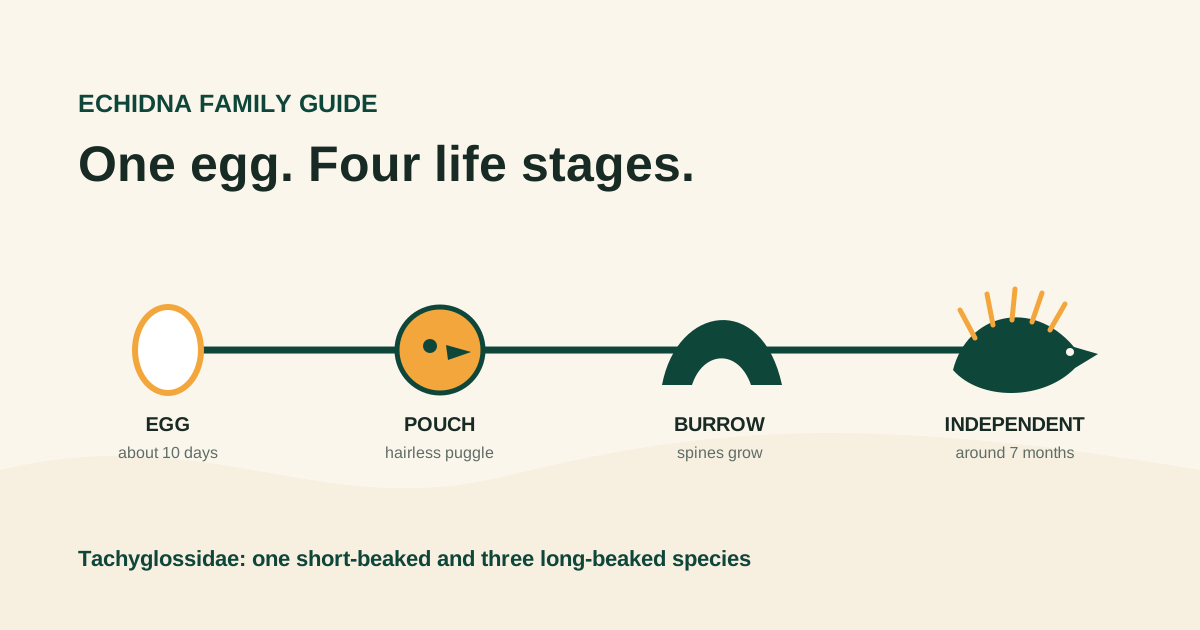
The echidna family is Tachyglossidae, a group of four living egg-laying mammal species: one short-beaked echidna and three long-beaked echidnas. An echidna mother generally raises one young, called a puggle, first in a temporary pouch and later in a burrow. A simple family learning project can follow that life cycle and compare it with animals your child already knows.
Which animals belong to the echidna family?
The echidna family includes the short-beaked echidna and three species of long-beaked echidna. The Australian Museum identifies the short-beaked echidna as Australia's only echidna species and places it in the family Tachyglossidae; its museum tour describes three long-beaked species found only in New Guinea.
The count is four living echidna species in two genera:
| Branch of the family | Genus | Living species | Main modern range |
|---|---|---|---|
| Short-beaked echidna | Tachyglossus | 1 | Australia, Tasmania, and parts of New Guinea |
| Long-beaked echidnas | Zaglossus | 3 | New Guinea |
Echidnas and the platypus belong to the order Monotremata, the living mammals that lay eggs. A hedgehog and a porcupine may look like plausible relatives because they also carry spines, but neither belongs to the echidna family.
What is a baby echidna called?
A baby echidna is commonly called a puggle. It hatches blind, hairless, and extremely small, then stays protected while it feeds on its mother's milk.
The Australian Museum says the short-beaked echidna “lays one egg at a time.” Its account places hatching at about ten days after laying. San Diego Zoo Wildlife Alliance adds that the egg is about the size of a grape and the newly hatched puggle is smaller than a jelly bean, two comparisons children can picture without handling wildlife.
The mother has no nipples. Milk comes from specialized mammary areas, and the puggle laps it from the mother's skin and hairs. An echidna can lay an egg and still be a mammal because it has the traits that define mammals, including producing milk for its young.
How does an echidna mother raise her puggle?
An echidna mother raises her puggle first in a temporary pouch and later in a nursery burrow. The move happens as the young animal's spines begin to emerge and the pouch becomes an impractical place for it to stay.
Sources give slightly different timing, a good reminder that animal development doesn't follow a kitchen timer. The Australian Museum says a short-beaked puggle suckles in the pouch for two or three months, then continues feeding from its mother in a burrow for roughly six more months. San Diego Zoo places emerging spines at about day 53 and says the mother returns to the burrow to feed the puggle every five to ten days until it becomes independent at about seven months.
| Life stage | Approximate timing | What happens |
|---|---|---|
| Egg | Day 0 to about day 10 | One soft-shelled egg stays in the mother's temporary pouch |
| Pouch puggle | Hatching to roughly 2 months | The blind, hairless young drinks milk and grows |
| Burrow puggle | Roughly 2 to 7 months | The young develops spines; the mother returns periodically to nurse |
| Independent young | Around 7 months, with variation | The young begins living and feeding on its own |
Treat the dates as a learning timeline rather than a countdown clock. Species, individuals, and source definitions can shift the boundary between stages.
Do echidnas live as a family group?
Echidnas generally do not live as a standing family group of two parents and several young. The mother provides the parental care, while the young occupies the pouch and later the nursery burrow.
Adult short-beaked echidnas are usually solitary, although their home ranges can overlap. During breeding season, several males may follow a female in an “echidna train.” That temporary courtship group is separate from the mother-and-puggle rearing period.
For children, “echidna family” can mean two things. In taxonomy it means Tachyglossidae, the branch containing all echidna species. In everyday family-life language it usually means one mother caring for one puggle.
What do young echidnas learn to eat?
Young echidnas eventually feed on small invertebrates using a specialized snout, tongue, and strong digging limbs. Short-beaked echidnas commonly break into ant and termite nests; long-beaked echidnas also take prey such as earthworms.
The Australian Museum explains that the name Tachyglossus means “swift tongue.” A short-beaked echidna flicks its sticky tongue into insect nests, while its claws open compact soil and rotting wood. It has no need for the chewing teeth a child might expect after studying dogs or people.
Food makes a good comparison activity. Ask a child to connect each body feature with a job: claws with digging, a long snout with reaching, a sticky tongue with collecting insects, and spines with defense. Keep the activity on paper or use a museum video. Wild echidnas should remain undisturbed.
How can we make an echidna family lesson at home?
An echidna family lesson works well as a 25-minute read, sort, measure, and explain activity. It needs paper, a ruler, four small labels, and one reliable museum or zoo page.
Try this plan:
- Read for five minutes. Find the family name, number of living species, and the word puggle.
- Build the life-cycle route for seven minutes. Label four stops: egg, pouch, burrow, independent young.
- Measure for five minutes. Mark 53 centimeters on the floor to see the upper end of the Australian Museum's 40 to 55 centimeter adult size range.
- Compare for five minutes. Write one similarity and one difference between an echidna, a platypus, and a hedgehog.
- Teach it back for three minutes. Let the child explain why an egg-laying echidna still counts as a mammal.
The schedule totals 25 minutes. If fitting a nature activity into the week is the hard part, the 30-minute family reset gives one place to choose the day and name who gathers the materials.
Should we use points or a reward for the lesson?
A point or ticket can mark completion when your family already uses a learning reward system. Keep the animal discovery as the main event. Offer the credit for an observable action such as building the four-stage timeline or teaching one fact back.
Keep the rule short: “Finish the life-cycle route and explain one stage to earn the agreed tickets.” If you need the mechanics for recording learning tickets and setting a parent-chosen prize, the Parent Prize Portal setup example walks through the account, pairing, and first reward.
Avoid awarding tickets for touching, feeding, following, or collecting anything from a wild echidna. The Australian Museum lists cars, dogs, foxes, and other predators among risks to short-beaked echidnas, so a respectful lesson watches from a distance and leaves the habitat as found.
Frequently asked questions
Are echidnas related to hedgehogs?
No. Echidnas are monotremes in the family Tachyglossidae. Hedgehogs belong to a different mammal order; their spines are a similar defense that evolved on a separate branch.
How many babies does an echidna have?
The short-beaked echidna typically lays one egg at a time and raises one puggle. The mother moves the young from her temporary pouch to a nursery burrow as its spines develop.
Are echidnas mammals if they lay eggs?
Yes. Echidnas produce milk for their young and share the defining anatomy and ancestry of mammals. They belong to the egg-laying mammal order Monotremata.
Where do echidnas live?
The short-beaked echidna lives across Australia, Tasmania, and parts of New Guinea in habitats ranging from forest to arid country. The three long-beaked species live in New Guinea.