How to Help With Math Homework When You Were Never a Math Person
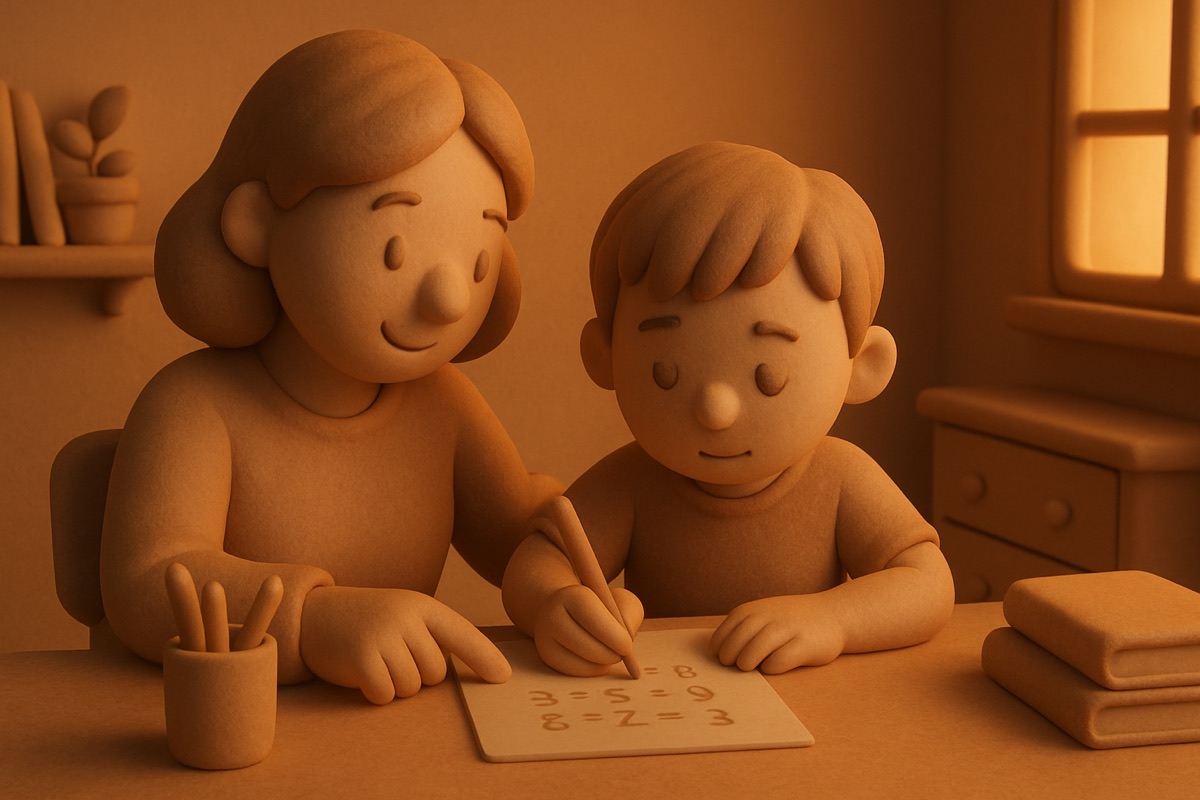
The problem is usually the fear, not the fractions
A dad stopped me after conferences last fall and said, almost like a confession, that he could not help his daughter with math because he was never a math person. He had a good job, ran a household, did his own taxes. But the second his fourth grader pulled out a worksheet with those little area-model boxes on it, he froze. Figuring out how to help with math homework when you were never a math person feels impossible, and I get why. The methods look nothing like what we learned.
Here is the thing I tell every parent in that spot. Your kid does not need you to be good at math. They need you to be calm near math. Those are two completely different jobs, and you are already qualified for the one that matters.
What your kid actually catches from you
Kids read our faces before they read the problem. When you sigh, push the paper away, and say "I was never good at this either," you think you are being relatable. What your kid hears is permission to quit. I have watched it happen in real time. A seven year old will mirror the exact expression on the adult's face when a hard problem shows up.
So the first move is not mathematical at all. It is managing your own face and voice. You can be honest without being scared out loud. There is a big gap between "I don't remember this method, let's figure it out" and "ugh, I hate this, I could never do it." One keeps the door open. The other slams it.
A few phrases that help, that you can use even when you have no idea what the answer is:
- "Show me how your teacher did it."
- "Let's read the problem again, slower."
- "I'm not sure either. Where do you think it starts?"
- "That's a good try. What made you pick that?"
None of those require you to know the math. All of them keep your kid working.
Let them be the teacher
The best trick I know costs nothing and works better than any tutor. Ask your child to teach you the problem.
This flips everything. Instead of you performing knowledge you do not have, your kid has to explain their thinking out loud, which is exactly what makes it stick. When my students explain a problem to a partner, I can hear the moment the fog clears. They catch their own mistakes mid sentence. "So you carry the... wait, no, that's wrong." That correction, the one they find themselves, is worth ten corrections from an adult.
You just have to ask the right small questions. "Why did you do that step?" "What does that number mean here?" "Can you draw it?" You are not grading. You are giving them a reason to slow down and say the reasoning out loud. If they get stuck explaining it, you have found the real gap, and now you both know where to look.
When you genuinely cannot figure it out
Sometimes you will hit a wall together. The method is unfamiliar, the example in the book is confusing, and it is 8pm and everyone is tired. That is a normal Tuesday, not a failure.
Do not fake it. Kids can tell, and a wrong "help" is worse than none. Here is what I do instead:
- Circle the two or three problems that are stumping you both and leave a short note to the teacher. Something like "we tried, got stuck here, can you show her tomorrow." Every teacher I know would rather get that note than a page of quietly wrong answers copied from a parent who guessed.
- Look up the method by name, not the answer. If the sheet says "partial products" or "number bonds," search that exact phrase and add "for kids." Watch one short video together. You are learning the method, not doing the problem for them.
- Call it a night if the tank is empty. Fifteen focused minutes beats an hour of tears. A kid who is crying is not learning, they are just marinating in the feeling that they are bad at this.
The goal on a rough night is not a finished worksheet. It is a kid who still believes tomorrow will go better.
Why the new methods look so strange (and why that is okay)
A lot of parent frustration comes from the boxes and lines and "draw it three ways" stuff. We learned one way, we memorized it, and it worked, so why change it?
Because memorizing one procedure is exactly the trap. I have taught kids who could run the long division steps perfectly and had no idea what the answer meant. Ask them if the answer should be bigger or smaller than the number they started with, and they would just stare. They had the trick, not the understanding. The new methods, clumsy as they look, are trying to build the understanding first so the shortcut actually means something later.
You do not have to love the new way. You just have to not trash it in front of your kid. When you say "this is stupid, just do it like I learned," you put your child in the middle of a fight between you and their teacher, and the homework still is not done. Let the method be the method. Your job is the confidence and the calm.
This is also why grinding endless worksheets rarely fixes anything. Twenty of the same problem when the kid does not understand the first one just teaches them that math is a punishment. Ten problems they actually think through, where the reward is real progress and not just a checked box, does far more. We built our little math app around that same idea, but honestly you can do it at the kitchen table with a pencil and some patience.
The part nobody tells you
You are allowed to be a beginner right alongside your kid. Some of the best homework sessions I have heard about from parents were the ones where the mom or dad said "I have no clue, let's crack this together" and meant it. The kid saw a grown up be confused and keep going anyway. That is a lesson worth more than any single worksheet, because it is the whole thing in miniature. Being stuck is not the same as being dumb. It is just the part right before you figure it out.
So if you were never a math person, good news. That was never the requirement. Sit close, stay steady, ask them to show you, and be honest when you are lost. Your kid will remember that you stayed in the chair. They will not remember whether you knew the answer.