The Quiet Power of Letting Your Kid Teach You Math
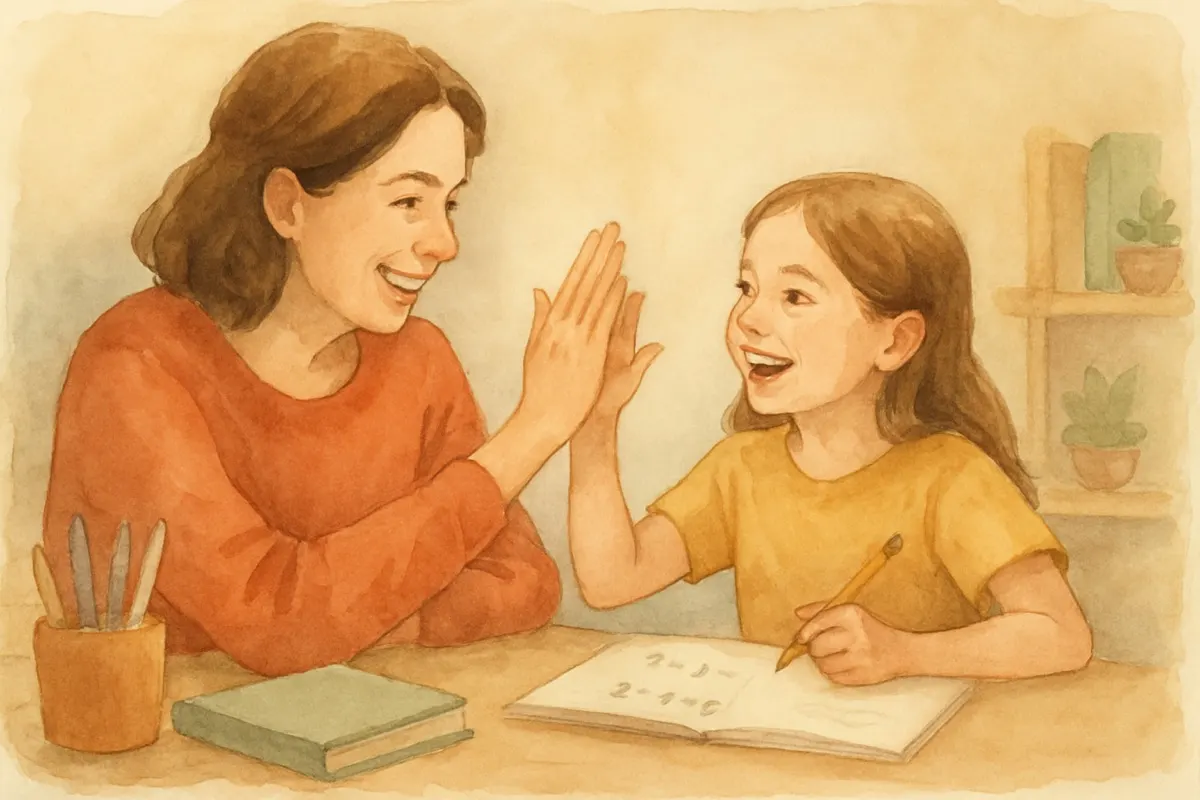
My daughter explained long division to me at the dinner table last week, and she got two things wrong in the process. That was the point. I already know how to divide. I asked her to teach me because the second she started, every gap in her understanding walked right out into the open where we could both see it. When you let your child teach you math, you learn more about what they actually know in five minutes than a week of watching them do worksheets will tell you.
This is one of the oldest tricks teachers have, and it costs nothing. There's even an old line in education about it: to teach something is to learn it twice. The person doing the explaining is doing the real cognitive work. So flip the roles. Hand your kid the marker and become the confused student. It feels backward, and it works.
Why teaching forces real understanding
There's a difference between recognizing an answer and being able to produce an explanation. A kid can nod along to a lesson, get the right answers on ten problems, and still not actually understand what they're doing. They've learned the pattern of the steps without the meaning underneath. You can't see the gap, because the right answers hide it.
Teaching blows the cover. To explain 3 times 4 to someone, a kid has to decide what it means. Is it three groups of four? Four groups of three? Both? A kid who's only memorized "3 times 4 is 12" often can't say, and the moment they try to teach it, that hole is obvious. They stall. They say "you just... it's just 12." And now you know exactly what to work on, not because you tested them, but because they showed you.
I saw this with a fifth grader who could compute with fractions flawlessly on paper. Adding, subtracting, all of it correct. I asked him to teach me why you need a common denominator before you add. He couldn't. He knew the rule cold and had no idea what it was for. That's a kid who's one bad test question away from being lost, and no worksheet would have flagged it. His face teaching me did.
How to actually do it at home
You don't need a whiteboard or a lesson plan. You need to be a slightly clueless student, which most of us can pull off. Here's the shape of it:
- Pick something they just learned or are working on. "Show me how you did that one. I never really got this."
- Play a little dumb. Ask the questions a struggling student would ask. "Wait, why did you carry that? Where did the one go?"
- Let them fumble. Do not rescue them the instant they hesitate. The struggle to find the words is the learning.
- When they get stuck, ask, don't tell. "What does that step actually do?" beats "you forgot to borrow."
- If they teach you something wrong, don't correct it flatly. Ask them to walk you through it once more, slowly. Half the time they catch the mistake themselves, and self-caught errors stick.
The playing-dumb part matters more than it sounds. A kid who's explaining to a genuine learner is relaxed and generous. A kid who suspects you're secretly quizzing them tenses up. Keep it real. Be actually curious about how they see it, because how they see it is the whole game.
If your child wants a science warm-up before trying this with math, the echidna family life-cycle lesson ends with a three-minute teach-back using the same idea.
What you'll learn about your kid
This flip tells you things a grade never will. You'll find out whether your kid understands the concept or just memorized the steps. You'll hear the exact word or idea where their confidence drops. You'll catch a wrong method they've been quietly using, the kind that produces right answers on easy problems and falls apart on hard ones.
You'll also see something about their confidence. A kid who lights up teaching you is a kid who feels some ownership over the math. A kid who shrinks from it, who says "I don't know, I just do it," is telling you the subject feels like something being done to them, not something they hold. That's worth knowing, and it's the kind of thing a report card can't show you.
And here's the quiet bonus. Kids love being the expert. Most of a child's day is spent being told things by taller people. Handing them the authority, even for four minutes over dinner, does something for a kid who's decided math isn't their thing. My daughter walked away from that long division session prouder than any worksheet score has ever made her, and she'd just exposed her own two mistakes to me in the process. She didn't experience it as being caught out. She experienced it as being the teacher.
The part that isn't about math
There's a version of helping with math that's really just correcting. You lean over, spot the error, point at it, and the kid fixes it and learns to wait for you to spot the next one. It's efficient and it teaches dependence. Letting your child teach you is the opposite move. It puts the thinking on them and the listening on you.
You don't have to do it every night. Once a week, pick one thing and ask to be taught it. Sit on your hands when they stumble. Ask the dumb question. You'll be amazed what shakes loose. The math they can explain is the math they actually own, and everything they can't explain yet is your map for what to work on next. Best diagnostic tool I know, and it happens over dinner with no marker required, though my daughter did insist on the marker.