The Praise That Actually Builds Math Confidence (and the Kind That Doesn't)
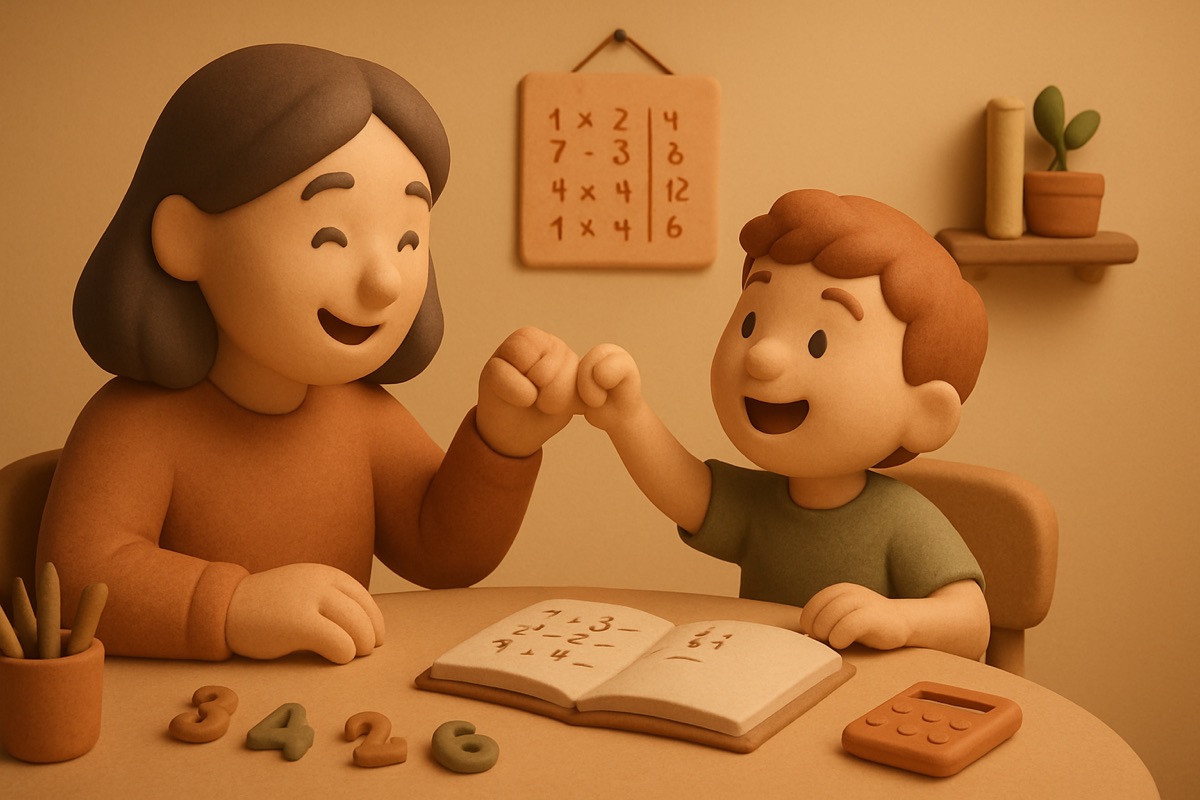
The kid who stopped trying the hard ones
I taught a third grader named Owen who was, by every early measure, a natural at math. He got his facts fast, and every adult in his life told him so. "You're so smart." "Math just comes easy to you." By spring, Owen had a habit I've seen a hundred times. The second a problem looked hard, he put his pencil down. Not because he couldn't do it. Because if he tried and failed, he'd lose the one thing everyone had told him he was. Smart.
That's the trap hiding inside kind words, and it's why how to praise your child in math matters more than most parents realize. The wrong praise, offered with total love, can teach a kid to protect their reputation instead of doing the work. After sixteen years of watching this play out, I can tell you the fix isn't to praise less. It's to praise different.
Why "you're so smart" backfires
When you tell a kid they're smart, you're praising a fixed trait, something they either have or don't. It feels great in the moment. The problem shows up later, when the work gets hard, because now a hard problem isn't a challenge. It's a threat. If smart kids do math easily and this problem isn't easy, then struggling means maybe they aren't smart after all. So they avoid the struggle to keep the label.
I watched Owen do this all year. He'd race through the problems he already knew and stall out on anything new, because the new stuff carried a risk the easy stuff didn't. The praise had taught him that being fast and right was the whole game, and being stuck was a kind of failure. That's exactly backward. Being stuck is where the learning lives.
Praise the process, not the person
The shift is small and it changes everything. Instead of praising the child, praise what the child did. Instead of the outcome, the effort and the strategy that got there.
- Name the effort. "You stuck with that one even when it got frustrating." This tells a kid that persistence is the thing you noticed, so persistence is worth repeating.
- Name the strategy. "You broke that big number into tens and ones. Smart move." Here you're praising a choice they made, something they can do again on purpose.
- Name the improvement. "Last week regrouping tripped you up. Look at you now." This makes progress visible, and progress is the most motivating thing a kid can see in themselves.
- Praise the checking. "You went back and checked your work and caught the mistake. That's what good mathematicians do."
Every one of those points at something the child controls. Effort, strategy, checking, sticking with it. None of them says "you were born good at this." They say "you did this, and you can do it again."
The mistake most of us make with wrong answers
How you react to a wrong answer is praise too, just the quiet kind. If your face falls every time your kid misses, you're teaching them that wrong answers are shameful, and a kid who's ashamed of mistakes will stop taking risks. A kid who won't take risks won't attempt the hard problems, and the hard problems are the only ones that grow the skill.
Try treating a wrong answer as information instead of a verdict. "Interesting, show me how you got that" does two things. It keeps the kid talking instead of shutting down, and it usually reveals exactly where the thinking went sideways. I had a fourth grader who kept getting 7 times 8 wrong. When I asked her to walk me through it, she was counting by sevens on her fingers and losing track at the sixth jump. The wrong answer told me precisely what to fix. If I'd just said "no, try again," I'd have learned nothing and she'd have felt worse.
What real math confidence is made of
Here's the part that surprises parents. Confidence doesn't come from being told you're good. It comes from evidence you collect yourself, from doing something hard and watching yourself get through it. That's why praise tied to real progress works and praise tied to nothing doesn't. A kid can feel the difference between "great job!" thrown at every worksheet and "you figured out the one that stumped you yesterday." The first is noise. The second is proof.
This is also why I'm wary of anything, an app or a program, that hands out rewards for simply showing up or tapping through screens. When the reward comes loose from any real accomplishment, kids sense it and it stops meaning anything. Praise and rewards land when they're earned by actual thinking, actual struggle, actual progress. Tie them to busywork and you've taught your kid that math is a machine you feed to get a treat, not a thing you can genuinely get better at.
A few phrases to keep in your pocket
You won't rewire your instincts overnight. "You're so smart" will still fly out sometimes, and that's fine, no single sentence ruins a kid. But if you want a handful of better defaults, keep these ready.
- "You didn't give up on that one."
- "How did you figure that out?"
- "That was a tough one and you kept going."
- "You made a mistake and then you fixed it. That's the whole job."
- "I can see you thinking. Take your time."
Notice none of them are about being fast, and none of them are about being smart. They're about the work.
Back to Owen
I spent the rest of that year deliberately praising Owen's effort and his strategies and saying almost nothing about how quick or clever he was. It was slow going. He'd been trained the other way for years. But by the last month, he started attempting the hard problems again, and the first time he wrestled one to the ground on his own, he looked up at me kind of stunned, like he'd found money in an old coat. That look is the thing you're actually after. Not a kid who's been told he's good at math. A kid who's proven it to himself.