The Order I Teach Multiplication Facts (and Why I Never Start at the 2s)
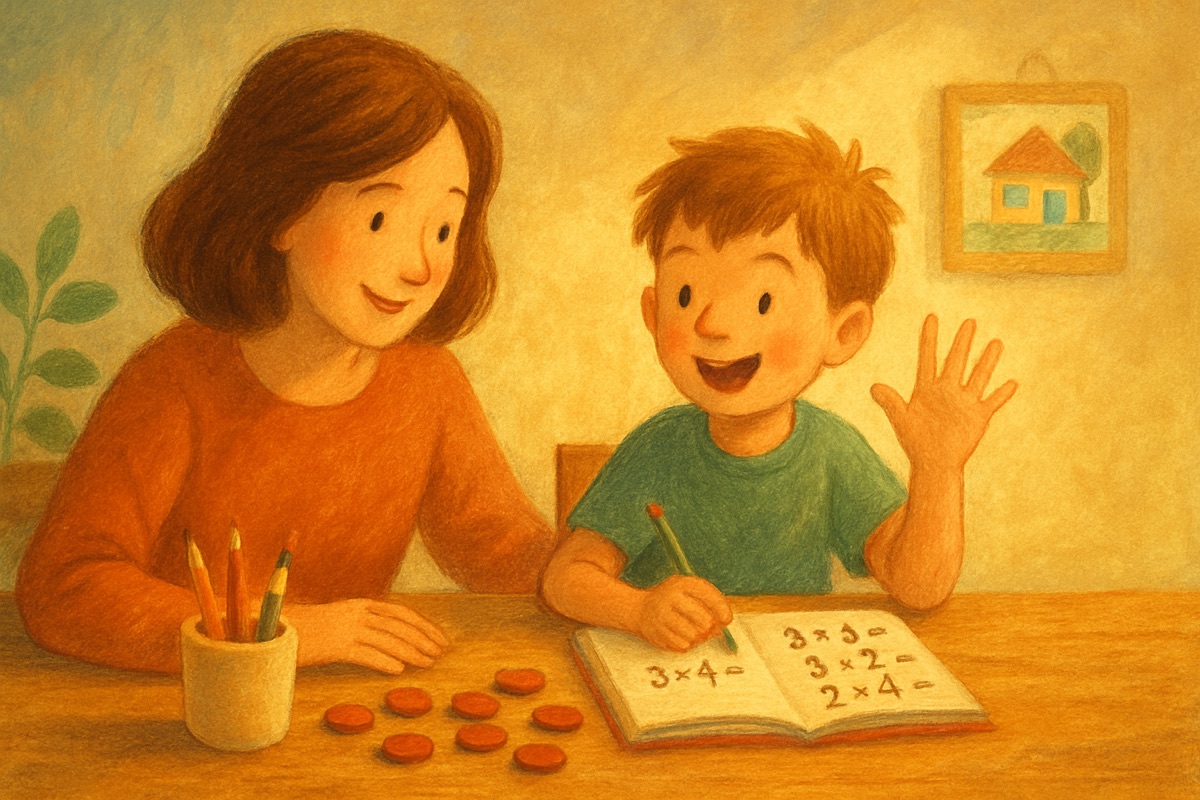
Most multiplication charts you'll find at the store go in a straight line: 0s, 1s, 2s, 3s, all the way up to 12. It looks tidy. It also sets a lot of kids up to stall out around the 6s and 7s and decide they're bad at math. After sixteen years of teaching third and fourth grade, I've landed on a different order to teach multiplication facts, and the first thing it does is throw out the idea that you start at the beginning of the number line.
I don't start at the 2s. I start where a kid already has a foothold.
Why the "start at 2" order backfires
The problem with going 0, 1, 2, 3, 4 in order is that it treats all the facts as equally hard, and they aren't. The 2s aren't the easiest facts. They feel early because 2 is a small number, but a kid still has to actually learn them one at a time.
Meanwhile the truly easy facts, the ones almost every kid can do on day one, are sitting further down the chart getting ignored. So you spend the first week grinding through 2s and 3s, the kid is already tired, and they haven't had a single moment of "oh, I've got this." By the time they hit the 4s they've decided multiplication is a slog.
I want the first week to feel like a win. That changes everything about whether a kid keeps showing up.
The order I actually use
Here's the sequence, roughly, and I'll explain the logic below it:
- 10s first
- then 5s
- then 2s
- then 1s and 0s (a quick side trip)
- then the squares (3x3, 4x4, 6x6, and so on)
- then 9s (using the trick)
- then the hard middle: 3s, 4s, 6s, 7s, 8s
Notice that the 6s, 7s, and 8s, the ones every kid dreads, come dead last on purpose. By the time we get there, most of the grid is already gone. A kid who knows their 10s, 5s, 2s, 9s, and squares has already knocked out more than half of every row. The scary part turns out to be much smaller than it looked.
Start with 10s and 5s because kids already own them
Ask a first grader to count by tens. They can do it. Ask them to count by fives. Most can. That skip-counting is multiplication wearing a different hat, and the kid doesn't even know they already have it.
So on the very first day, I don't teach anything new. I say, "You already know the 10s. Watch." We count 10, 20, 30, 40, and then I write 4 x 10 = 40 next to it. The lightbulb is immediate. Same move with the 5s. I had a third grader last year, a kid who'd told his mom flat out that he "couldn't do times tables," get through the entire 10s and 5s rows in one afternoon and look genuinely shocked. He hadn't learned less than the other kids. He'd just never been shown that he already had a running start.
That early confidence is the whole point. Fluency is built on top of belief, not the other way around.
The 2s are just doubles
When the 2s finally show up, third in line, I never call them "the 2s." I call them doubles. Every kid understands doubling from real life. Two hands, ten fingers. Two cookies each for four kids. 7 x 2 isn't a fact to memorize, it's "double seven," and they can find it.
Putting doubles third means the kid already has two full rows behind them and a bit of momentum. The 2s land as easy instead of as the first hurdle.
Squares and 9s before the ugly middle
Squares (a number times itself) get their own moment because kids like them. There's something satisfying about 6 x 6 = 36. They're memorable, and knowing the squares gives a kid an anchor point in the middle of every row. If you know 7 x 7 = 49, then 7 x 8 is just one more seven, 56. That "nudge from a known fact" trick only works if the squares are solid, so I teach them as a set.
The 9s come next, and yes, I teach the finger trick and the "the digits add up to nine" pattern. Some teachers frown on tricks. I don't, as long as the kid also understands what's happening underneath. A trick that gets a nervous kid a right answer buys them the calm they need to actually think. Understanding and a shortcut aren't enemies.
By the time we reach 3s, 4s, 6s, 7s, and 8s, here's what's left in, say, the 7s row: 7x3, 7x4, 7x6, 7x7, 7x8. The 7x1, 7x2, 7x5, 7x9, and 7x10 are already done. Five facts, not eleven. And two of those five are within a nudge of a square. Suddenly the hard row is a handful of facts, not a wall.
How I know a fact is actually learned
This is the part I care about most, because it's where a lot of practice goes wrong. A kid can chant a row perfectly in order and still not know it. Order recall is a different skill than real fluency. The chant becomes a little song, and the song falls apart the second you ask 8 x 4 out of nowhere.
A fact is learned when a kid can answer it:
- out of order, no run-up ("what's 6 x 8?" cold)
- inside a word problem, not just as a bare number
- a few days later, not just the day you drilled it
So I mix. I ask facts sideways, in weird orders, tucked into a story about sharing forty crackers. If a kid can only produce a fact by starting at the top of the row and climbing up to it, that fact isn't ready yet. That's fine. It just means more spaced practice, not more speed drills in a single sitting.
And I keep the daily dose small. Ten focused minutes beats a forty minute flashcard grind that ends in tears every time. The goal was never to do the most repetitions. It was to build something that holds. When my own kids practice on the app my husband and I built, that's the rule we coded in too: short, mixed, and tied to whether they actually got it, not to how many they cranked through.
Start where the kid already has ground under them. Save the hard middle for when it's small. Check that a fact holds up out of order and a few days later. That order, and that patience, is what turns "I can't do times tables" into a kid who just quietly knows them.