The One Question That Unsticks Almost Any Homework Problem
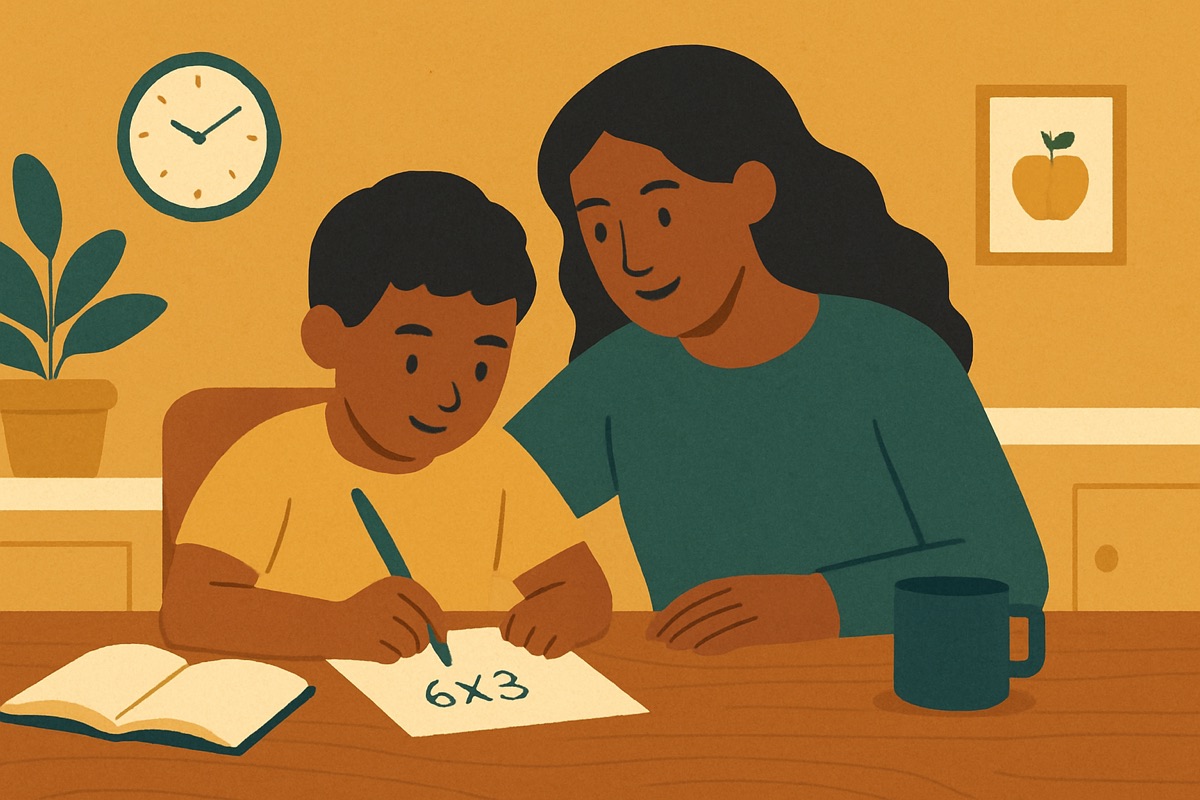
A boy in my third-grade class used to freeze the second a word problem got long. Trains leaving stations, apples divided among friends, that kind of thing. He'd read it, look up at me, and just wait. Not because he couldn't do the math. He could. He froze because he didn't know where to start, and staring at the whole problem at once felt like being handed a knot with no loose end.
If you want to help a child stuck on a math problem, the instinct is to explain. Show them the steps. Point at the number they missed. It feels helpful. It usually isn't, because it skips the part where they get to think. There's one question that works better than almost any explanation, and it costs you nothing to ask.
The question
"What do you already know?"
That's it. When a kid is frozen, they're treating the problem as one giant unsolvable thing. That question breaks it into pieces they can actually hold. It moves them from "I can't do this" to listing facts, and listing facts is doable even when the answer feels impossible.
With the boy and his trains, I asked it. He said, slowly, "There are two trains." I nodded. "One goes 40 miles an hour." Nod. "The other goes 60." By the time he'd listed what he knew, he'd basically set up the problem without noticing. The freezing wasn't a math problem. It was a starting problem. The question gave him a place to start.
Why it beats just telling them
When you explain the steps, you do the hard part for them. The hard part in math is almost never the arithmetic. It's figuring out what the problem is asking and what to do first. If you hand them that every time, they learn that getting unstuck means waiting for an adult to appear. That's a terrible habit, and it's one I see constantly in kids whose parents are very involved and very quick to rescue.
"What do you already know?" puts the thinking back on them, but gently. It's not "figure it out yourself," which just restarts the panic. It's a specific, answerable prompt. There's always something they know. Even "I know there are apples in it" is a start you can build on.
There's a second reason it works. It shows you where the actual gap is. When a kid tells you what they know, you find out fast whether they're stuck because they don't understand the situation, or because they don't know which operation to use, or because they just can't do 7 times 8. Those are three different problems with three different fixes, and you can't tell them apart until the kid talks.
What to do after they answer
Once they've listed what they know, you follow with a small chain of questions, not statements. Keep handing the work back to them.
- "Okay, so what are they asking you to find?"
- "Which of those numbers do you think you need?"
- "What could you try first?"
- "Does that answer make sense for the question?"
Notice none of those tell the kid anything. They just aim the thinking. If the child says something wrong, resist fixing it out loud. Ask "how'd you get that?" instead. Half the time they catch their own mistake while explaining, which is worth ten of your corrections.
I had a girl who insisted a leftover-cookies problem needed multiplication. Instead of saying no, I asked her to read the question again and tell me what "how many are left" meant. She paused, said "oh, that's taking away," and switched to subtraction on her own. If I'd just said "it's subtraction," she'd have written it down and learned nothing about why.
When the question isn't enough
Sometimes "what do you already know?" reveals that the kid genuinely doesn't have a piece they need. They don't know their multiplication facts, so a division problem is hopeless. They don't know what "perimeter" means, so no amount of questioning will conjure it. That's fine. Now you know. That's information, not failure.
At that point you do teach the missing piece, plainly and briefly, and then step back out. "Perimeter is the distance all the way around. Add up every side." Short. Then hand it back: "So which sides do you have?" You're patching one specific hole, not taking over the whole problem.
The goal is never to get through the homework. The goal is a kid who, six months from now, is stuck and asks themselves "what do I already know?" without you in the room. That only happens if you've modeled the question enough times that it becomes their own voice. Repetition of the question, not repetition of worksheets, is what builds that.
The hard part is your mouth
The real difficulty with this isn't the child. It's you. After you ask "what do you already know?", there will be silence. Ten seconds can feel like a minute. Every instinct will scream to fill it, to nudge, to give a tiny hint. Don't. The silence is the kid thinking. If you jump in, you steal the exact moment you were trying to create.
Count to ten in your head. Look mildly interested, not worried. Most kids will start talking before you hit eight, because silence is uncomfortable for them too, and talking is the release valve. What comes out is the beginning of them solving it.
The boy with the trains got over his freezing by December. Not because the trains got easier. Because he'd internalized the question. I'd watch him read a hard problem, mutter "okay, what do I know," and start listing. He'd hand himself the loose end of the knot. That's the whole thing I was ever trying to teach, and it fit in four words.