Subtraction Across Zeros: The Fact-Fluency Gap Nobody Talks About
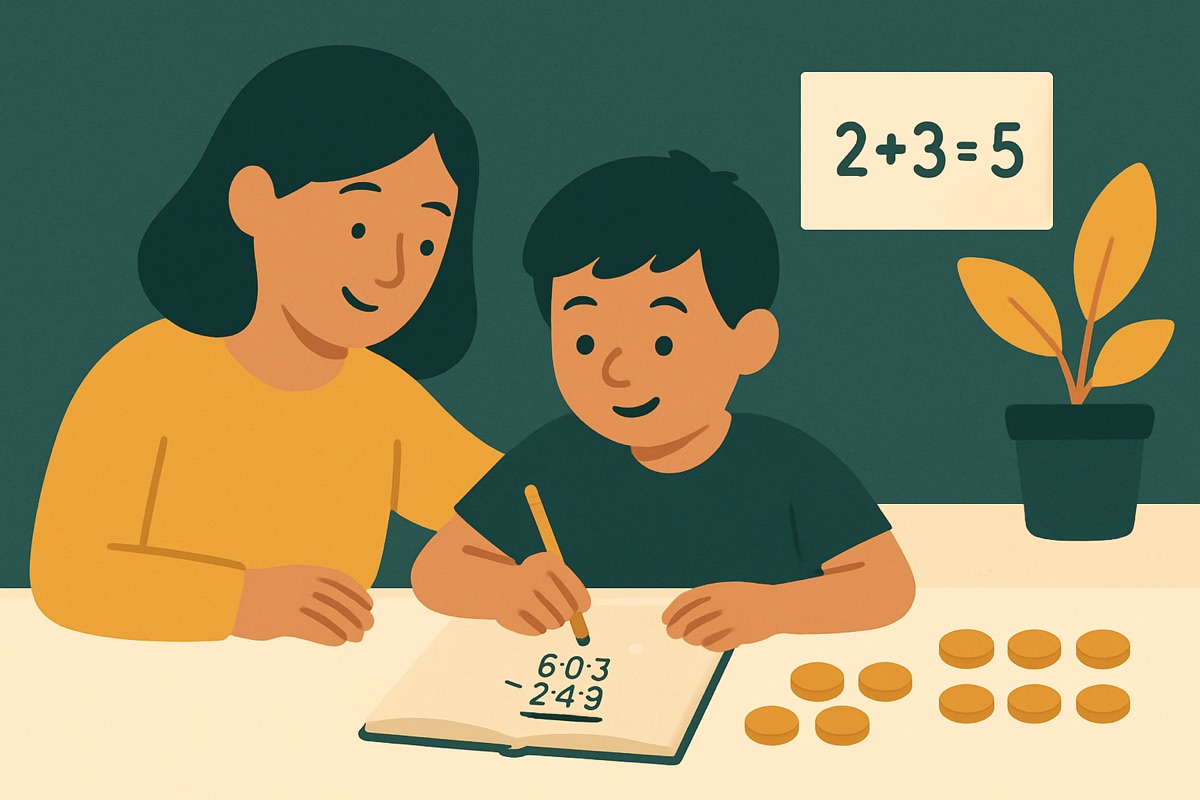
Consider this illustrative example: a child answers 14 minus 6 correctly, then pauses at 1000 minus 486. The subtraction facts are familiar, but the child does not know how to regroup when the neighboring digits are zeros.
This guide focuses on that regrouping step. Knowing subtraction facts does not by itself explain what to do when a child needs to borrow across several zeros. A routine that works for 52 minus 27 needs another step for 1000 minus 486.
Why zeros break the borrowing they already know
When your kid subtracts 52 minus 27, they borrow one ten from the 5, turn the 2 into 12, and carry on. Simple. There's always a friendly number next door to lend a ten.
Now look at 300 minus 148. The ones column asks to borrow from the tens. But the tens are a zero, and a zero has nothing to give. So the kid has to go one more house down, to the hundreds, borrow from there, walk that value back through the empty tens place, and then finally hand a ten to the ones. That's three steps chained together, and if any link in the chain is fuzzy, the whole thing collapses.
Here's the part that catches parents off guard. This is not a facts problem. A kid can have every subtraction fact memorized and still stall here, because borrowing across zeros is a procedure, not a fact. Fluency with the facts is necessary, but it isn't the same skill.
Regroup across the block of zeros
One way to show the pattern is to regroup across the whole block of zeros, then explain how the value moves between columns.
Take 1000 minus 486. Work through the regrouping like this:
- The 1 in the thousands loans out, and every zero to its right becomes a 9, except the very last one, which becomes a 10.
- So 1000 turns into 0, 9, 9, 10 across the columns.
- Now subtract straight down. 10 minus 6 is 4. 9 minus 8 is 1. 9 minus 4 is 5. The answer is 514.
The regrouped number still has the same value: 9 hundreds plus 9 tens plus 10 ones equals 1000. Write the changed digits above their columns so the child can follow each subtraction.
A reminder such as "the zeros become nines, and the last one becomes ten" can help with this example. Pair it with the place-value explanation rather than treating the reminder as proof of understanding.
Practice that builds understanding, not just speed
Correct answers to several similar problems do not show, on their own, whether a child understands the regrouping. Ask for an explanation as well as an answer.
Try a short practice session with a mix of problems:
- Start with a real quantity. Money is perfect. "You have a thousand-dollar prize and you spend 486. How much is left?" The zeros suddenly mean something.
- Do two or three problems, then stop and ask the kid to explain the 9s to you. Use their explanation to decide whether to try another problem together.
- Throw in a problem with no zeros, like 742 minus 318, so they don't start assuming every subtraction problem uses the trick.
- Revisit the idea in a later short session and adjust the amount of practice to what the child can explain.
The goal is to connect the written steps to place value. Use the child's explanation and the addition check below to decide what needs more practice.
A specific example to walk through with your kid
Try 5000 minus 2374 together. This example also has three zeros in a row, but the leading digit is greater than 1.
Write it out. Point at the ones column. Ask, "Can we take 4 from 0?" No. "Is there a ten next door to borrow?" No, it's a zero too. "Keep going. Anything?" Also zero. Finally you hit the 5.
Now the move. The 5 becomes a 4. The first two zeros become 9s. The last zero becomes a 10. So the top number reads 4, 9, 9, 10. Subtract: 10 minus 4 is 6, 9 minus 7 is 2, 9 minus 3 is 6, 4 minus 2 is 2. Answer, 2626.
Check it by adding 2626 and 2374 back together. The sum is 5000. Ask the child to explain both the addition check and why regrouping did not change the original number.
What to watch for next
Two mistakes show up after kids learn this. First, they start turning zeros into nines even when there's no borrow needed, so watch for that and remind them the trick only fires when the top digit is too small. Second, they forget to knock the borrowed-from digit down by one. In 1000 minus 486, the leading 1 has to become a 0. Miss that and the answer comes out a thousand too big.
If either mistake appears, return to the place-value explanation and work through another example together. Check the answer with addition and ask the child which digit changed and why.