Elementary Geometry Basics Every Parent Can Teach in the Kitchen
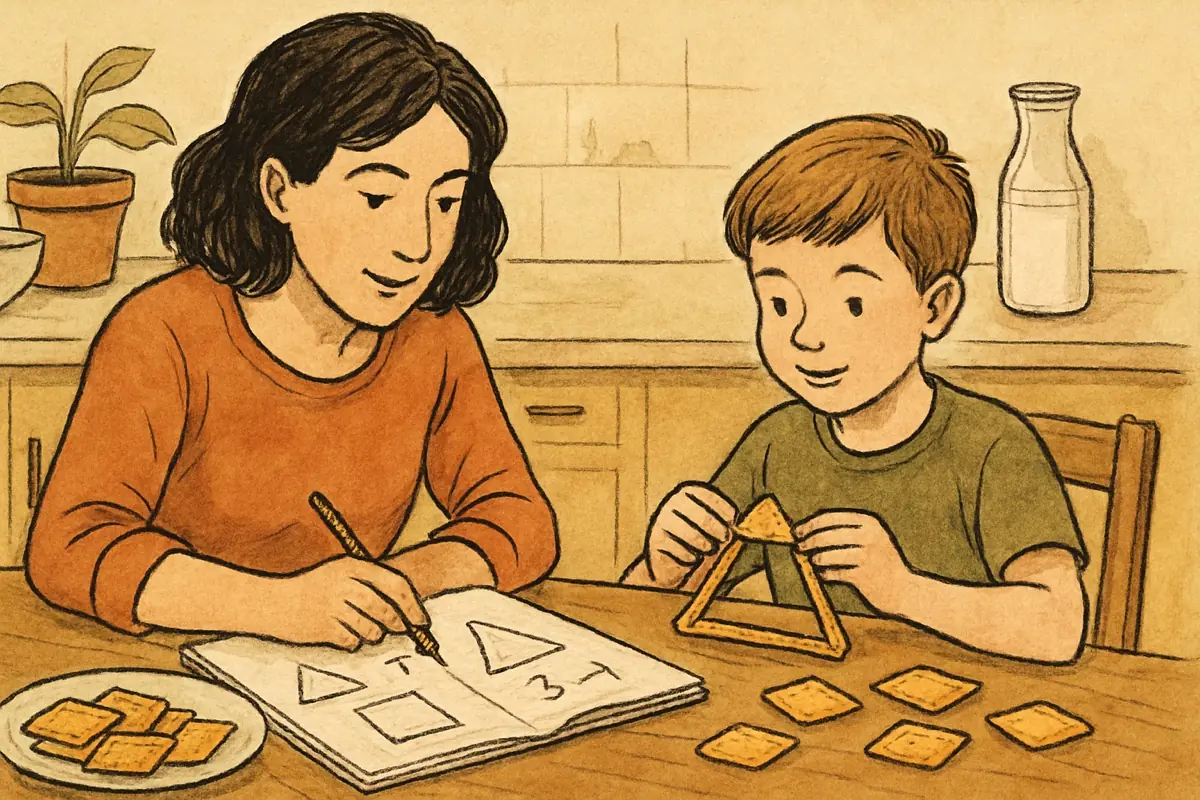
Hand a six-year-old a quesadilla and ask them to cut it in half, then in half again, and you have just taught more about fractions and symmetry than most worksheets manage in a week. Elementary geometry for kids is not a subject that needs a desk. It is the most physical math there is, and your kitchen is already full of it.
I have taught elementary math for years, and geometry is the one strand where parents at home have a real advantage over the classroom. I have to teach shapes with a picture on a screen. You have the actual objects, the real cutting and stacking and pouring. Kids learn geometry through their hands long before they learn it through their eyes, and the kitchen is where the hands already are.
Start with shapes you can hold
Before angles and area, kids need to really know shapes, and knowing a shape means more than naming it. A lot of kids can say "square" but think a tilted square is a diamond, or believe a long thin rectangle is not a rectangle because it does not look "right." The fix is handling lots of examples.
Go through the kitchen and name shapes together, and push past the easy ones.
- The plate and the pot lid are circles. So is the top of a can.
- A cereal box is a rectangular prism. Point out that every face is a rectangle.
- A slice of pizza is a triangle, and so is the corner you fold a napkin into.
- An ice cream cone is a cone, and this is a good moment to say the word "point" and the word "curved."
The goal is for a kid to see that a shape is defined by its properties, not by how it happens to sit. Turn the cereal box on its end. It is still a rectangular prism. That idea, that a shape stays itself no matter how you rotate it, is quietly one of the most important in early geometry.
Angles are just how far things open
Angles sound advanced. They are not. An angle is just how wide something opens, and a kid understands that with their whole body before they ever see a protractor.
The best tool in the kitchen is a pair of tongs or a cupboard door. Open it a little, that is a small angle. Open it wide, that is a big one. Open a door until the two sides make a perfect L and you have a right angle, which is the one worth naming because it shows up everywhere. Have your kid hunt for right angles: the corner of the counter, the edge of the fridge, where the wall meets the floor. Then find angles that are not right. A slice of pie is a nice sharp one.
You do not need degrees yet. Bigger and smaller, and "that one is a square corner," is plenty for elementary. The vocabulary can come later. The feel comes first.
Symmetry with a folded napkin
Symmetry is one of the most satisfying ideas to teach because kids can check their own work by folding.
Take a paper napkin, fold it in half, and cut a shape into the folded edge. Open it up. Whatever you cut appears twice, mirrored. That fold line is a line of symmetry, and now your kid has made one with their own hands. Then go looking. A slice of bread is roughly symmetrical. A fork is symmetrical down the middle. A coffee mug with a handle is not, and noticing why not is just as useful as noticing why something is.
Cutting a sandwich is a small daily chance for this. Cut it corner to corner and you get two matching triangles. Cut it side to side and you get two matching rectangles. Ask which cut gives bigger pieces. They are the same, of course, and that surprises kids, which is exactly the kind of surprise that makes an idea stick.
Area and volume you can actually pour
Area and volume are where geometry stops being about looking and starts being about measuring, and food makes both concrete.
For area, use tiles or crackers. Cover the bottom of a baking pan with square crackers and count them. That count is the area, and you have just shown that area means how many squares fit inside. Do a small pan and a big pan and compare. This beats the formula by a mile, because a kid who has physically filled a rectangle will understand later why you multiply the sides. The formula is a shortcut for the counting they already did.
For volume, get out the measuring cups and let them pour. How many quarter cups fill the whole cup. How many cups fill the pitcher. Pour rice or dry beans back and forth between a tall skinny container and a short wide one. Kids are usually sure the tall one holds more, and pouring one into the other proves it does not. That single experiment corrects a misconception that trips up much older students.
Keep it loose
None of this needs to be a lesson. You are not running a class at the counter, and the second it feels like a quiz the magic drops out of it. Drop a shape name into a normal moment. Ask one angle question while you set the table. Let the folded-napkin thing be a two-minute detour, not a project.
Real understanding in geometry comes from handling the actual stuff, not from filling in shapes on a page, so trust the pot lids and the crackers and the folded sandwiches to do the work. My own students who arrive already knowing that a rectangle is still a rectangle when you tip it, that a right angle is a square corner, that volume is how much fits inside, almost always come from homes where somebody let them cut and pour and stack. You do not need a curriculum for that. You need a kitchen and a little patience, and you already have both.