Estimation: Teaching Kids to Know When an Answer Is Ridiculous
A fourth grader once handed me a paper where he'd written that 4 times 6 equals 240. What got me wasn't the mistake. It was that he'd moved on to the next problem without a flicker of doubt. He'd hit a wrong button on his brain's calculator and never asked whether the answer even made sense. That moment is the whole reason to teach estimation skills to kids. Not so they can round for its own sake, but so they develop a gut feeling for when a number is obviously, laughably off.
Estimation is a smoke alarm. It doesn't do the cooking. It just goes off when something's burning.
Estimation is a check, not a chore
Most kids meet estimation as a worksheet that says "estimate 47 plus 32" right next to a worksheet that says "add 47 plus 32," and they quietly wonder why they're doing the same thing twice, badly the first time. No wonder they hate it. Framed that way, estimation looks like being asked to guess when you could just know.
I flipped it. Estimation isn't a replacement for the real answer. It's the thing you do around the real answer to make sure you didn't do something dumb. I told my kids their job was to be the boss who checks the worker's math. The worker (their pencil) computes 4 times 6. The boss (their head) says, "Four sixes, that's around 24, so if you tell me 240 I'm going to know you slipped a zero somewhere."
That framing gave estimation a purpose kids actually cared about: not looking silly. Kids hate turning in something obviously wrong. Estimation is how they catch it before I do.
Round to friendly numbers first
Before a kid can estimate a whole problem, he has to be comfortable making a number friendlier. Rounding numbers for kids trips people up because it gets taught as a rule about the digit to the right, and the rule floats free of any reason.
I taught it as "which ten (or hundred) is it closest to?" Draw a number line if you have to.
- 47 is closer to 50 than to 40, so call it 50.
- 32 is closer to 30 than to 40, so call it 30.
- 50 plus 30 is 80, and that's your ballpark.
Then compute the real thing, 79, and notice it landed right next to 80. The estimate wasn't wasted. It confirmed the answer was in the right neighborhood. When a kid sees his estimate and his real answer shake hands like that a few times, he starts to trust the process instead of resenting it.
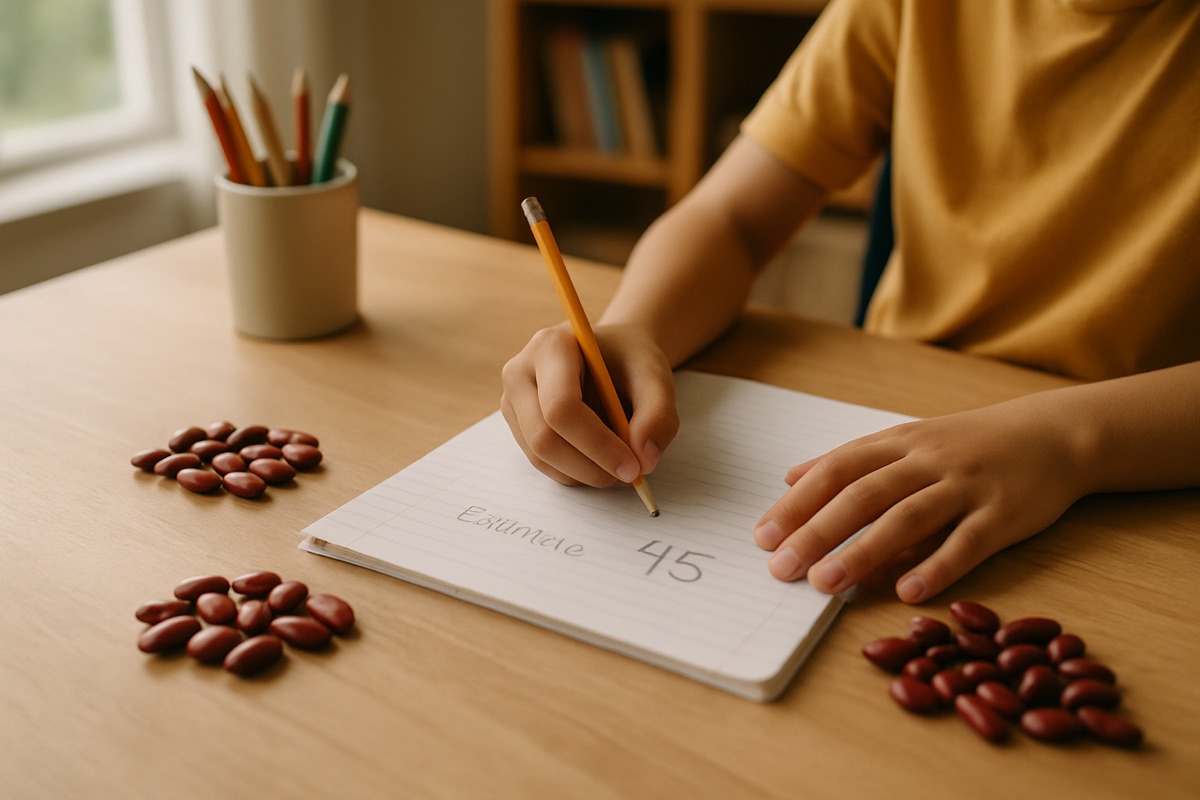
For the halfway cases like 45, I didn't die on the "round up" hill. I told them either neighbor is fine for a ballpark, because an estimate isn't supposed to be exact. Loosening that rule actually made kids more willing to estimate, because they stopped fearing they'd round it "wrong."
The one habit that catches the most mistakes
If I could install one reflex in every kid, it'd be this: before you circle an answer, ask "does this make sense?" Out loud, every time, until it's automatic.
That single question would've caught the 240. It catches the decimal that landed in the wrong spot. It catches the kid who divides and gets an answer bigger than what he started with. It catches the classic where a kid adds two prices at the store, gets an answer smaller than one of the prices, and doesn't notice.
I made it a routine, not a lecture:
- Before circling, cover the work and just look at the answer.
- Ask, "Is that about the size I expected?"
- If it's wildly off, don't erase yet. Find where it went sideways.
The "find where it went sideways" part matters. Estimation that only says "you're wrong" is nagging. Estimation that says "you expected around 24 and got 240, so check your zeros" is a map to the mistake. That's the difference between a kid who dreads checking his work and one who actually uses it.
Practice it where the numbers are real
Estimation dies on worksheets and comes alive at the store. The grocery run is the best estimation practice I know, and it costs nothing.
Hand your kid the cart and a job: keep a running ballpark of the total. Round each item to the nearest dollar and add as you go. A $3.79 box of crackers is "about 4." The $2.20 milk is "about 2." By the checkout, your kid has a number, and then the register gives the real one. If his ballpark was $30 and the register says $31.50, he nailed it. If he guessed $30 and it rings up $58, something got miscounted, and now there's a real reason to figure out what.
Other spots that work:
- "About how many minutes until we get to Grandma's?" Then check the clock when you arrive.
- Filling the gas tank. "Roughly what'll this cost?"
- Splitting a pizza. "If we each want about 3 slices and there are 4 of us, is one pizza enough?"
None of this is drill. It's the skill doing its actual job in the wild, which is where it needs to live if a kid is ever going to reach for it without being told.
Speed will come, but understanding comes first
There's a temptation to turn estimation into another timed race, a stack of "round these forty numbers" problems. Cranking through rounding drills a kid doesn't see the point of just teaches him to round fast and forget why. I'd rather a kid slowly estimate five real grocery totals than blaze through a page of disconnected numbers.
The kid with the 240 got there, eventually. Not because he did more rounding worksheets. Because he built the habit of glancing at his own answers and asking whether they were even close. One afternoon he stopped himself mid-problem, looked up, and said, "Wait, that can't be right, it's way too big." That's the whole game. A kid who can smell a ridiculous answer will catch a hundred mistakes I never see, and he'll catch them on his own. That's worth more than any perfect worksheet.