Building a Home Math Kit: The Manipulatives Worth Buying and the Ones to Skip
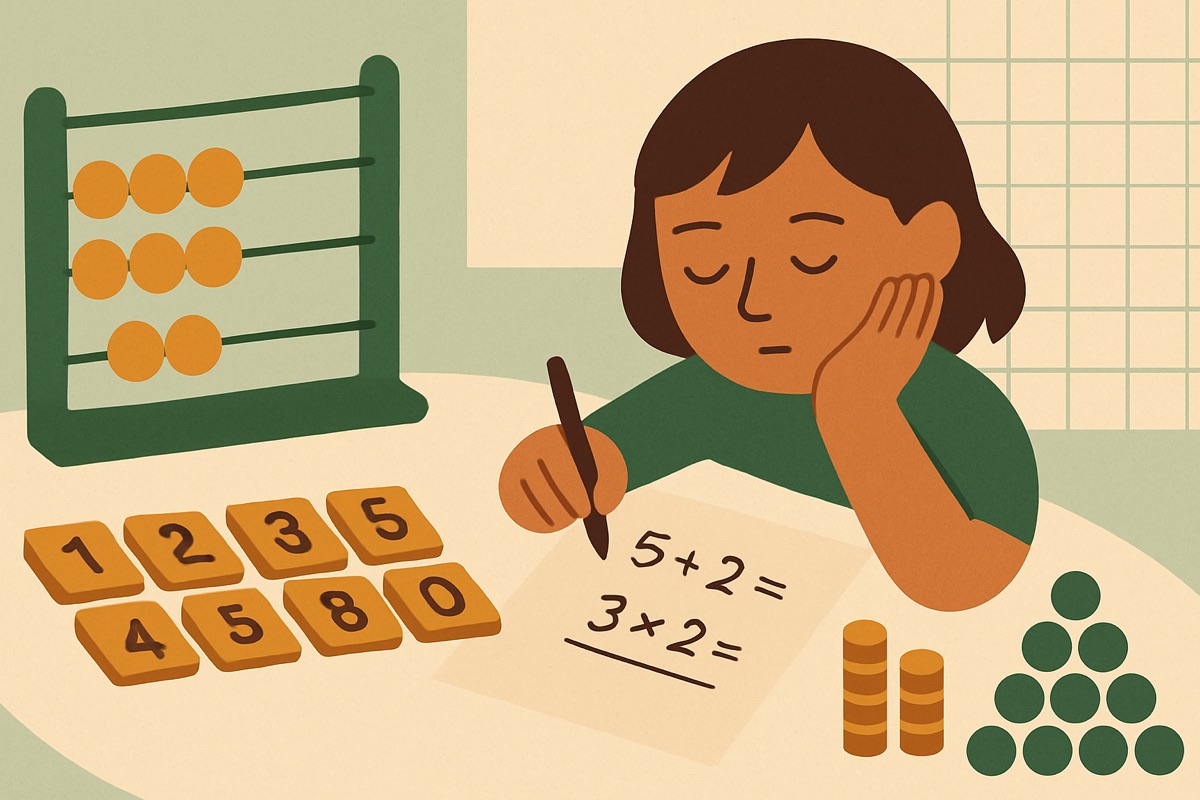
I spent about forty dollars on a "complete math manipulatives set" when my oldest was five. It came in a molded plastic tray with eleven compartments, and I'd guess we used maybe three of them. The rest sat in a closet. If you're building a math manipulatives at home kit, I want to save you that closet, because I've now figured out which of these things earn their space and which are just markup on plastic with a curriculum brand stamped on the side.
I'm a software engineer, not a teacher, but I've built a math app for my own kids and spent a lot of time watching what makes a concept click versus what just looks educational. Physical objects matter more than any screen for the early stuff. A kid needs to move real things with real hands before the abstract version means anything. The trick is that the objects almost never need to be the fancy branded ones.
The short list of things actually worth buying
Here's what I'd spend money on, and it's not much:
- Base ten blocks. These are the one manipulative that's genuinely hard to fake at home. The little unit cubes, the rods of ten, the flats of a hundred. They make place value physical in a way nothing else does. A decent set is ten to fifteen dollars.
- A set of two-color counters. Red on one side, yellow on the other. Cheap, and useful for addition, subtraction, and later for negative numbers. You could substitute two colors of dried beans and lose almost nothing.
- A basic analog clock with movable hands. Digital clocks hid the whole concept of "quarter past" from a generation of kids. A three-dollar teaching clock brings it back.
That's it for stuff you should pay for. Under twenty dollars total, and every item does real work. If I had to cut the list further, I'd keep the base ten blocks and drop the rest, because those are the only ones I couldn't rig up from things already in the house.
What you already own and shouldn't buy
Most manipulatives are just organized household objects with a price tag. Before you order anything, look around your kitchen.
Coins teach counting, skip counting, and place value, and you have them in a jar right now. Measuring cups are your fraction set. A one-cup measure and a half-cup measure will show a kid that two halves make a whole faster than any workbook, because they can pour it and see the water level match. Dried beans, buttons, and LEGO bricks are counters. An egg carton is a ten-frame if you cut two cups off, which is the exact tool teachers use to build number sense to ten.
I'm a little skeptical of the education supply catalogs for this reason. A lot of what they sell is a normal object, made in bulk, marked up because it's aimed at people who feel like they need special equipment to teach. You don't. You need a kid, some objects, and a reason to count them.
What to skip entirely
Some of it is just bad. In my experience these are the ones that end up in the closet:
- Giant sets with fifty different types of pieces. Variety looks impressive on the box and overwhelms an actual six-year-old. More types of things is not more learning.
- Fancy fraction "pizzas" and pie pieces. Real measuring cups and a real snack do the same job and connect to something the kid already understands.
- Anything electronic that beeps when you press it. The beep becomes the point. The kid learns to chase the sound, not the math. This is the same trap a lot of math apps fall into, where the reward is the animation and not the actual progress underneath it.
That last one is worth sitting with, because it's the same failure whether it's a plastic toy or a screen. If the fun part is disconnected from real understanding, the kid optimizes for the fun part. When I built our app I fought hard to tie any reward to genuine mastery instead of just tapping through, because a reward for busywork teaches the wrong lesson. The physical version of that lesson is the beeping toy your kid mashes without doing any math at all.
How to actually use the kit
Owning the objects does nothing. Using them at the right moment is everything. The pattern that works is simple: when your kid hits a wall on an abstract problem, get it into their hands.
My middle kid could not, for weeks, understand borrowing in subtraction. Thirty-two minus seventeen was a mystery. Then I put base ten blocks in front of her. Three rods and two cubes. She needed to take away seven cubes and only had two, so she had to physically trade one rod for ten cubes to make it work. She got it in about four minutes. The blocks did what my explaining couldn't, because she could see the trade happen instead of following a rule she didn't believe.
That's the whole point of a home math kit. Not to look like a classroom. To have the right physical thing on hand for the moment when a concept refuses to go abstract. Buy the base ten blocks, the counters, and the clock. Raid the kitchen for the rest. Skip the closet full of plastic. Your kid needs their hands on real objects and a parent paying attention, and almost none of that requires a purchase order.