How to Help With Math Homework Without Just Giving the Answer
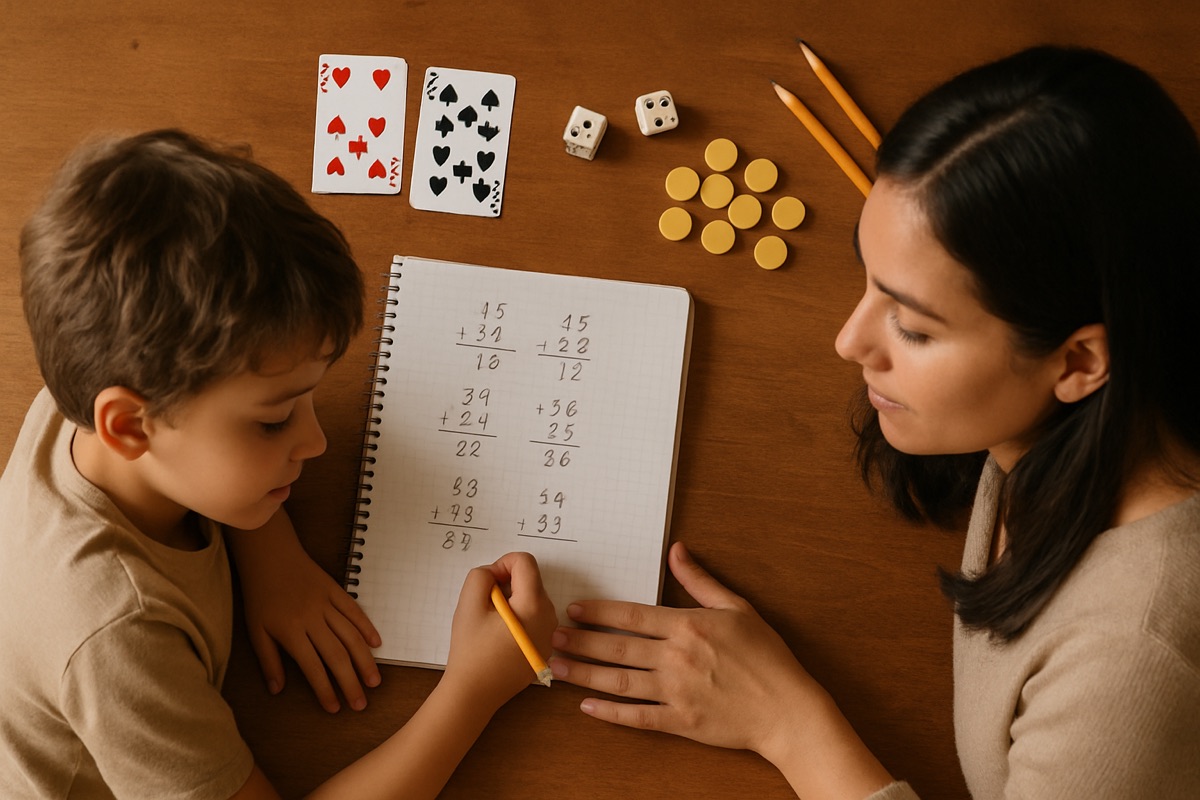
Last spring a mom told me she and her son had a system for long division homework. He would put the pencil down, look sad, and she would lean over and walk him through the whole problem while he wrote what she said. They finished every night in twenty minutes. He also bombed the unit test. She was not doing anything wrong on purpose. She just wanted the crying to stop, and giving the answer stops the crying fast.
If you want to help with math homework without giving the answer, the first thing to accept is that it will take longer some nights, and that the longer version is the one that actually teaches. The good news is there is a real method to it, and it is not complicated.
Why handing over the answer backfires
When you solve the problem and your kid copies it down, the homework gets finished but nothing moves. The whole point of practice is the struggle of retrieving the steps yourself. That is the part that builds the memory. If you do the retrieving, you get stronger at long division and your kid gets stronger at waiting for you.
I see it every fall. A kid who breezed through homework all year suddenly can't do anything the moment there's a quiz and no parent next to them. The homework looked perfect. The learning never happened. So the goal at the kitchen table isn't a finished worksheet. It's a kid who could do the next one alone.
Ask, don't tell
The single most useful move is to answer a question with a question. When your kid is stuck, resist the urge to explain and instead figure out where the wheels came off. A few that I use constantly:
- "What is the problem actually asking you to find?"
- "What did you try already?"
- "Where did you get stuck, the first step or somewhere in the middle?"
- "Can you do one just like it that's easier?"
- "How would you check if your answer makes sense?"
These sound simple. They do a lot of work. They hand the thinking back to the kid, and they tell you exactly which step is broken so you can aim your help there instead of re-teaching the whole thing.
The trick is to actually wait after you ask. Count to ten in your head. Kids fill silence with thinking if you let them, and most of us jump in at second three because the quiet is uncomfortable.
Find the real stuck point
A lot of homework battles are not about the skill on the page. A kid crying over two-digit multiplication usually has shaky times tables underneath. A kid who freezes on a word problem often reads it fine but has no idea which operation the words are pointing to. The visible problem sits on top of an earlier one.
So when your child is stuck, drop down a level before you push forward. If tonight's problem is 34 times 6 and it's a disaster, ask them 4 times 6 and 6 times 3 by themselves. If those are slow or wrong, you found the real work, and it isn't tonight's worksheet. Shore up the floor first. It's less painful than grinding the hard skill on a foundation that won't hold it.
Give a hint, then step back
You don't have to choose between saying nothing and saying everything. There's a middle setting, and it's where most of the good help lives. Think of it as the smallest possible nudge.
If a kid is stuck on 7 times 8, don't say 56. Say "you know 7 times 7, right? So what's one more group of 7?" That's a hint that makes them do the last piece. Or point at the step, not the answer. "Check your carrying on that second column." Or just cover part of the problem so it looks smaller.
Then, and this is the part people skip, back off and let them finish the step. A hint you follow up by doing it for them anyway isn't a hint. It's a delayed answer.
Let them be wrong on purpose
Here's the one that's hardest for parents. Sometimes the best thing you can do is let your kid write down a wrong answer and find out later it was wrong. A mistake they catch themselves teaches more than a mistake you prevent.
When they do get one wrong, don't correct it. Say "show me how you got that." Nine times out of ten they find their own error while explaining it, which is the whole ballgame. And on the tenth time, you get to see exactly how they were thinking, which is worth more than a red X. A wrong answer is information. It's not a verdict on whether your kid is good at math.
I had a third grader who was convinced she couldn't do subtraction with borrowing. Turned out she understood borrowing perfectly. She kept forgetting to cross out the number she borrowed from, so her next step used the wrong digit. One tiny habit, not a missing concept. I would never have found it if I'd just fixed her answers.
Keep the mood out of the ditch
Kids read our faces. If you tense up, sigh, or say "I was never a math person either," they hear that math is a scary thing some people just can't do, and they quietly file themselves under can't. You don't have to fake being excited about fractions. You do have to stay calm and treat homework like a puzzle you're both looking at, not a test of whether they're smart.
If it's turning into tears every night, stop the session. Nothing gets learned through a meltdown. Take a break, do a couple of easy ones to end on a win, and come back later. A short calm session beats a long miserable one every time.
When you actually should just show them
Not every problem is a teachable moment, and pretending otherwise makes homework take three hours. If your kid has genuinely never seen a concept, or it's late and they're fried, or you've been circling one problem for fifteen minutes with no movement, go ahead and work one all the way through as an example. Then, right away, have them do the next one themselves while it's fresh. Show one, they do one. That's not giving the answer. That's teaching, and then checking that it stuck.
The line I try to hold is this. Helping is fine. Doing it for them is not. Most nights the difference is just whether the pencil ends up back in their hand before the problem is done. Keep it there as often as you can, ask more than you tell, and let the hard parts stay a little hard. That's the version that pays off on the day you're not sitting next to them.