Family Reward Chart: One Week From Math to Game Night
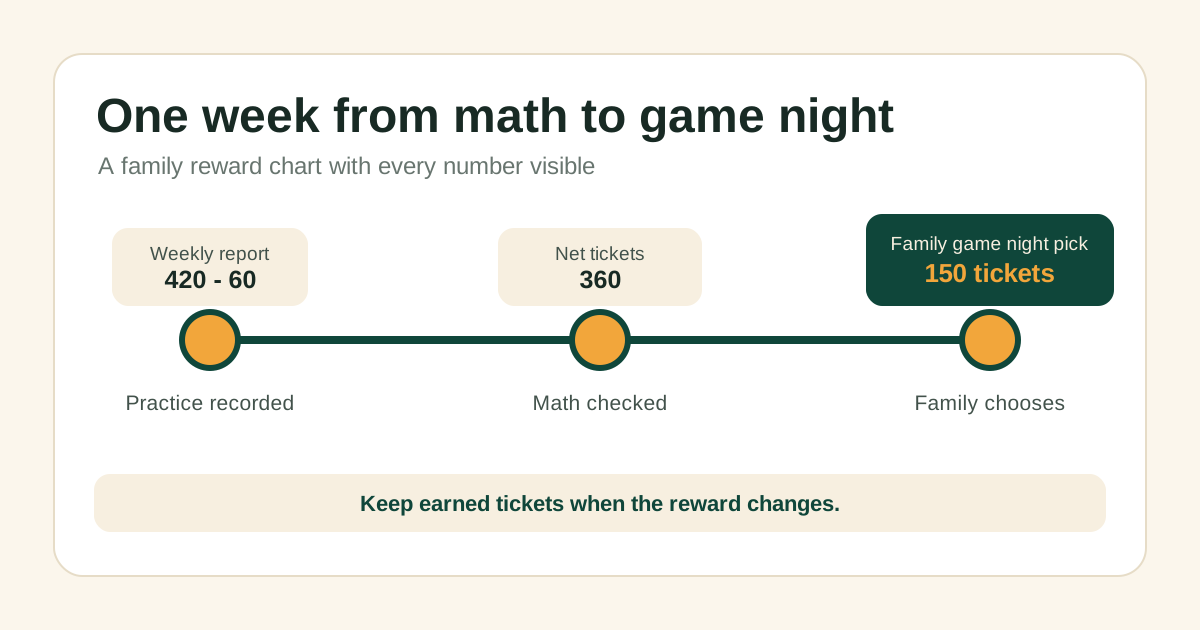
A family reward chart works when a child can follow the whole route: the practice that counts, the ticket math, and the reward the family agreed to provide. This worked week uses Math Prizes fixture data: 420 tickets earned, 60 lost, 360 left, and a 150-ticket choice of the board game for family game night. The repository uses these numbers in mock mode; they do not describe a real family or show that rewards improve learning.
What should a family reward chart show?
A family reward chart should show the agreed action, the earned amount, any clearly explained adjustment, the running total, and the reward menu. A row that says only "math done" leaves too much room for an argument on Friday.
Write the earning rule in language a child can repeat. Here, the chart records tickets reported by the connected learning app. The parent still checks what was practiced and decides what those tickets can buy. A ticket total accounts for tickets. It does not grade the work or prove mastery.
Put the reward on the chart before the week begins. The product's local mock prize list includes Family game night pick at 150 tickets. The child chooses the board game, and the rest of the family agrees to play it. This asks for family time without requiring another purchase.
How does one week of math practice become tickets?
One week of math practice becomes a net ticket total by subtracting reported losses from reported earnings. The tracked mock report contains the exact fields tickets_earned: 420 and tickets_lost: 60; the arithmetic fits in one line.
| Chart line | Number | What the family can safely say |
|---|---|---|
| Tickets earned during the week | 420 | The fixture reports 420 earned tickets |
| Tickets lost during the week | 60 | The fixture reports 60 lost tickets, without explaining every event in this excerpt |
| Net change | 360 | Earned tickets minus lost tickets |
| Family game night pick | 150 | The mock prize list uses this ticket price |
| Balance after one game-night choice | 210 | The family still has tickets for a later choice |
The ticket line is reproducible: 420 earned - 60 lost = 360 net tickets. If the family redeems one 150-ticket game-night choice, 360 - 150 = 210 tickets remain.
Keep the story inside what the source supports. The mock report does not identify a child in production, explain every one of the 60 lost tickets, or make 420 tickets a healthy pace for every child. It gives us stable numbers for checking the chart and its arithmetic. Your chart should use the balance and activity your own family can verify.
How should a family choose the reward?
A family should choose a reward that the child actually wants and the parent can provide at the promised pace. Put two or three practical choices on the menu, then let the child pick before practice starts.
The 150-ticket game-night choice fits this example because the net 360-ticket week covers it without requiring a perfect week. A parent can also deliver it on Friday or Saturday. If game night already happens in your house, reward control of the game, snack, or teams. Keep access to family time off the price list.
The reward-pricing worksheet uses a child's ordinary weekly pace to set small, weekly, and longer-term prices. Use that method when 150 tickets would take your child one afternoon or six weeks. The number only makes sense beside the earning pace.
What should I do when my child loses interest?
A family reward chart should preserve earned tickets while the family checks whether the practice, the reward, or the chart itself stopped fitting. Interest is useful information. It is not a reason to erase the 210 tickets left in this example.
The CDC says children can tire of rewards and develop new interests, so parents should keep a running list and change it over time. Its Tips for Using Praise and Rewards also says earned rewards should not be removed for misbehavior. The page addresses parents of toddlers and preschoolers. I use it here only for practical chart guidance; it does not show that a ticket plan improves an older child's math.
Use the first honest answer you get:
| What changed? | What to change next | What stays put |
|---|---|---|
| "I don't care about game night now." | Replace future menu choices together | Tickets already earned |
| "These problems are all the same." | Check the practice level or switch the activity | The written earning rule for completed work |
| "The reward takes forever." | Review the price after the week closes | This week's posted price |
| "I forgot the chart existed." | Move it where the family checks it and trim extra rows | The current balance |
The questions in what to do when a math reward chart loses its pull help sort those answers. Find the stale part. Change one thing, then watch the next week.
How do I keep the chart from taking over math?
A family reward chart stays in its place when the family discusses the math separately from the tickets. Ask what felt easy or which problem needed a second try. Then update the chart in under a minute.
Adding tickets after pleading or withholding a posted reward after a messy week makes the numbers negotiable once the work is done. Hold the written agreement. If the chart causes more bargaining than practice, honor the current balance before pausing new earning rules.
A routine also needs days when the household is busy. The realistic weekly family math plan leaves room to skip a day and return without treating the gap as failure. A reward chart should survive the same ordinary week.
What does this worked example prove?
This worked example shows that the repository's fixture values fit on a clear family chart and can be checked with ordinary subtraction. The source supports 420 earned tickets, 60 lost tickets, and a 150-ticket family game-night choice in mock mode. It gives no evidence about customer behavior, motivation, learning gains, or live account settings.
That limit matters. A clean chart can make an agreement easier to inspect. It cannot tell you whether the practice was well matched to the child, whether the child understood the math, or whether the same reward will still matter next month.
Frequently asked questions
How many points should a reward cost for kids?
Start with what the child normally earns in one ordinary week, then price at least one wanted choice within reach of that pace. In this fixture example, 360 net tickets can cover a 150-ticket game-night choice. Your family's numbers may be much smaller or larger.
Should I take away tickets after bad behavior?
Do not remove tickets that were already earned under the chart's stated rule. Address the separate behavior separately, and change future chart rules before the next earning period if the agreement needs work.
What are good rewards for kids doing math?
Good rewards are wanted by the child and practical for the parent to provide. Choosing the family game, dinner music, a bedtime story, or the weekend activity can work without turning every practice session into a purchase.
What if my child quits halfway through the week?
Keep the tickets already earned, ask what changed, and decide whether to adjust the practice or future reward menu. One unfinished week is not enough evidence to label the child unmotivated or to rewrite the agreement after the fact.