Family Game Night Ideas That Slip Math Past the Whole Table
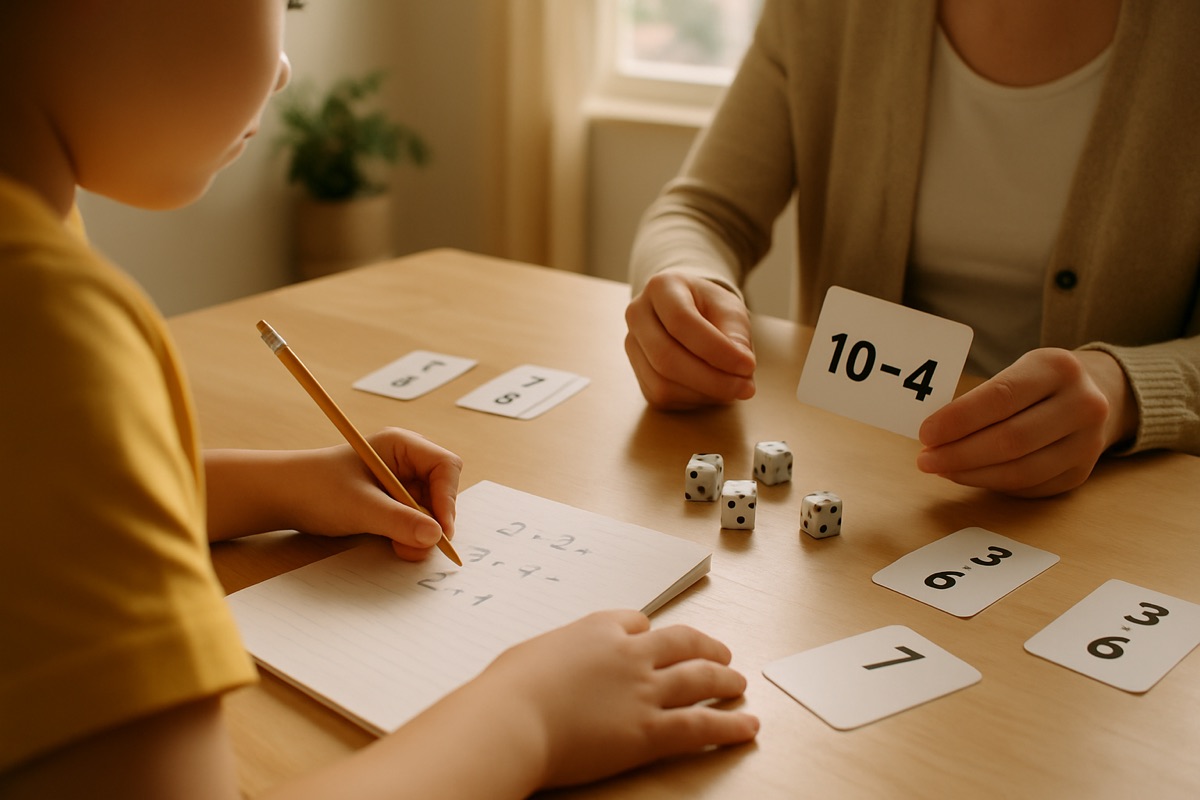
The best math my own kids do all week happens on Friday night, and not one of them knows it's math. We clear the dinner plates, somebody grabs a game off the shelf, and for the next hour there's adding, keeping score, figuring odds, and comparing amounts, all of it buried inside the fun. That's the whole trick of family game night math. When the point is winning, the arithmetic stops feeling like a chore and starts feeling like a tool.
I've taught elementary school for sixteen years, and I've watched the same kid who freezes on a worksheet rattle off "I need seven more to catch up to you" without blinking. The math was never the problem. The word "math" was. Games take that word off the table.
Why games work when worksheets don't
A worksheet asks a kid to do twenty problems for no reason they care about. A game gives them a reason. When your son is deciding whether to buy the orange property or save his money, he's doing real cost comparison and mental subtraction, and he's doing it because he wants to win, not because a box needs filling in.
There's also no red pen. A wrong count in a game just means you miscounted your move, you fix it, and you keep going. That low-stakes, try-again feeling is exactly the environment where kids get braver with numbers. Nobody's grading them. They're just playing.
And repetition stops being boring. A kid who'd revolt at doing the same addition problem ten times will happily add two dice fifty times over a night of Yahtzee, because each roll matters to the game. That's the difference between practice and grinding. Grinding is doing something over and over for no reason the kid cares about. Practice inside a game is doing it over and over because you want the next turn. Same skill, completely different experience.
Store-bought games that carry real math
You don't need anything labeled "educational." Some of the best math games are the classics already in your closet.
- Monopoly (or Monopoly Junior for littler kids). Making change, adding rent, deciding whether you can afford something. Let your kid be the banker. It's the single best job at the table for practicing addition and subtraction under mild pressure.
- Yahtzee. Adding dice, multiplying for the number categories, and real strategy about which score box to fill. My third graders would groan at a multiplication drill and then happily multiply four fives to fill their Yahtzee sheet.
- Sushi Go or Ticket to Ride. Both hide steady point-counting and planning inside gorgeous cards. Ticket to Ride sneaks in a surprising amount of "how many more cards do I need" subtraction.
- Uno. Even this one has quiet math when you tally the cards left in everyone's hand at the end of a round. Small, but it counts.
The rule I give parents: if there's a score to keep or a cost to weigh, there's math in it. That covers most of the shelf.
Games you can make from what's in the drawer
Some nights you don't want to set up a board. A deck of cards or a pair of dice is plenty.
One we play constantly is Target Number. Roll two dice, and the goal is to get as close as you can to a number we pick, say 12, using the two rolls and any operation. A 5 and a 3 could be 8, or 15, or 2, or 5 minus 3 is 2, and you argue for your best answer. It's flexible thinking dressed up as an argument, which kids love.
Another is Card Flip War with a twist. Each player flips two cards and adds them. Higher sum wins the pile. For older kids, multiply instead. My daughter learned half her addition facts this way and never once called it studying.
And if you have a jar of coins, "make this amount" is a real game. I call out 37 cents, everyone races to grab it, and closest without going over wins. Counting money is one of the skills that quietly falls through the cracks at school, so a coin jar earns its keep. For older kids, add a rule: you have to make the amount with the fewest coins possible, which forces real thinking about quarters versus a pile of nickels.
Dominoes deserve a mention too, and not the fancy version. Just matching the ends teaches younger kids to recognize dot patterns without counting one by one, which is a real number-sense skill called subitizing. Older kids can add both halves of each tile for a score. A single box of dominoes covers a wide age range at one table, which matters when you've got a kindergartner and a fourth grader who both want in.
Keeping the math invisible
The fastest way to ruin family game night math is to announce it. The second you say "see, this is just like your homework," a kid's guard goes up. So don't. Let it stay a game. If your son adds the dice wrong, you don't correct him like a teacher. You say "wait, let me count that with you," and you count together. He fixes it himself and never feels caught.
A few small habits keep the math flowing without turning game night into a lesson:
- Let the kids keep score, even if it's slow. Slow counting is still counting.
- Play the game at the kid's real level, then nudge up. A frustrated kid quits, and you can't practice what you've quit.
- Resist the urge to praise the math specifically. Praise the good move, the smart trade, the gutsy risk. The math comes along for the ride.
We don't do worksheets on Friday nights. We keep score, we argue about whose turn it is, and somebody usually gets a little too competitive over a plastic hotel. Underneath all of it, a whole week of arithmetic gets done. That's the version of practice that sticks, because nobody at the table ever felt like they were practicing.