Family Reward Chart: My Friday Ticket Audit
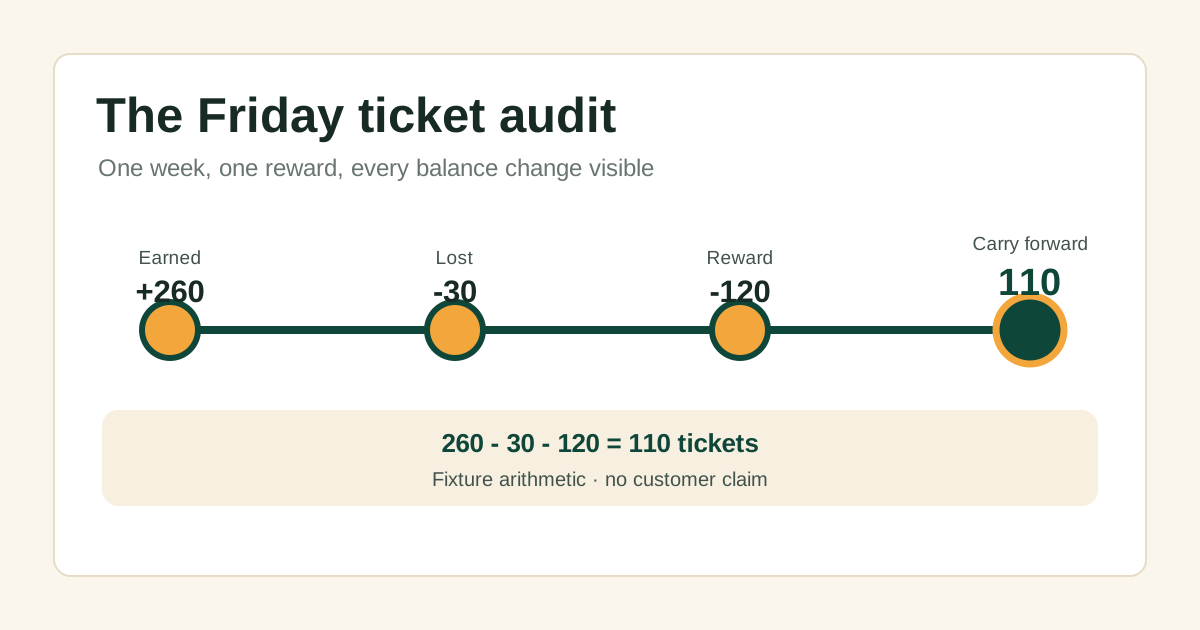
A family reward chart should make the week's agreement checkable: what counted, how many tickets came in, what changed the balance, and what reward was redeemed. I ran Parent Prize Portal's second demo report through a Friday closeout: 260 tickets earned, 30 lost, a 120-ticket extra bedtime story, and 110 left for next week. These numbers come from repository fixtures; they don't describe a customer result or show that rewards improve math.
What did I put on this family reward chart?
I put the earning rule, weekly report, reward cost, and carryover balance on one family reward chart. Streaks, percentages, and decorative stars stayed off. None of them changes the ticket agreement.
The demo source also gives default ticket values by math problem type. I used those values to make the earning rule concrete before looking at the weekly total.
| Math task | Default tickets for one earning event |
|---|---|
| Addition | 1 |
| Subtraction | 2 |
| Multiplication | 3 |
| Division | 4 |
| Fractions | 5 |
| One event in each row | 15 |
That strip adds up to 1 + 2 + 3 + 4 + 5 = 15 tickets. The portal lets a parent change these payouts, so I would put the words "default demo values" right above it. This is a settings walkthrough. It does not tell every family what to pay.
How did I close the demo week on Friday?
I closed the demo week by writing each balance-changing line once, then carrying the remainder into the next week. The tracked report gives a weekly total. It does not give a trustworthy ticket amount for Monday, Tuesday, or each topic, so I left out the daily split.
| Friday chart row | Source value | Ticket movement | Running week total |
|---|---|---|---|
| Learning tickets reported for the week | 260 | +260 | 260 |
| Ticket losses reported for the week | 30 | -30 | 230 |
| Extra bedtime story redeemed | 120 | -120 | 110 |
| Carry into next week | 110 | 0 | 110 |
The arithmetic is 260 earned - 30 lost = 230 spendable tickets. Redeeming the 120-ticket bedtime story leaves 230 - 120 = 110 tickets. I would write all four lines where the child can see them, then put the pencil down. Friday's ticket math should take less time than the practice did.
The earlier one-week family game-night chart uses the first mock report, a 150-ticket shared prize, and different arithmetic. This audit uses the second report and focuses on reconciling the chart with the parent dashboard.
How many points should the reward cost for kids?
A reward should cost an amount the child can understand and the parent can honor at the family's normal earning pace. In this fixture, the 120-ticket bedtime story uses about 46% of the week's 260 gross tickets. After the reported losses, it uses about 52% of the 230 available tickets.
Those percentages tell me whether the child could reach a wanted choice and still save something. Here, 110 tickets remain. A family with a much slower earning pace could lower the price. A faster-earning family could keep it and add a longer-term choice.
Do the pricing review before the week starts. Changing 120 to 200 on Friday because the child earned more than expected turns a posted price into a moving target.
What does the parent dashboard add to the paper chart?
The parent dashboard gives the family a source for the weekly totals and a place to check the reward price. A paper chart can still live on the fridge. I would not turn it into a second ledger with competing numbers.
I would use the paper row for the agreement and copy the Friday totals from the portal. The parent dashboard test explains why a useful report separates practice details, progress, and purchases instead of rolling everything into one cheerful score.
This demo's 260 earned and 30 lost describe ticket movement. They do not explain which skill improved, why every loss occurred, or whether the child understood a problem. Ask about the math separately: "Show me one problem that felt easier by Friday" works better than reading a balance as a grade.
What should a parent do when the chart and app disagree?
If the family reward chart and app disagree, I would pause the closeout and trace the last confirmed number. Do not erase a child's paper total or add a guessed adjustment just to make the columns match.
Check the earning rule first. A changed payout can make today's task worth a different amount from last week's task. Then check for a redemption, refund, or loss line that appears in one place and not the other. Write a short note beside the unresolved amount and settle it after checking the ledger.
Google Family Link does a different job. It can manage app access and device time, but it does not read learning activity and award tickets. The guide to Google Family Link and learning rewards shows where device control ends and a family reward ledger begins.
Which reward-chart rule did I keep after the audit?
I kept one rule after the audit: earned rewards stay earned. The CDC's Tips for Using Praise and Rewards says, "Never take away rewards your child has earned" (CDC).
That CDC page is written for parents of toddlers and preschoolers. It is useful here for the narrow chart rules about clarity and earned rewards. It does not test Parent Prize Portal, math practice, or an older child's response to tickets.
If interest fades, change the next agreement instead of rewriting the week that already happened. The math reward-chart review gives a short way to check whether the task, reward, or timing stopped fitting.
What does this Friday audit prove?
This Friday audit shows that the tracked demo values fit a transparent chart and that anyone can reproduce the arithmetic from the repository. The source supports the five default payout values, the 260-ticket weekly earning total, the 30-ticket loss total, and the 120-ticket demo prize.
The evidence stops there. It does not show a real family, a live production balance, a child's reason for practicing, or a learning result. A parent can use the layout with their own verified values and keep those limits visible.
What are the frequently asked questions about a family reward chart?
Parents usually ask how to price, reset, and share a family reward chart without turning it into a negotiation.
Should a family reward chart reset to zero every Monday?
No. Carry forward tickets that were already earned unless the family agreed to a time-limited system before earning began. This demo carries 110 tickets into the next week.
How many tasks should go on a reward chart?
Use only tasks the child can name and the parent can verify. For math, a few problem types or one agreed practice block is easier to audit than a long list of vague goals.
Should I list ticket losses on the chart?
List a loss when it is part of the stated earning system and the source confirms it. Keep the reason visible, cap the downside, and never use an unexplained loss to settle a separate behavior problem.
Can a parent dashboard replace a family reward chart?
It can replace the arithmetic ledger if everyone can see and understand it. A small paper chart can still hold the family agreement, the current reward menu, and the next review date.