Multiplication Facts for the Kid Who Says 'I'm Just Bad at This'
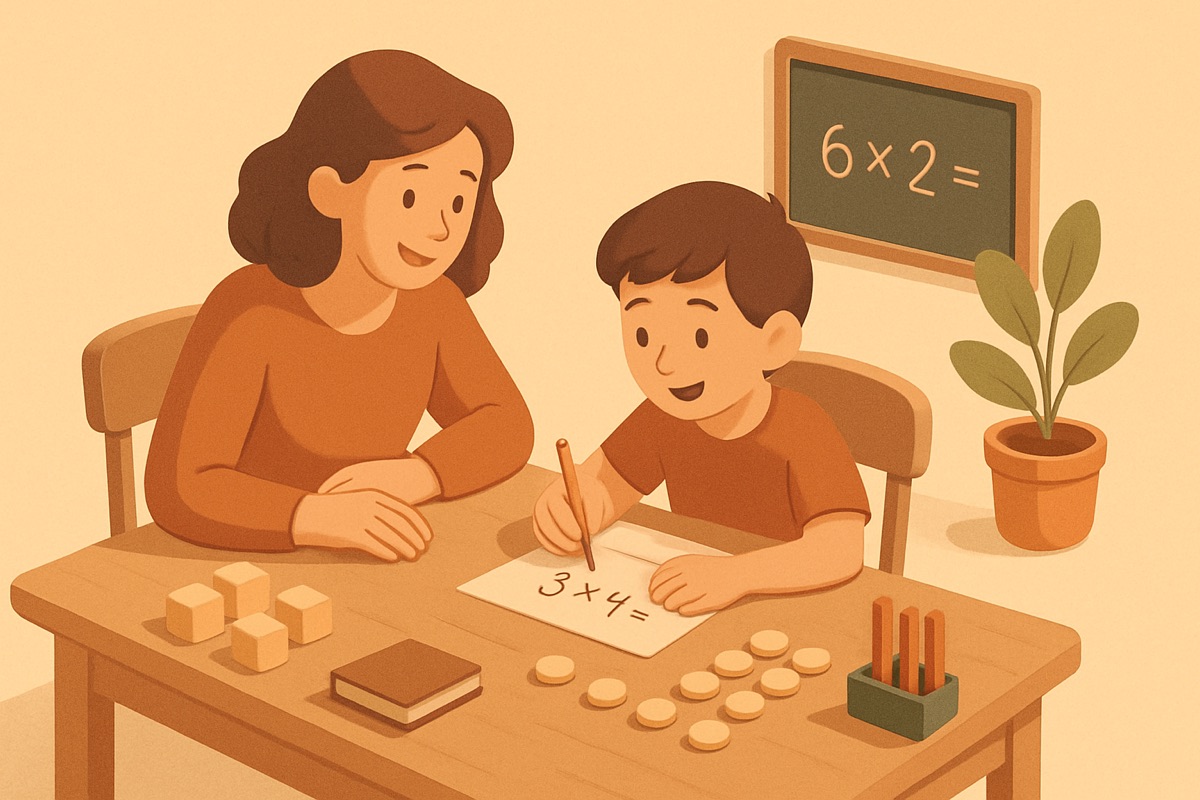
A girl in my third grade class used to put her head down on the desk the second I said the word "multiplication." Not dramatically. Just quietly, like someone bracing for a shot. She'd already decided, somewhere around the sevens, that she was bad at this and no amount of practice was going to change it. If you want to help a child who hates multiplication, that head-on-the-desk moment is the real problem, and it comes before the math.
Because here's the thing about a kid who says "I'm just bad at this." They're not lazy and they're usually not actually bad at it. They've hit a wall on a handful of specific facts, gotten drilled on them until the drilling itself became the enemy, and drawn a giant conclusion from a small pile of evidence. The facts are fixable. The story they've told themselves is the harder part.
They don't hate multiplication, they hate the drill
When a kid resists multiplication, watch what specifically they're resisting. Nine times out of ten it isn't the concept. It's the flashcard-and-timer machine that's been aimed at them.
Timed drills are the fastest way I know to make a shaky kid shakier. A child who's unsure of six times seven, put under a clock, doesn't get faster. They panic, guess, get it wrong, and now that fact carries a little jolt of failure attached to it. Do that daily and you've trained them to flinch at the sevens. The repetition didn't build fluency. It built dread.
So the first move to help a child who hates multiplication is often to stop the thing that's making them hate it. Put the timer away. Retire the giant stack of cards. You're going to rebuild this, but not by grinding.
Find the six facts that are actually the problem
Kids talk like they don't know any of it. "I don't know my times tables." That's almost never true, and proving it wrong is one of the more useful things you can do.
Sit down and go through the facts calmly, no clock, and quietly sort them. You'll find the vast majority are solid. The ones times anything, the twos, the fives, the tens, most kids own these. The squares like six times six often stick because they feel special. What's left is a small, specific set of troublemakers. For most kids it's some version of these:
- six times seven
- six times eight
- seven times eight
- seven times nine
- eight times nine
That's it. Five or six facts, usually. Not "the times tables." A handful of specific ones clustered in the same corner. When you show a kid that they already know eighty-something facts and there are really only six giving them trouble, the whole "I'm bad at this" story starts to wobble. You can't be bad at multiplication when you just demonstrated you know most of it.
Give each hard fact a hook
Naked repetition doesn't stick for these tough facts, or it wouldn't have worked by now. What sticks is a hook, a reason the answer makes sense, so the fact is understood instead of just memorized.
Seven times eight is the classic. I teach it as "five, six, seven, eight," because 56 equals 7 times 8, and the digits 5, 6, 7, 8 run in order. Kids love it because it feels like a trick, and a trick is the opposite of a wall. For six times eight, I lean on doubling. A kid usually knows three times eight is 24, so six times eight is just double that, 48. For nine facts, there's the finger method, but honestly I prefer "one less than the ten." Nine times seven is seventy minus seven, which is 63.
The point isn't the specific hook. It's that each hard fact gets a path to the answer that isn't "just remember it." A kid who can rebuild a fact when it slips doesn't panic when it slips. And the ones who understand where the answer comes from are the ones who actually hold onto it, long after the kids who only crammed have forgotten.
Practice the six, leave the rest alone
Once you've found the real troublemakers, aim everything there. Do not review the whole set of tables. Reviewing facts a kid already owns is a waste of their patience and it dilutes the work that matters.
Five minutes a day on just those five or six facts, using the hooks, no timer. You're looking for understanding first and speed as a slow byproduct, not the goal. When you check, ask "how'd you get it?" as much as "what's the answer?" A kid who says "seven times eight, five six seven eight, 56" is fluent in the way that lasts. A kid who blurts 56 but can't tell you how is one bad day away from losing it.
If you use an app or a game for this, make sure the reward is tied to getting the hard ones right, not to how many problems flew by. A kid can rack up points on the twos all day and never touch the sevens that are the actual issue. The practice has to point at the six facts that matter, and it should celebrate the moment a stubborn one finally clicks, not reward mindless volume.
Let them catch themselves getting better
The story a kid tells about themselves changes through evidence, not encouragement. You can tell a child they're good at multiplication all day. It doesn't land. What lands is them noticing, on their own, that six times seven came out of their mouth without a struggle.
So make the progress visible. Keep a tiny list of the troublemaker facts and cross one off out loud when it's genuinely solid. "That one's yours now. Four left." Kids feel that. It reframes the whole thing from "I'm bad at multiplication" to "I'm down to four facts," which is a mountain shrinking into a to-do list.
My head-on-the-desk girl got there. It took maybe three weeks of five minutes a day on her six hard facts. One afternoon she answered seven times eight before I'd finished asking it, then looked up, a little surprised at herself, and said, "Oh. I know that one now." She didn't put her head down that day. That's what helping a child who hates multiplication actually looks like. Not more drilling. A shorter list, a few good hooks, and enough small wins that they stop believing the thing they told themselves.