Doubles and Near-Doubles: The Fastest Addition Facts to Lock In First
Start where the kid already feels strong
Ask a first grader what 5 plus 5 is and watch what happens. Most of them answer without pausing, and a lot of them smile a little, because they know it cold. Doubles feel safe. A kid who freezes on 7 plus 8 will fire back "12" for 6 plus 6 like it's their name. That confidence is worth building on, and it's exactly why a doubles addition facts strategy is the smartest place to start when you're helping a kid get fluent.
Here's the plan in one sentence. Lock in the doubles first, because they're already halfway learned, then use them as anchors to reach the harder facts nearby. It's less memorizing than most parents expect, and it turns the addition table from a wall of forty scary facts into a handful of easy ones plus a trick.
Why doubles are the easy on-ramp
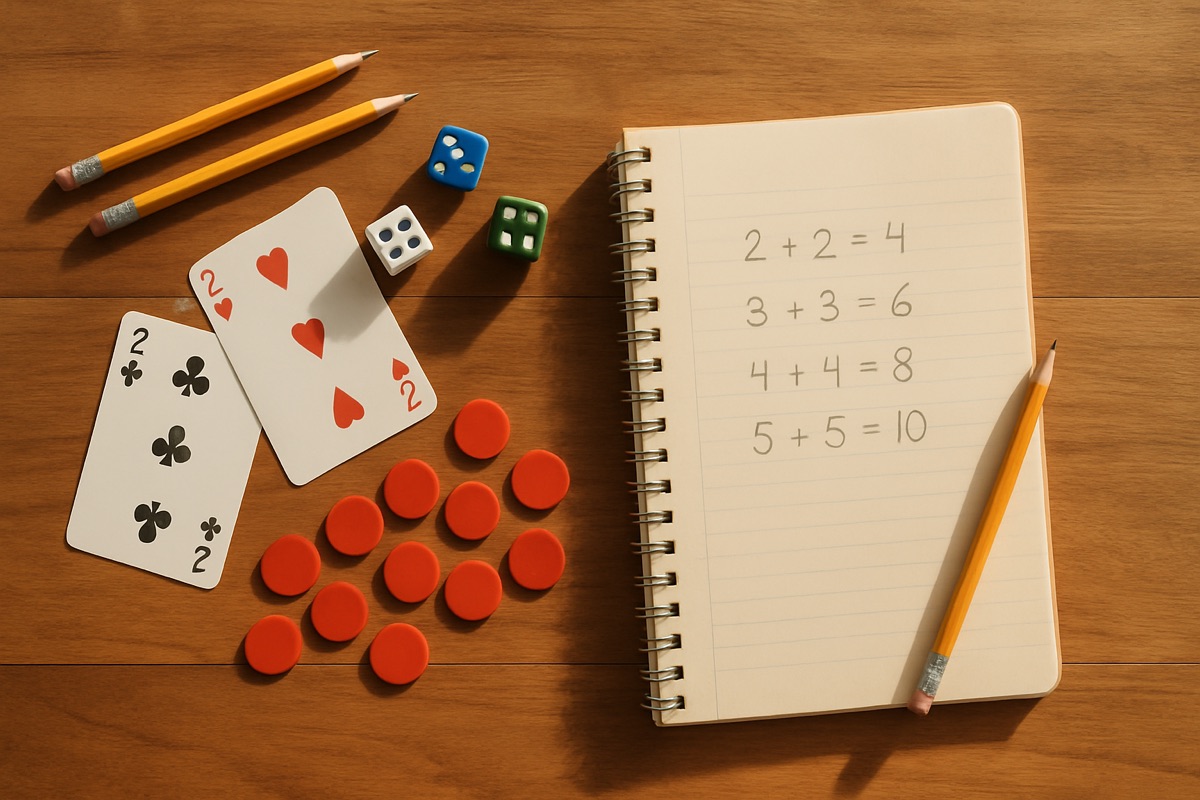
Doubles are the facts where both numbers match: 1 plus 1, 2 plus 2, on up to 9 plus 9. There are only nine of them, and kids latch onto them naturally because doubling shows up everywhere in a kid's world. Two hands with five fingers each. A carton with six eggs on each side. Two dice showing the same number. The pattern is concrete and physical before it's ever an equation.
Because they come easy, doubles are the confidence facts. When a kid is drowning in flash cards, hitting a double is a breath of air. So teach them deliberately and celebrate them. Get all nine to instant recall before you touch anything harder. A kid who knows every double without thinking has a set of anchor points scattered all through the addition table, and every one of those anchors is about to do double duty.
The near-doubles move
Now for the payoff. A near-double is a fact where the two numbers are just one apart: 6 plus 7, 8 plus 9, 4 plus 5. Kids look at those and see brand new facts to memorize. They're not. They're doubles in disguise.
Take 6 plus 7. A kid who knows 6 plus 6 is 12 just needs to notice that 7 is one more than 6. So 6 plus 7 is 12 plus 1, which is 13. That's it. The double they already own hands them the near-double for free, plus one small step.
- 6 plus 7? Think 6 plus 6 is 12, add 1, get 13.
- 8 plus 9? Think 8 plus 8 is 16, add 1, get 17.
- 4 plus 5? Think 4 plus 4 is 8, add 1, get 9.
You can double the higher number instead if the kid prefers. For 6 plus 7, some kids like to think 7 plus 7 is 14, then subtract 1 to get 13. Both work. Let the kid pick whichever feels natural. The point isn't the specific route. It's that they're building the answer out of a fact they already trust instead of memorizing a stranger.
How to actually teach it at the table
This doesn't take fancy materials. I've taught it with a bowl of raisins and a napkin.
Start with the double in front of them, physically. Put out two rows of six raisins. Have them count and confirm, 6 and 6 makes 12. Then slide one more raisin into the second row. Ask what changed. Now it's 6 and 7. How many? A lot of kids reach for it and count from one, and that's the moment to catch them. "You already had 12. You just added one. So what is it?" The lightbulb is the goal, not the counting.
Do that a few times, different numbers, same move. Then take away the raisins and do it out loud. "9 plus 9 is 18, so 9 plus 8 is one less, 17." Say the reasoning every time at first, out loud, until the kid starts saying it back to you. Then let them run it silently. You're wearing a groove into how they approach any two numbers that sit next to each other.
Keep it short. Five focused minutes beats twenty minutes of grind, and grinding is exactly what this strategy is meant to replace. The whole appeal of doubles and near-doubles is that a kid learns nine facts and a move, and gets close to twenty facts out of the deal. That's understanding doing the work, not repetition.
What this unlocks later
The habit you're really teaching here is bigger than addition. You're teaching a kid to reach a hard fact by leaning on an easy one they already know. That's the same move that makes multiplication click later. A kid who solves 6 times 7 by starting from 6 times 6 is doing the exact same thing, just with a different operation. Kids who never learn to lean on known facts end up trying to brute-force everything, and they run out of memory around the time the numbers get big.
So resist the urge to drill all forty addition facts as separate items to memorize. Get the nine doubles rock solid, teach the near-doubles as one small step off a double, and let the kid feel how much of the table falls out of just those two ideas. My own students used to groan at addition flash cards until we did this. After a couple weeks of the raisin trick, one boy told me the near-doubles were "just doubles being lazy." He wasn't wrong, and he never forgot them again.