Addition Facts First: Why Subtraction Gets Easier When You Flip It
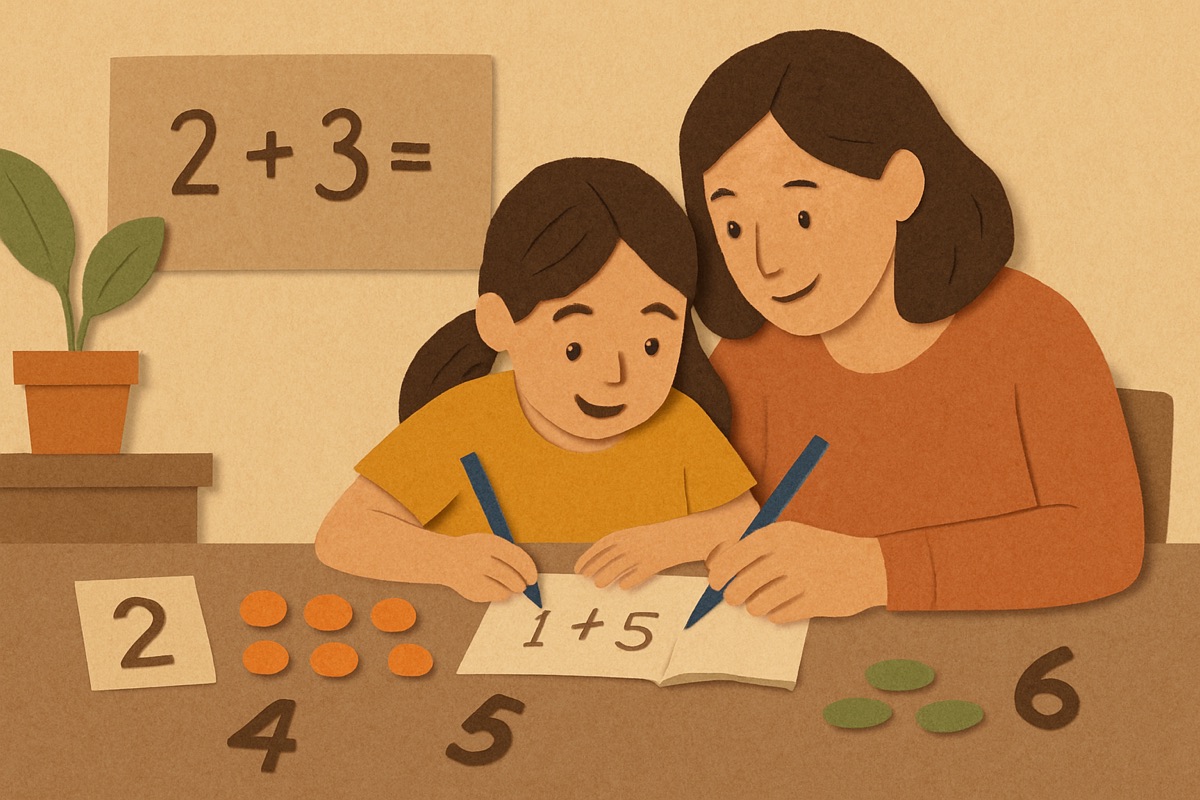
The kid who knew the answer and didn't know it
A second grader named Leo was stuck on 13 minus 8. He counted backward on his fingers, lost track around 10, started over, and landed on 6. Wrong. I asked him a different question. "Leo, 8 plus what makes 13?" He said "5" instantly, no fingers, no pause. Then he looked at the subtraction problem, looked at me, and his whole face changed. He had known the answer the entire time. He just did not know it was the same question.
That moment is the whole point of teaching subtraction facts using addition. When you build addition facts first, you are not teaching one skill. You are secretly teaching two, because subtraction is addition wearing a different hat. Most kids never get told that, so they treat subtraction as a brand new mountain when they are already standing on top of it.
Why counting backward fails
Watch a kid do subtraction the hard way and you will see the trouble. To solve 15 minus 7, they count down: 14, 13, 12, 11, 10, 9, 8. Seven hops backward. It is slow, it is error-prone, and counting backward is genuinely harder for young brains than counting forward. One slip and the answer is off by one, which is exactly what happened to Leo.
Meanwhile that same kid, if they know 7 plus 8 is 15, can answer 15 minus 7 in the time it takes to blink. The information is already in their head. The counting-backward method makes them do a hard chore to dig up a fact they already own. Flipping it turns a slow, shaky process into instant recall.
Fact families are the bridge
The idea that makes this click is the fact family. Three numbers that travel together and make four true equations. Take 6, 7, and 13:
- 6 + 7 = 13
- 7 + 6 = 13
- 13 - 6 = 7
- 13 - 7 = 6
Same three numbers, four ways to say the relationship. When a kid really understands that these are not four facts to memorize but one relationship seen from different angles, subtraction stops being separate. It becomes the addition fact they already know, read from the other direction.
I like to draw a little house with the big number, 13, living up in the roof and the two small numbers, 6 and 7, living in the rooms below. The whole is on top, the parts are underneath. Once a kid pictures it that way, "13 minus 6" just means "I have the whole and one part, what is the other part?" That is a much friendlier question than "count down six."
How to actually teach it
Here is the order that works, and it is worth being patient about because the payoff is huge.
First, get addition facts solid. Not perfect, but genuinely fluent, especially the ones that make 10 and the doubles. If addition is still a finger-counting struggle, subtraction has nothing to stand on. Build the foundation before you build the flip.
Then teach the flip explicitly. Do not assume kids will notice it on their own. Most will not. Say it out loud: "Every subtraction problem is really an addition problem in disguise. It is asking, what do I add to get back to the top?" Show them, over and over, with real numbers.
Then practice the question form. When they hit 12 minus 5, coach them to think "5 plus what makes 12?" instead of counting down. At first you will have to prompt it every single time. That is normal. You are wearing a new groove into how they approach the problem.
- Start with small numbers where they already feel confident, like fact families under 10.
- Use real objects at first. Ten blocks, hide some, ask how many are hidden. That is subtraction as a missing addend, in the hands.
- Say the fact family out loud together. Hearing all four equations back to back cements the link.
- Keep sessions short. Five focused minutes of flipping beats a long grind that just tires them out.
When it clicks, protect it
Once a kid can flip fluently, the temptation is to pile on a hundred subtraction problems to "lock it in." Do not. A kid who understands the relationship does not need a mountain of repetition. They need a little practice, spread out over days, so the recall stays quick.
What actually erodes the skill is drilling it as a disconnected fact to be memorized. If a kid ever slips back into "13 minus 6 is just its own thing I have to remember," gently pull them back to the family. "What plus 6 makes 13?" Keep the relationship alive and the fact takes care of itself. The goal was never to memorize four hundred separate subtraction facts. It was to understand that they were never separate to begin with.
The bigger reason this matters
This is not a trick for passing a fluency quiz. It is how math is supposed to feel. When Leo learned to flip, he did not just get faster at subtraction. He learned that math pieces connect, that a thing you already know can quietly hand you a thing you thought you did not. That is the mindset that carries a kid all the way to fractions and algebra, where everything is built out of relationships you already have.
So put addition facts first, teach the flip out loud, and let subtraction be the easy part it was always meant to be. Leo's mom told me he came home one day and announced that subtraction was "just addition backward." She said it like it was cute. It was actually the whole thing.