A Simple After-School Homework Routine That Sticks
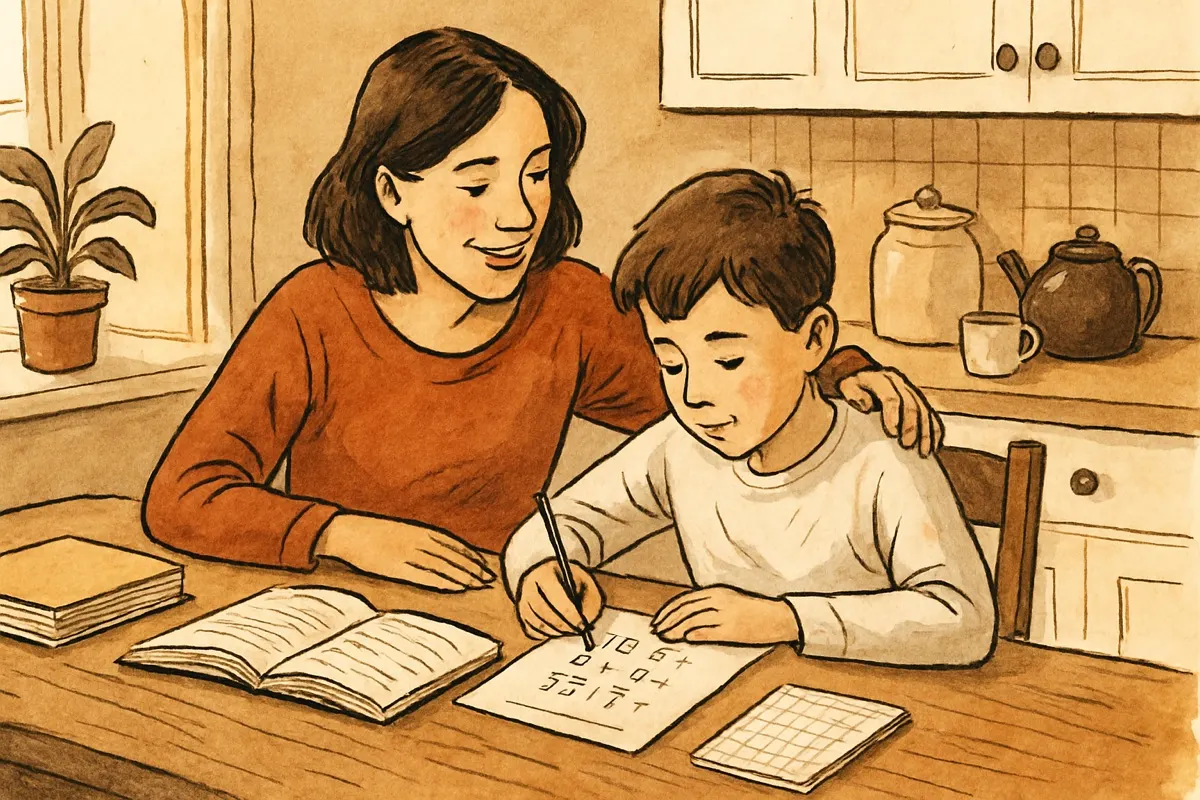
The kids who did homework calmly in my class weren't smarter than the ones who fought it every night. They had a groove. Same time, same spot, same rough order of events, so that starting didn't require a decision or a negotiation. The fighting almost always came from families where homework happened at a different time and place every day, so every single afternoon started with the question "when are you going to do it?" and every single afternoon that question turned into a standoff. A good after-school homework routine mostly exists to kill that question before it's asked.
I've watched a lot of these routines get built and a lot of them collapse. The ones that stick are embarrassingly simple. The ones that fall apart are the ambitious color-coded ones that assume every day goes to plan. Here's what actually holds up.
Decompress first, then start
A kid who's been holding it together at school for seven hours cannot walk in the door and do fractions. Their tank is empty. If you make them start cold, you're paying for it with a meltdown.
Build in a real break. Twenty to thirty minutes of snack and downtime, ideally something with a body in it, going outside, shooting a basket, just lying on the floor. Not a screen, if you can help it, because screens don't refill the tank the way they promise to, and prying the tablet away to start homework becomes its own fight. A snack matters more than parents think. A hungry kid is a bad-at-math kid. Peanut butter toast has salvaged more homework sessions than any pep talk I know.
Then a set start time. Not "after you relax," which is infinitely stretchy, but an actual time. "Homework starts at 4:00." When it's a time and not a mood, it stops being up for debate.
Pick one spot and keep it there
Where homework happens should be the same place every day, and it should be boring on purpose.
The kitchen table beats a bedroom for most elementary kids, because a bedroom has a bed and a bin of toys and a door, and a kitchen has you nearby doing dishes. Kids this age do better with a grown-up in earshot, not hovering over the paper, just there. Clear the spot of everything that isn't homework. The tablet goes in another room. The toy gets put up. You'd be amazed how much smoother it goes when the only interesting thing on the table is the worksheet, because a bored kid will actually do the boring thing if there's nothing better within reach.
Keep the supplies right there so nobody burns ten minutes hunting for a sharp pencil. A little box, a caddy, a shoebox, whatever, stocked with pencils, an eraser, and whatever else keeps walking off. The hunt for supplies is where a lot of routines quietly die.
A loose order that lowers the dread
Kids do better when they know the shape of what's coming. You don't need a rigid checklist, just a rough sequence.
- Start with something quick and doable. Not the hardest thing. A short, winnable task gets them moving, and starting is the hardest part of the whole evening. Save the tough subject for second, once the engine's warm.
- Do the hard thing in the middle. That's when they've got the most left in the tank.
- End with something light. Reading, or a task they like, so the session ends on a good note instead of in tears. What a kid feels at the end is what they'll remember tomorrow when it's time to start again.
That last point does a lot of quiet work. If homework always ends badly, the dread builds night over night. If it usually ends okay, starting gets a little easier each time.
Have a rule for when to stop
This is the piece most families skip, and it's the one that saves the routine.
Homework should not eat the whole evening. A rough guide many teachers use is about ten minutes per grade level, so twenty minutes in second grade, forty in fourth. If your kid blows way past that, night after night, something's wrong, and the answer is not to grind harder. Grinding a frustrated kid through another hour teaches them that math is a punishment and that trying doesn't end the pain. That's the opposite of what you want.
Set a stopping point. When a problem has turned into a wall and you've genuinely tried, it's fine to write a short honest note to the teacher: "we worked on this for 25 minutes and got stuck here." Any decent teacher would rather see that note than a tear-stained page finished at 9pm. It tells them exactly where the gap is, which is useful information, not a failure.
And on the days the routine falls apart anyway, because it will, don't scrap the whole system. A routine that sticks isn't one that never breaks. It's one you go back to the next day without a lecture. Missing a day isn't the problem. Deciding the routine is broken because you missed a day is the problem.
Start smaller than you think you should. Pick the time and the spot, get those two rock solid for a week, and add the rest once they're automatic. A plain routine you actually keep beats a perfect one you abandon by Wednesday. That's the whole secret, and it's less exciting than it sounds, which is exactly why it works.