When Homework Takes Two Hours: Shrinking the Nightly Math Battle
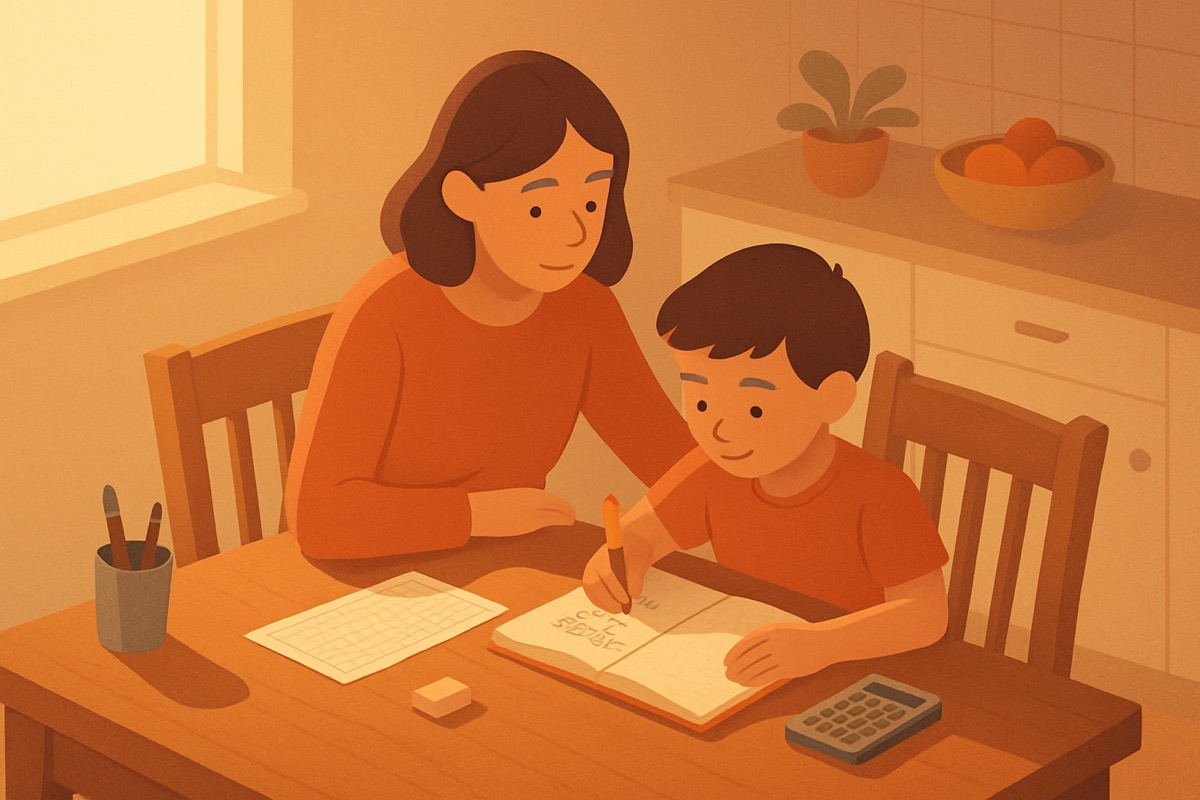
A mom emailed me once, near tears, because her third grader's twenty-minute math worksheet had turned into a two-hour ordeal that ended with both of them yelling. She wanted to know if her daughter had a learning problem. The girl did not. She had a homework problem, which is a different thing, and it is far more common and far more fixable.
If math homework takes too long in your house, you are not looking at proof that your kid is bad at math. You are usually looking at a mix of a few ordinary things stacked on top of each other. Let me walk through what those things are, because once you name them, most of them come apart pretty easily.
Why twenty minutes becomes two hours
The assignment almost never takes two hours of actual math. What eats the clock is everything around the math.
Start with the timing. A kid who gets home at 4:00 and sits down at 4:15 is a different creature than the one who starts at 7:30 after dinner, a meltdown about the tablet, and a bath. Tired brains do everything slower, and math is the first thing to fall apart when a kid is fried.
Then there is the wandering. I have watched plenty of capable students spend forty-five minutes on ten problems, not because the problems were hard, but because they got up for water, found a pencil they liked better, told me about a dog they saw, and generally did anything except the next problem. That is not defiance. Young kids genuinely cannot hold focus on something dull for very long, and a worksheet of drills is dull.
And sometimes, yes, part of it is a real gap. If your child never solidly learned that eight plus five is thirteen, then every single problem that contains it becomes a slow count on fingers. Ten problems that each hide a shaky fact turn a quick page into a slog. That piece is worth taking seriously, but it is usually only one piece.
Shrink the session before you shrink the math
Before you touch the actual assignment, change the conditions around it. This alone fixes a lot of two-hour nights.
- Pick a real start time and protect it. For most kids, sooner after school is better, with a snack first. Same spot, same time, every day. The routine does more work than any pep talk.
- Clear the table. No tablet, no toys, no sibling doing something more interesting three feet away. One pencil, one page, one glass of water already poured.
- Set a visible timer for a short block. Ten or twelve minutes of real work, then a two-minute stretch. Kids will grind for a chunk they can see the end of. They fall apart when the finish line is invisible.
- You are nearby, not on top of them. Fold laundry at the same table. Available for a stuck moment, not hovering over every problem waiting to pounce on a mistake.
None of that changes the math. It changes whether the math gets done in one sitting or spread across a miserable evening.
The rule I give every parent: stop at a set time
Here is the thing that surprised the crying mom the most. I told her she was allowed to stop.
Pick a reasonable amount of time for the grade. For a third grader, twenty to thirty minutes of honest effort on math is plenty. When that timer goes off, you stop, even if the page is not done. You write a short note to the teacher: "We worked hard for twenty-five minutes and got through six problems." Any teacher worth their salt would rather see that than a completed page finished at 9:30 by a sobbing kid and a parent who did half of it.
Homework that runs long past a reasonable stopping point is not teaching your child math. It is teaching them that math is the thing that ruins the evening. That lesson sticks harder than any fact ever will.
When it is a gap, fix the gap, not the worksheet
If you notice your child counting on fingers for the same kind of problem over and over, that is your signal. Grinding through more of the same worksheets will not close that gap, because the worksheet is testing the fact, not teaching it.
Set the homework aside for a moment and work the underlying skill in a low-stakes way. If she freezes on seven plus six, get out a handful of dried beans and build it. Seven beans, six beans, push them together, count. Do it a few nights in a row, plus the near-neighbors like seven plus seven and seven plus five. Real understanding grows from that kind of small, concrete practice, not from doing the same fill-in-the-blank sheet faster.
That is also the difference between practice that helps and busywork that just fills time. You want the repetition tied to something your kid is actually starting to understand, so each rep builds on the last one instead of drilling a hole in a fact that was never there.
What a calmer night actually looks like
The mom wrote back a couple of weeks later. Snack at 3:45, table cleared, timer set for twenty-five minutes, her sitting nearby with her own book. Some nights the page got finished. Some nights it did not, and she sent the note. The yelling stopped almost entirely.
Her daughter's math did not magically transform overnight. But the fight around it did, and that mattered more than she expected. A kid who is not braced for a two-hour battle every evening has room left over to actually learn something. Give the night a real edge, keep the effort honest, and let the timer, not the tears, decide when you are done.