When a Deck of Cards Beats Any Math App You Can Buy
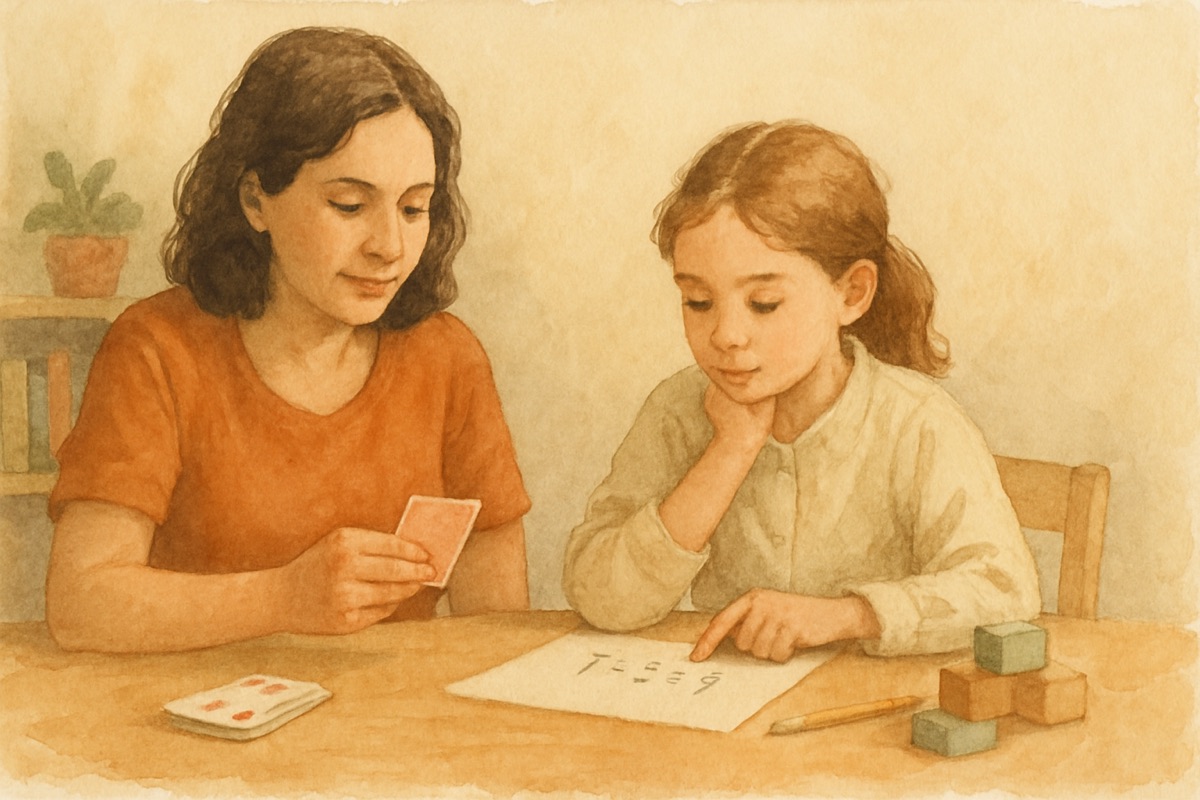
I write software for a living, and I built a math app for my own kids. So it feels a little strange to admit that some of the best math practice in my house happens with a beat-up deck of cards from a hotel gift shop. My daughter and I played War with it last Tuesday for twenty minutes, and she added seven and eight faster by the end than she had all week on a screen.
That is the honest version of the math card games vs app question. An app is not automatically better because it lights up and keeps score. Sometimes the cards win, and it helps to know why.
What a deck of cards actually does well
A standard deck is a random number generator with a physical body. Every card is a number between one and ten (drop the face cards, or make them all count as ten). You can shuffle it into thousands of combinations, and none of them cost anything or need a battery.
Here is the part that matters for how kids learn. When your child flips two cards and has to say the sum out loud, to a real person who is waiting, the pressure is social and gentle at the same time. There is no timer bar draining red. There is no cartoon groaning when they miss. Just you, saying "take your time," which is a thing no app has ever said convincingly.
Cards also make the math visible. Six of hearts is six actual heart shapes on the card. A kid who is shaky on what "six" means can count the pips. That physical anchor is something a glowing "6" on a tablet does not give you.
Five games worth playing tonight
You do not need instructions printed on glossy cardboard. These take one minute to learn.
- War, but you add. Each player flips two cards. Whoever calls the correct sum first takes all four cards. Great for addition facts. Switch to multiplication for older kids and it turns brutal in the best way.
- Make Ten. Deal ten cards face up. Kids grab any two (or three) that add to ten. Whoever clears the most pairs wins. This builds the ten-friends that make mental math click later.
- Twenty-One-ish. Flip cards and keep a running total in your head, trying to land near twenty-one without going over. It is blackjack with the gambling filed off, and it is sneaky addition practice.
- Salute. Three players. Two hold a card to their forehead without looking. The third calls out the product. Each player has to figure out their own card from the answer and the one they can see. This one teaches division and inverse thinking without saying either word.
- Close Call. Deal four cards, arrange them into two two-digit numbers, and try to make the difference as small as possible. Real place-value reasoning hides in this.
Pick one. Play it three nights in a row. That is more repetition than most kids get in a full app session, and they asked to do it.
When the app is the right tool instead
I am not going to pretend the cards win every time, because that would make me a liar and a bad engineer. There are real situations where a screen does the job better.
If nobody in the house has fifteen free minutes to sit and play, a card game just does not happen. An app your kid can open alone, in the back seat, while you drive to soccer, will get more actual reps than the deck sitting untouched in a drawer. Reps you actually do beat perfect reps you skip.
Software is also better at one specific thing: it can watch which facts your kid keeps missing and quietly serve those up more often. A deck of cards is random. It does not know that your son nails eight plus four but freezes on seven plus six every single time. A decent app tracks that and adjusts. That is genuinely useful, and it is the one feature I think is worth paying for.
And honestly, some kids are motivated by the collecting and the goals a game layers on top. If earning something for real progress gets a reluctant kid to practice at all, that is a fair trade. The trap is when the rewards get handed out for mindless repetition instead of actual understanding. I built Math Prizes to tie rewards to real progress, not to how many times a kid can tap a button, and I still hand my daughter the cards half the time.
The thing neither one can fake
The reason the deck works is not the cards. It is that a person is sitting there. When my daughter got seven plus eight wrong, I did not correct her. I put down two piles, seven cards and eight cards, and slid them together. She counted. She got fifteen. She got it herself, and the next time it came up she did not have to count.
No app watched that happen. No app said "nice, do the next one." I did. That two-way thing, where a real adult notices the exact moment a kid is stuck and does one small thing to help, is still the most powerful tool in the house. The cards are just an excuse to sit down together.
So buy the app if it gets your kid practicing on the days you cannot sit down. Use it. But do not throw out the deck of cards, because on the nights you can sit down, that stack of paper rectangles will out-teach anything I could ever ship.