Times Tables at Home: A Steady Plan, Not a Panic
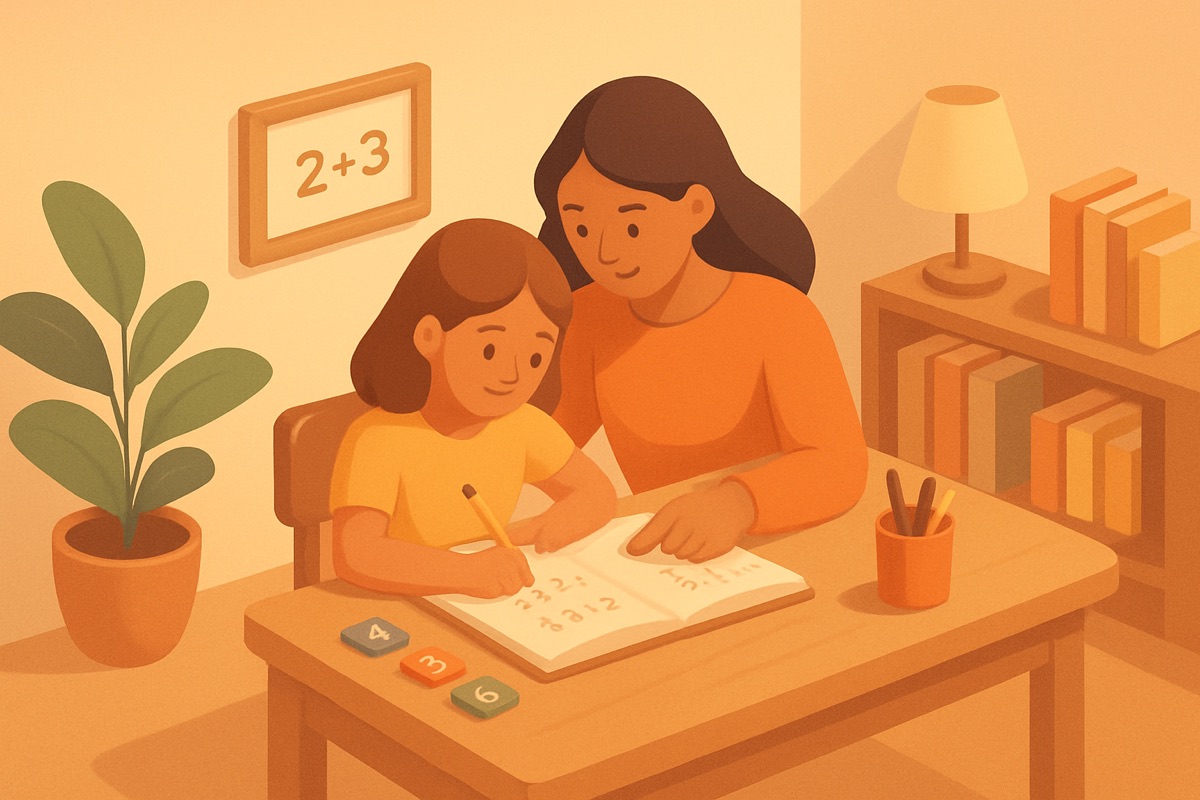
A note comes home in October: your third grader isn't fluent with their multiplication facts, please practice at home. So you buy flashcards, run a hundred of them the first night, both of you end up frustrated, and by Thursday the cards are in a drawer. I've seen the aftermath of that exact panic show up in my classroom for years. The kid isn't behind because the facts are hard. They're behind because the way most families try to practice times tables at home is a sprint, and this is a distance event.
Here's the reframe that fixes most of it. You don't need a big push. You need a small, boring, repeatable routine that runs for a few weeks. Ten minutes, most days, in a sensible order. That's how facts actually stick, and it's a lot calmer than the flashcard bonfire.
Understanding comes before memorizing
Before you drill a single fact, make sure your kid knows what multiplication is. Not the definition. The picture. Four times three is four groups of three, or three rows of four cookies on a tray. A kid who's memorizing noises with no meaning underneath will forget them the second the pressure's off, and they'll have no way to rebuild a fact they blank on.
I test this with one question: "If you forget what seven times four is, can you figure it out?" A kid who understands says something like "I know seven times two is fourteen, so double it, twenty-eight." A kid who's only memorized just shrugs. You want the first kid. So spend the first few days with a tray of actual objects, small crackers or coins, building groups, before you go anywhere near speed. Understanding first isn't a delay. It's the thing that makes the memorizing hold.
The order that actually works
Don't practice the tables in order from one to twelve. That front-loads the easy ones and saves nothing but dread for the end. Teach them in order of leverage, easiest and most useful first, so your kid feels the pile of unknowns shrinking fast.
- 1s, 2s, 5s, 10s first. These have obvious patterns and most kids half-know them already. Knock them out and you've covered a huge chunk of the whole table in a few days.
- 0s. One quick conversation. Anything times zero is zero, always, done.
- The doubles (3s, 4s). Build on the 2s. Three times six is six doubled plus one more six. Four times anything is the 2s doubled.
- 9s. They have a tidy trick, and kids love a trick. The digits of every answer add to nine, and the tens digit is one less than the number you multiplied.
- The stubborn middle (6s, 7s, 8s). This is the real work, but by now it's a small list, because a lot of these facts already got covered by the earlier groups.
By the time you reach the hard part, your kid isn't facing a wall of a hundred and forty-four facts. They're facing maybe fifteen genuinely tricky ones, and that's a fight you can win.
Ten minutes, not an hour
The routine is the whole thing. Keep it short enough that your kid never dreads it. Ten minutes after dinner, four or five days a week, is plenty. A short session your kid will actually do beats a long one that ends in tears and gets abandoned by the weekend.
Mix how you practice so it doesn't turn into pure drudgery. Some nights, flashcards, but only the group you're working on plus a few review ones, not the whole deck. Some nights, call out facts while you're driving. Some nights, a quick game. My own kid learned her 8s by us taking turns skip-counting up a staircase, one step per number, which sounds silly and worked. A calculator-timer app can help too if it's built to add facts gradually instead of firing the whole table at once. That's the difference that matters: gradual, mastered groups, not a random blast of everything.
And keep it low-stakes. If a fact isn't there yet, that's just information about tomorrow's list, not a failure. The moment practice starts feeling like a test, kids tense up, and a tense kid remembers less. You want it closer to catch in the backyard than a quiz.
Speed comes last, and gently
Somewhere along the way you'll be tempted to add a timer and chase speed, because the school probably gives a timed test. Resist it until the facts are solid. Speed is the last layer, not the first. A kid who's rushed before the facts are reliable just gets faster at guessing wrong, and worse, learns to feel a spike of panic every time numbers show up with a clock running.
Once a group is genuinely known, then a little speed practice is fine and even fun for some kids. Beat your own time from last week, not somebody else's time. The competition is with the kid they were on Monday. That keeps the whole thing about their own progress instead of a race they might lose.
What the finish line looks like
Give it three or four weeks of steady, short sessions and something quiet happens. Your kid stops counting on their fingers for the facts you've covered. The answer just arrives. Not because they were drilled into exhaustion, but because they built understanding first, worked in a sensible order, and showed up for ten minutes most days.
That's the whole method. No panic, no flashcard marathons, no tears at the kitchen table. Just a small routine that respects how memory actually works and trusts a few weeks to do their job. The note from school said practice at home. This is what practicing at home is supposed to feel like, and it's a lot gentler than that first frantic night with a hundred cards.