Practicing Math Facts: Why Fluency Frees Your Kid's Brain
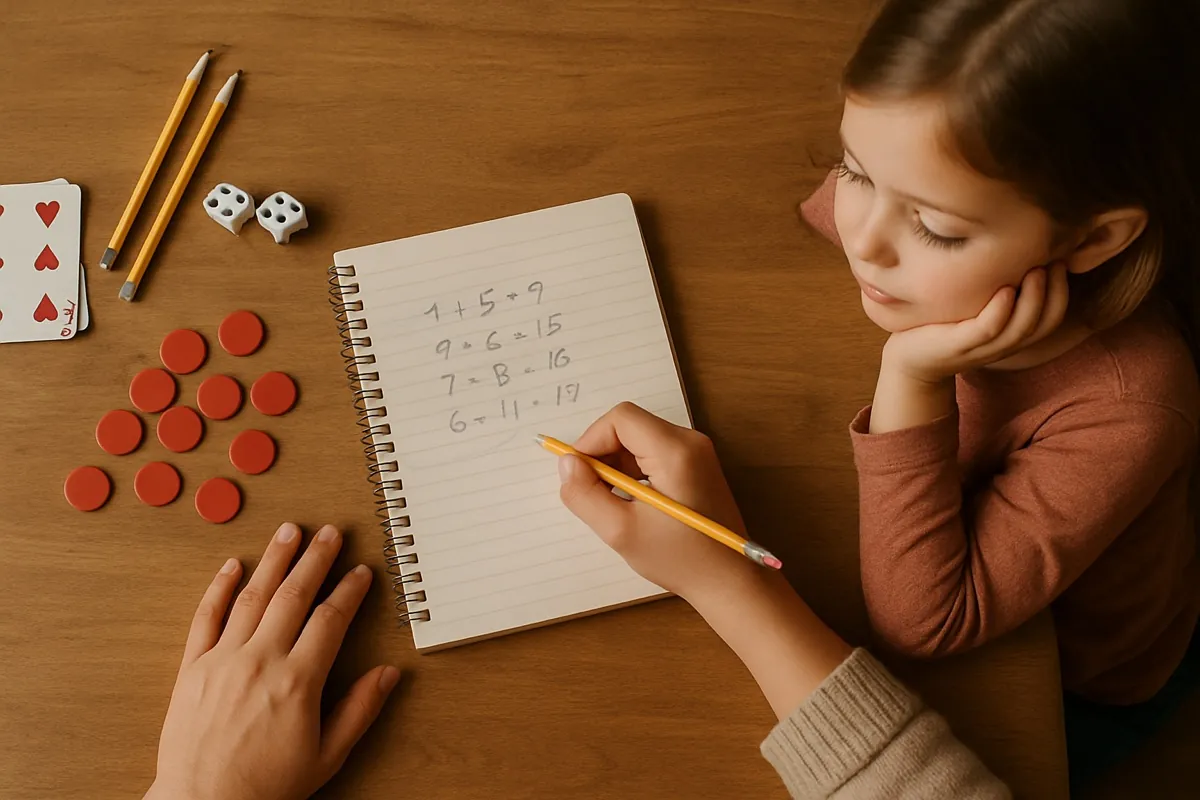
I once watched a fourth grader spend so long counting up to figure out 6 times 7 that by the time he had 42, he had completely forgotten what the word problem was even asking. He wasn't bad at math. He just didn't have the fact memorized, so every step of a longer problem cost him a small fortune in attention. That's the case for math fact fluency practice in one sentence: when the little answers come free, the brain has room left over for the actual thinking.
Fluency gets a bad reputation because people confuse it with drill. They picture flashcards flying and a kid in tears. But fluency isn't about speed for its own sake, and it definitely isn't about pressure. It's about a kid being able to reach for 7 plus 8 and have it just be there, the way you don't sound out the word "the" anymore. Let me walk through what that really means and how to get there without wrecking the dinner hour.
What fluency actually is
Fluency is quick, accurate recall of basic facts without having to stop and compute them. Addition and subtraction facts up to 20. Multiplication and division facts up to 12 by 12. That's the set most of school math leans on.
There's a real difference between recall and counting, and it matters more than parents think:
- A kid who recalls 8 plus 5 says 13 almost instantly.
- A kid who counts 8 plus 5 starts at 8 and taps out five more, or uses fingers, or stares at the ceiling.
Both land on 13. But the second kid used up working memory to get there, and working memory is the thing you need for the harder parts of a problem. Counting strategies are wonderful when a kid is first making sense of what addition even is. They're supposed to fade, though. When a nine year old is still counting up for every single fact, longer problems become exhausting, and exhausting things get avoided.
Why the freed-up brain matters so much
Here's the part that convinced me, back when I first started teaching. Working memory is small. Most people can hold only a handful of things in mind at once. When a kid has to compute every basic fact from scratch, those slots fill up fast, and there's nothing left for the multi-step reasoning the problem is actually testing.
Think about long division, or a two-step word problem, or reducing a fraction. Each one has a bunch of small facts buried inside it. If the small facts are automatic, the kid spends their attention on the structure: what's being asked, which operation fits, does this answer even make sense. If the small facts are not automatic, the kid burns out halfway through and the answer that comes out is often just wrong, not because they didn't understand division but because they lost the thread while counting.
I've seen kids labeled "bad at word problems" who were really just spending all their fuel on arithmetic they should have had memorized two years earlier. Fix the facts and the word problems often fix themselves.
How to build the facts without a fight
The goal is short, frequent, and low-stakes. Nobody builds fluency in a single marathon session, and a stressed kid memorizes almost nothing. Here's what tends to work at home:
- Keep it to five or ten minutes. Fluency lives on repetition over time, not on one long grind. A short round most days beats an hour on Sunday.
- Work on a small set at once. Don't drill all the multiplication facts. Pick the fours this week. Get those solid, then add the next set. A kid who "knows their facts" really knows a lot of small overlapping groups.
- Anchor new facts to ones they already own. If they know 5 times 6, then 6 times 6 is just one more group of six. If they know doubles like 7 plus 7, then 7 plus 8 is that plus one. Teaching the relationship builds recall faster than raw memorization.
- Say the whole fact out loud, answer included. "Six times seven is forty-two." Hearing and speaking the complete fact helps it stick better than just seeing a number appear.
- Mix review in. Toss in a few facts they already know cold. It keeps confidence up and keeps old facts from slipping.
One concrete example from a family I worked with: they kept a small stack of index cards on the kitchen counter, ten facts their son was shaky on. While the pasta water heated up, they ran through them once. Two minutes, most nights. In about six weeks the whole stack had moved to the "knows it" pile. No tears, no worksheets, no big production.
What to skip
Skip the timed tests that make your kid feel like a failure. A little bit of "beat your own time" can be fun for a kid who's already confident, but for an anxious kid, the clock just triggers the freeze, and a frozen brain retrieves nothing. Speed is a side effect of fluency, not the way you get there.
Skip the idea that more practice is automatically better. Once a fact is solid, drilling it forty more times does nothing except make math feel like punishment. Move on. The point is real recall, not piling up repetitions to look busy. If an app or a workbook rewards a kid for grinding the same easy facts over and over, it's optimizing for the wrong thing. Rewards should track new ground covered, not laps around facts they already own. (This is the one place a good tool helps: something like Math Prizes tying its rewards to actual progress rather than sheer volume keeps kids pushing forward instead of farming the easy stuff.)
Skip guilt if your kid isn't there yet. Fluency comes at wildly different times for different kids, and a late bloomer on facts can still be a strong mathematical thinker. The facts are worth building because they make everything downstream easier, not because a kid who's slow on them is behind as a person.
The honest payoff
When the facts finally click, you can usually see it. The kid stops dreading the worksheet. They finish problems they used to abandon. Homework that took forty-five minutes takes twenty, because half of that old time was spent recomputing 8 times 9 for the fifth time in one page.
That's the whole reason to bother with math fact fluency practice. Not to make a kid fast for its own sake. To hand back the mental room they need to actually enjoy figuring things out. Keep the sessions short, keep them kind, and let the facts settle in at their own pace. The freed-up brain does the rest.