The Trap of Doing the Homework for Them (and How to Catch Yourself)
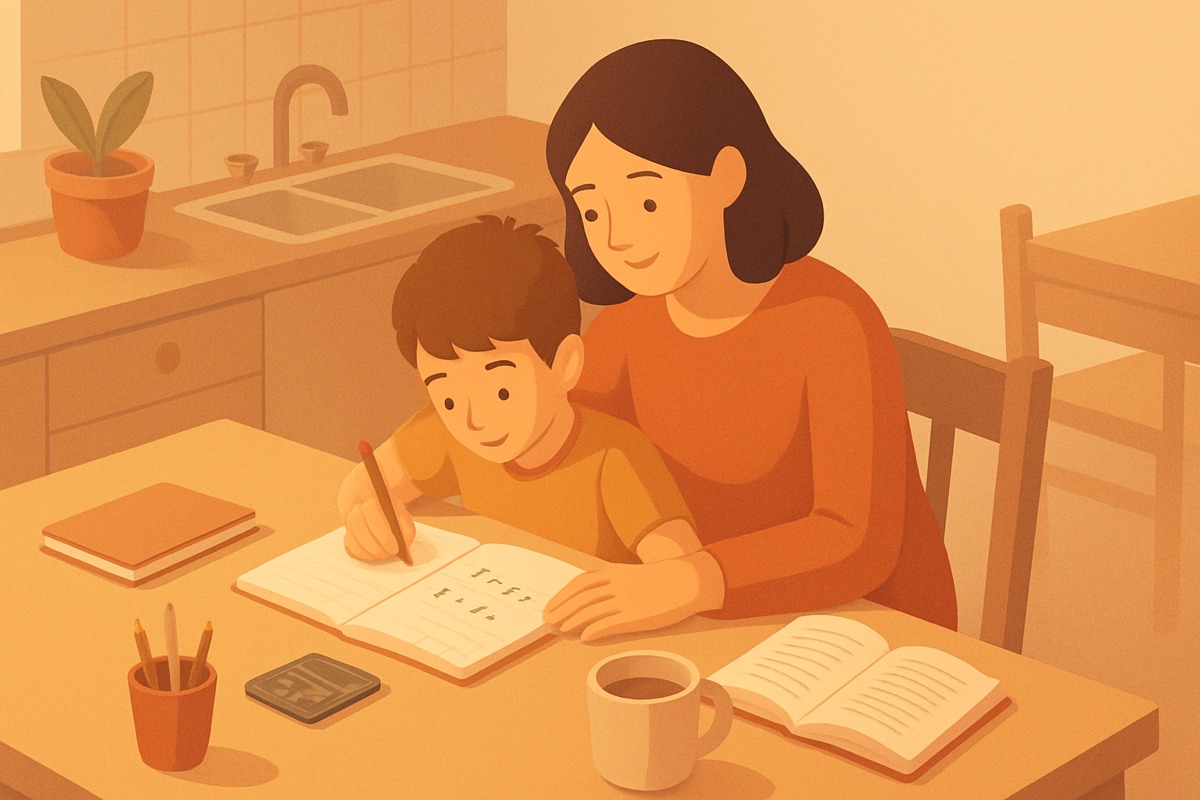
It's 8:40 on a school night. Your kid has been staring at problem four for ten minutes, it's almost bedtime, and you can see the answer plainly. So you say, "Okay, so 24 divided by 4 is what?" and they mumble "six," and you say "right, so write six," and you both move on. Nobody decided you'd do the homework. It just happened one nudge at a time.
That's the shape of it. Doing homework for your child almost never starts as a decision. It starts as help, and then the help creeps. You give a hint, then a bigger hint, then you're basically reading them the steps and they're transcribing. I did it as a teacher before I learned better, and I've watched hundreds of parents do it at the kitchen table. The intentions are always good. The result is a worksheet that says the kid understands something they don't.
Why it feels like helping when it isn't
The trap is comfortable because in the moment everyone feels better. The kid stops being frustrated. You stop watching them struggle, which is genuinely hard to sit through. The page gets finished and turned in.
But homework isn't there to produce a finished page. It's there to give the teacher information and to give the kid reps. When you supply the answers, both of those quietly break. The teacher sees a perfect sheet and assumes the concept landed, so she moves on. The kid never wrestled with the hard part, so nothing stuck. Then the quiz comes, the support isn't there, and the grade drops out of nowhere. Parents come to me confused, saying "but he does all his homework and gets it right." Often that's the exact problem. The homework was done together, and "together" had drifted into "by you."
There's a subtler cost too. A kid who's rescued every time they get stuck learns that getting stuck is an emergency, a signal to wait for an adult to swoop in. That's the opposite of what you want. Being stuck is the normal middle of learning, not a crisis.
How to catch yourself in the act
You don't need to overhaul anything. You mostly need to notice when the pencil is drifting toward your hand. A few tells that you've crossed the line:
- You're talking more than they are.
- You're pointing at the exact spot on the page where the answer goes.
- You're doing the arithmetic in your head and then feeding it to them one number at a time.
- You'd be able to finish the assignment faster alone, and part of you wants to.
When you catch one of those, stop and put the work back on their side of the table. Literally slide the paper back if you have to. The goal is that their pencil is moving and yours isn't.
Ask instead of tell
The single most useful switch is turning your statements into questions, and then actually waiting. Silence feels long when a kid is thinking. Let it be long.
Instead of "24 divided by 4 is 6," try:
- "What's the question actually asking you to find?"
- "What have you got so far?"
- "Where did it stop making sense?"
- "What could you try first?"
The trick is that these don't hand over the answer. They hand back the thinking. And you have to be okay with a wrong answer surviving to the page sometimes. If your kid works a problem, gets it wrong on their own, and turns it in, that's more honest and more useful than a right answer you supplied. The teacher needs to see the real mistake. That's how she knows what to reteach.
I tell parents to picture the difference between a coach and a player. A coach can explain, demonstrate, ask questions, point out patterns. A coach does not run onto the field and take the shot. The moment you take the shot, you've stopped coaching.
When they're truly stuck
Sometimes a kid isn't just resisting. They genuinely don't have the tool the problem needs, and no amount of "what could you try" will summon a skill that was never taught. That's real, and it's worth learning to tell apart from ordinary struggle.
If your kid has tried a couple of honest approaches and is still lost, the answer still isn't to solve it for them. Do one problem together as a model, out loud, showing your thinking, then hand them a similar one to do alone. And write a quick note on the page: "We got stuck on multi-step problems tonight, needed a lot of help." That note is gold to a teacher. It tells her exactly where the class or your kid needs another pass, which is the whole point of homework going home in the first place.
There's a difference between rescuing and teaching. Rescuing removes the struggle. Teaching gives the kid a way through it and then steps back. One produces a clean worksheet. The other produces a kid who can do it tomorrow.
The bedtime problem is real
None of this means you should let homework spiral until midnight to avoid touching it. If it's genuinely too late and your kid is fried, it's fine to stop. Write the note, put it away, and email the teacher if it's a pattern. A tired kid isn't learning anyway, and an unfinished assignment with an honest note beats a finished one full of your answers.
The next time you're at the table and you feel yourself reaching for the pencil, pause for one second and ask who's doing the thinking. If it's you, hand it back. It'll be slower tonight. It'll be a lot faster in a month, when the quiz comes and your kid can actually do it without you sitting beside them.