The Problem With Speed: Why Timed Math Tests Demotivate Some Kids
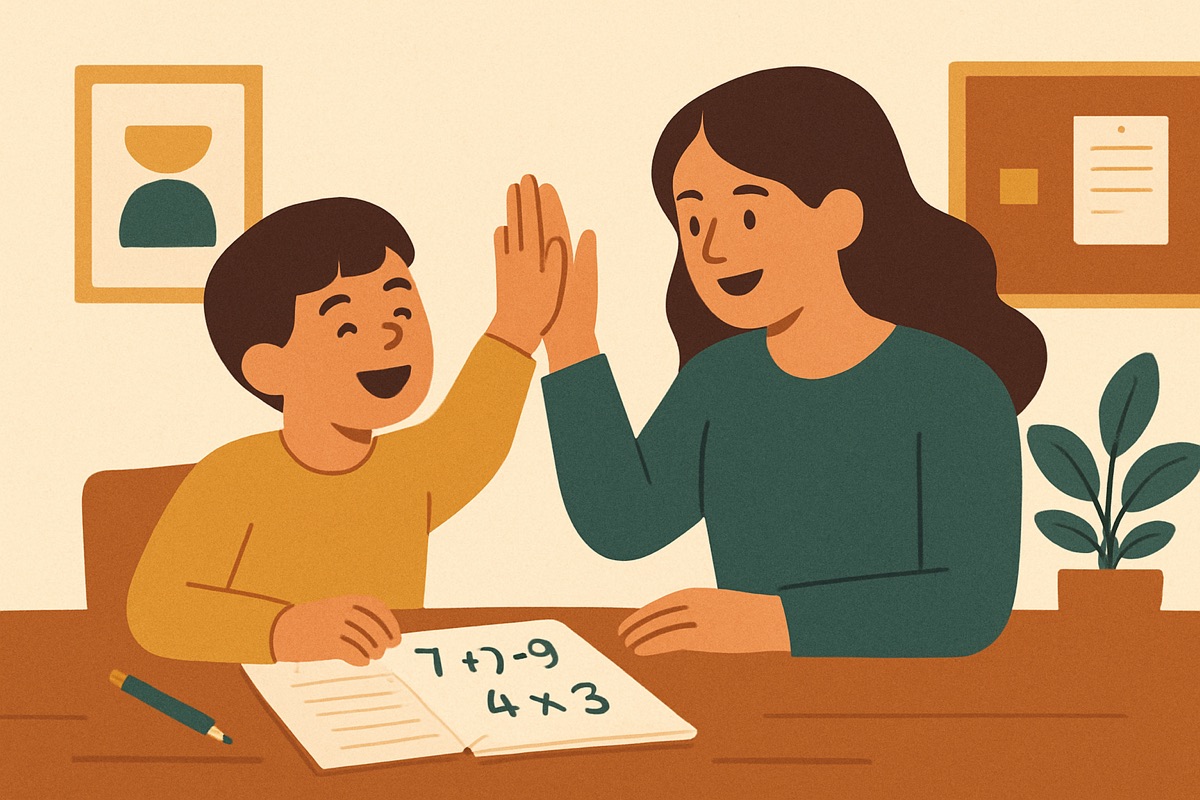
Every Friday for years I gave a two-minute timed test. Fifty addition facts, a stopwatch, the whole room silent except for pencils. And every Friday I watched the same girl, a kid who could explain to me exactly how she'd figure out 8 plus 6, put her pencil down halfway through and stop trying. She understood the math. The clock is what beat her. That's the part people miss when they wonder why timed math tests demotivate some kids while barely bothering others.
I'm not against fluency. A kid who has to count on their fingers for 4 plus 3 in fifth grade is going to struggle, and drilling facts has a real place. But speed and understanding are not the same thing, and when we measure one while pretending we're measuring the other, we lose kids who were doing fine.
What a timed test actually measures
A timed test measures recall speed under pressure. That's it. It does not measure whether a child understands why 7 times 8 is 56, whether they can use that fact in a word problem, or whether they'll remember it next month. It rewards the kids who happen to have fast recall and punishes the kids who are careful, or anxious, or simply wired to think a beat slower.
I've had brilliant students who were slow. One boy would stare at a problem, and you could almost see the gears turning, and then he'd give you an answer with a full explanation of three ways to get there. On a Mad Minute he scored in the bottom third of the class. Anyone reading only that number would have gotten him completely wrong.
Here is what the clock does to a kid like that:
- It swaps math thinking for panic. The working memory that should be solving the problem gets spent on watching the timer.
- It teaches them that being careful is a liability, which is the opposite of what good math requires.
- It attaches a bad feeling to a subject they were neutral about, and that feeling sticks.
The anxiety is not a character flaw
Parents sometimes tell me their kid "just needs to toughen up" about timed tests. I understand the instinct, but that's not how math anxiety works. When a child feels threatened, and a ticking clock in front of the whole class absolutely reads as a threat, the body floods with stress hormones that shut down the exact part of the brain doing the arithmetic.
You can watch it happen. A kid who counted out change perfectly at the store on Saturday sits down to a timed sheet on Monday and can't remember what 6 plus 5 is. Same brain, same facts, one has a clock on it. The math didn't leave. The access to it did.
The kids most affected are often the ones who care most about getting it right. Fast-and-sloppy kids don't mind the timer because they were never going to check their work anyway. The careful kid, the one who wants each answer to be correct, is the one who freezes. We end up demotivating our most conscientious students.
What to do instead at home
You can't always control the tests at school, but you can control the message at home, and that message matters more than any single Friday quiz. The goal is fluency without the fear.
- Separate "know it" from "know it fast." Practice facts calmly first, no clock. Once your kid genuinely knows them, speed comes on its own with repetition. It does not need to be forced.
- Race the kid, not the clock. If your child likes a challenge, play a game where you're both answering, like flipping cards and calling the sum. Beating a person feels like a game. Beating a stopwatch feels like a test.
- Ask "how did you get that," not "how fast." When you value the thinking out loud, you tell your kid the reasoning is the point. That builds the exact confidence a timer erodes.
- Watch your own face. Kids read us. If you tense up when they pause, they learn that pausing is bad. A slow correct answer deserves the same warmth as a fast one.
Building real fluency the slow way
Fluency actually does come, and it comes faster when the pressure is off. A fact your kid figures out ten times, calmly, becomes a fact they just know. That's how memory works. Repetition plus low stress, not repetition plus a stopwatch.
I tell parents to aim for a little practice most days rather than a big anxious push. Five minutes of cards at the kitchen table, a couple of facts practiced while walking to school, a math game on a Sunday. The kid who does that for a few months ends up fast anyway, and they get there without ever once feeling like they're being clocked. If you use an app for the practice, pick one that ties its rewards to real progress and understanding rather than to how many problems got hammered out in sixty seconds.
That girl who put her pencil down every Friday? Her mom eventually started doing calm card games at home, no timer, just playing. By the end of the year she knew her facts as well as anyone in the room. She'd known most of them all along. The clock had just been standing in the way, and once it was gone, so was the problem.