The Area Model: Why Your Kid Multiplies With Boxes Now
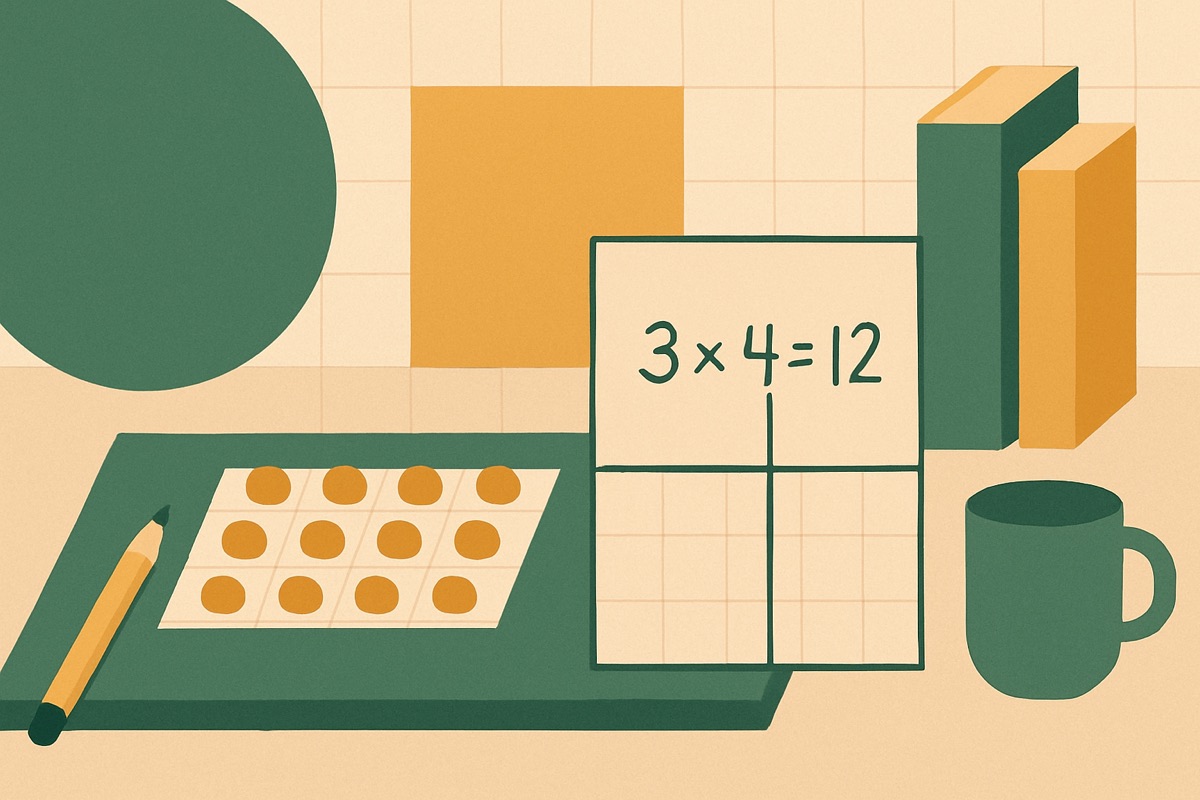
A dad came to conferences last spring holding his son's homework like it was written in another language. The problem was 23 times 47, and instead of the neat stacked column he grew up with, his son had drawn a grid of four boxes with numbers scattered inside them. "I know the answer's right," he told me, "but I have no clue what he did, and I can't help him." That's the area model, and if you've seen boxes on your kid's math page, you've met it too.
Area model multiplication looks strange to anyone who learned the traditional stacked method, so let me explain what it is, why teachers use it, and how to help without accidentally undoing what your kid learned in class.
What the boxes actually are
The area model breaks a multiplication problem into pieces by place value. That's the whole idea. Instead of treating 23 times 47 as one big scary operation, you split each number into its parts and multiply the parts separately.
For 23 times 47, your kid splits 23 into 20 and 3, and splits 47 into 40 and 7. Then they draw a two-by-two grid. Across the top go 40 and 7. Down the side go 20 and 3. Each box holds the product of its row and column:
- 20 times 40 is 800
- 20 times 7 is 140
- 3 times 40 is 120
- 3 times 7 is 21
Add up all four boxes: 800 plus 140 plus 120 plus 21 equals 1081. Same answer you'd get the old way, just laid out so you can see every piece.
Why teachers moved to it
The stacked method works, but it hides what's happening. When you write 47, then 23 under it, then multiply and carry the 1, most kids have no idea that they're really multiplying 3 by 40 or 20 by 7. They're just following steps. That's fine right up until they forget a step, and then they're stuck with no way to reason it back.
The area model keeps the place value visible. A kid can look at the box holding 800 and understand it came from 20 times 40, not from some carried digit they can't explain. When the numbers get bigger, or when they move to multiplying decimals or even algebra later, that understanding pays off. The box method for multiplying two binomials in high school is the exact same grid. Kids who learned it in third grade have a running start.
I'm not against the traditional method at all. I teach it too, usually after the area model, once kids understand what the shortcut is shortcutting. The order matters. Understand first, then speed up.
How to help without confusing your kid
Here's the trap parents fall into. You see the boxes, decide they're overcomplicated, and show your kid "the fast way" you learned. Now they've got two methods half-mixed in their head and they trust neither. I've had kids come in more confused after a weekend of well-meaning help than they were on Friday.
If you want to help, learn the boxes for a night. It takes about ten minutes and you already know how to multiply, so it's not new math, just a new layout. Then help your kid inside their method, not around it.
A few things that work at home:
- Ask your kid to explain one box to you. "Where did the 140 come from?" If they can answer, they understand it. If they can't, that's the box to slow down on.
- Point out the pattern. The biggest box (tens times tens) is always the biggest number. That's a good check when an answer looks off.
- Connect it to something real. A garden that's 23 feet by 47 feet really is made of those four rectangular chunks. The model is called the area model because it literally measures area.
A quick example to do together
Try 16 times 25 at the kitchen table. Split 16 into 10 and 6. Split 25 into 20 and 5. Draw the grid.
- 10 times 20 is 200
- 10 times 5 is 50
- 6 times 20 is 120
- 6 times 5 is 30
Add them: 200 plus 50 plus 120 plus 30 equals 400. Then, if your kid is up for it, check it the stacked way and watch them get 400 again. Seeing both methods land on the same number is what convinces a kid the boxes aren't some school gimmick. They're just the same multiplication, opened up so you can see inside.
I do this side-by-side comparison in class on purpose. When a kid realizes the "carry the 1" in the traditional method is the exact same regrouping that happens when you add the boxes, something clicks. The two methods stop feeling like rivals and start feeling like two views of one thing.
When boxes give way to speed
The area model is a teaching tool, not a life sentence. Most kids use it heavily for a year or so, then naturally start dropping the grid as the facts get automatic. By fifth or sixth grade, many have folded it into a faster written method, and that's exactly the arc teachers hope for.
Don't rush that. A kid who abandons the boxes too early, before the place-value understanding is solid, tends to make the same old mistakes, carrying wrong or lining up columns badly, with no way to catch themselves. Let the understanding settle. Speed comes on its own once the meaning is locked in, and it comes a lot more reliably for kids who built on top of the boxes than for the ones who only ever memorized steps.
So the next time you see a page full of grids, you'll know your kid isn't doing math the hard way. They're doing it the clear way, and if you meet them inside the boxes instead of pulling them out, you'll both be speaking the same language by the end of the homework.