Arrays and Area Models: The Picture That Ties Multiplication to Real Math
A girl in my third grade class could rattle off her times tables faster than I could. Six sevens, forty-two, no hesitation. Then a word problem asked how many cookies were on a tray with 6 rows of 7, and she just sat there. She had the fact. She didn't have the picture. That gap is exactly why I lean so hard on arrays before anything else. If you want to teach multiplication with arrays, the goal isn't to replace the facts. It's to give the facts something to hang on.
Because a memorized fact with no picture behind it is a trick. And tricks fall apart the second the problem looks unfamiliar.
An array is just stuff lined up in rows
An array is nothing fancy. It's objects arranged in equal rows and columns. An egg carton is an array: 2 rows of 6, and you can see at a glance there are 12 eggs without counting each one. A muffin tin, the squares of a chocolate bar, a window with panes, a parking lot marked into spaces. These are everywhere, and once a kid starts noticing them, multiplication stops being a school thing.
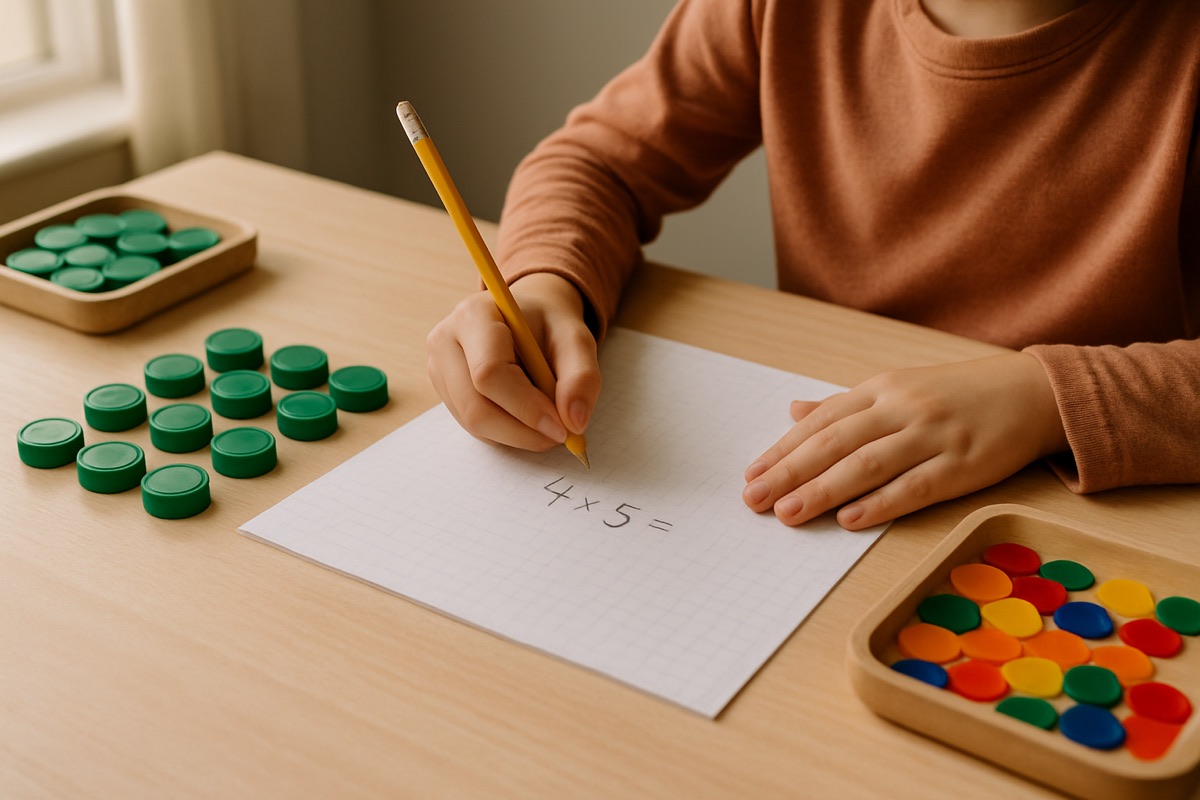
I'd start with actual objects on a desk. Line up 4 rows of 3 buttons. Then I'd ask the question that does all the work: "How could we find the total without counting every single button?" Some kids count by threes. Some count by fours. Both are right, and that's the point I wanted them to feel. 4 rows of 3 and 3 rows of 4 give the same total, so 4 times 3 equals 3 times 4. You don't have to teach the commutative property as a rule. The buttons show it, and the kid discovers it himself, which means he actually believes it.
Why rows-of matters more than the times sign
Here's a small thing that changes a lot. I taught kids to read the multiplication sign as "rows of" or "groups of," not just "times."
- 6 x 7 is "six rows of seven."
- 3 x 8 is "three groups of eight."
It sounds minor. It isn't. When my cookie-tray girl learned to hear "6 x 7" as "6 rows of 7," the word problem suddenly matched a picture in her head. The rows were the rows on the tray. Seven cookies in each. She could see it. The language and the picture lined up, and the freeze went away.
That's the real job of arrays. They connect the symbol on the page to something a kid can build and count. A kid who can draw the array will never be totally stuck, because he can always fall back on the picture and count it out. The fluency comes later, and it comes faster, because it's growing on top of understanding instead of floating on nothing.
Turning the array into an area model
The array works beautifully for small numbers, but nobody wants to draw 23 rows of 45 dots. This is where the area model takes over, and it's the same idea grown up.
Instead of drawing every dot, you draw a rectangle and label the sides. A 4-by-3 rectangle stands in for 4 rows of 3. The space inside is the answer, twelve, the same total the dots gave you. Now the rectangle is doing the counting for you. Once a kid trusts that the rectangle means the same thing as the array (and building a few side by side is how you earn that trust), you can go big.
Take 13 x 6. You break the 13 into 10 and 3, because tens are easy. Draw one long rectangle, split it into a 10-part and a 3-part.
- The 10 side times 6 is 60.
- The 3 side times 6 is 18.
- Add the two pieces: 60 plus 18 is 78.
Every step is visible. The kid isn't carrying a mystery digit and hoping. He's finding the area of two rectangles and adding them, and he can see exactly why it works. When he later meets the standard algorithm with its carrying and its neat columns, it isn't a magic spell. It's a shortcut for the thing he already understands. That's the whole reason to do it in this order.
Two-digit by two-digit without the tears
The area model really earns its keep on problems like 23 x 45, the ones that make kids groan. You draw a rectangle split into four pieces, because you break both numbers into tens and ones.
- 20 x 40 is 800.
- 20 x 5 is 100.
- 3 x 40 is 120.
- 3 x 5 is 15.
- Add all four: 800 plus 100 plus 120 plus 15 is 1,035.
Four small multiplications a kid can already do, then one addition. No lost digits, no "wait, do I carry here." And if the answer comes out wrong, the four boxes tell you which piece to check. A kid can debug his own work, which almost never happens with the traditional column method, where a single misplaced carry hides in a wall of numbers.
Practice the picture, not just the speed
The temptation, once a kid can multiply, is to drown him in timed drills. Speed has its place, but drilling facts a kid doesn't understand just trains him to answer fast and stay confused. I'd rather a kid draw ten arrays slowly than fill in a hundred blanks he doesn't get.
A few things that kept the picture alive at home:
- Point out arrays in the wild. "The parking lot has 5 rows of 8 spots. How many cars fit?"
- Bake something and count the muffin tin before you fill it.
- When a fact is forgotten, don't just supply it. Ask the kid to draw or picture the rows and rebuild it.
If your child practices on an app, look for one that shows the array or the area model, not just a number to type. The right kind of practice rewards a kid for understanding the picture, not for guessing quickly. Whether that's a worksheet, a set of buttons on the kitchen table, or something like Math Prizes, the same rule holds. The picture comes first, the speed follows.
The cookie-tray girl came around, by the way. Not because she drilled harder. Because once she could see six rows of seven, the fact she already knew finally had somewhere to land. That's what arrays and area models do. They turn a memorized answer into something a kid actually understands, and understanding is the part that lasts.