Ten Two Player Math Games for a Parent and One Kid
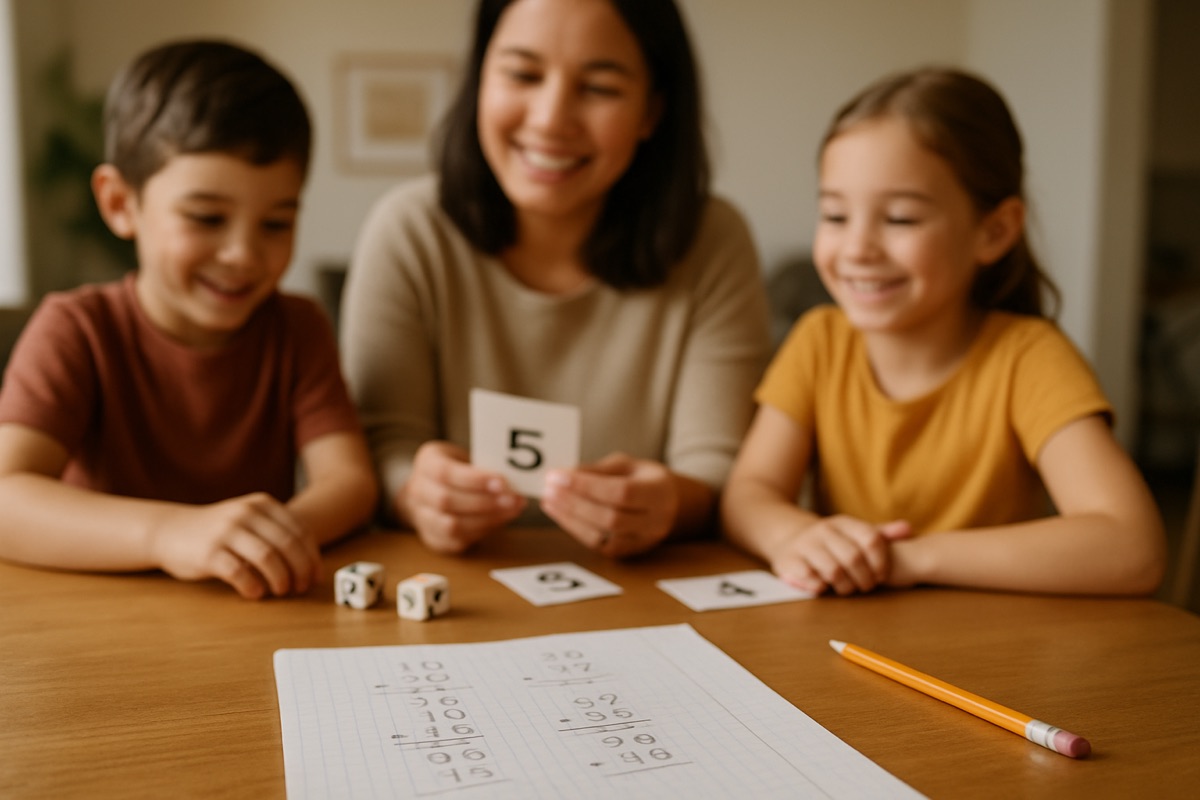
The best math practice my daughter ever got happened in a doctor's waiting room with a single deck of cards and about twenty minutes to kill. We played a flip-and-add game where high total wins, and she did more addition in that stretch than a whole worksheet would've pulled out of her, laughing the whole time because she kept beating me. That's the thing about two player math games. When it's just the two of you and there's something to win, a kid will do a hundred problems and call it fun.
These are ten I keep coming back to, all built for one parent and one child. No board game to buy, no fourth player to round up. Cards, dice, paper, maybe a coin. Every one of them is real practice wearing a costume, and none of them feel like drilling, which is exactly why they work when a worksheet would get shoved away.
What makes a math game actually work
Quick note before the list. A good math game hides the practice inside a reason to think. The kid isn't doing addition to do addition. They're doing it to win, and the math is just how you win. That framing is the whole trick. The moment a game starts feeling like a quiz with a game bolted on, kids smell it and check out. Keep it playful, keep it close (let the scores stay competitive), and stop before they're tired, not after.
1. War, but you add
Regular card War, except both players flip and whoever's two cards add to the higher total takes the pile. Face cards are ten, aces eleven. It's pure addition-fact practice disguised as a fast, lucky card game. For older kids, multiply the two cards instead of adding. Same game, harder math.
2. Twenty-one target
Deal cards one at a time. The goal is to get your running total as close to 21 as you can without going over, deciding each turn whether to take another. This one sneaks in mental addition on every card plus a real dose of "how close am I and should I risk it," which is early probability thinking without the vocabulary.
3. Dice multiplication race
Two dice, roll and multiply the numbers, first to reach a set score wins. Keep a running tally on paper. For a kid learning times tables, this beats flashcards by a mile because the same facts come up over and over inside a race they want to win. Bump to three dice when two gets easy.
4. Make the biggest number
Each player draws three or four cards and arranges them into the largest number they can. Highest number wins the round. This is place value in action. A kid who puts the 9 in the ones spot loses, learns fast, and never forgets that the leftmost digit is worth the most. Play "smallest number wins" to flip it.
5. Guess my number
One player thinks of a number in a range, say 1 to 100. The other guesses, and the answer is only "higher" or "lower." The hidden lesson is that guessing 50 first, then 25 or 75, finds the number in way fewer tries than counting up from 1. Kids figure out the halving strategy on their own, and that's real logical reasoning.
6. Coin flip and count
Grab a handful of coins. Take turns flipping a set number and adding up the value of the heads (or the tails). Highest total wins. This is money math and addition together, and it's genuinely useful practice because counting mixed coins is a skill kids are weirdly bad at. A pile of real coins on the table makes it stick.
7. Salute
You need a small deck or number cards. Both players draw a card and hold it to their forehead facing out, so each sees the other's card but not their own. The parent calls out the sum (or product) of the two. Each kid works backward to figure out their own card from the total and the one they can see. It's inverse operations, and it's genuinely clever. Kids love that they can see yours and not their own.
8. Race to 100
Start at zero. Take turns rolling a die and adding to a shared running total. First to land on exactly 100 wins, and you can't go over, so near the end you're doing "I need exactly 4, will this roll help me" math. Great for building fluency with adding to a growing number and thinking a step ahead.
9. Fraction pizza cutoff
Draw a circle, the "pizza." Take turns rolling a die to claim that fraction of the pizza (a 4 means one fourth, and so on), shading in slices. First to complete a whole pizza wins, but you can't go over, so the last slice has to fit exactly. This builds a real feel for how fractions add up to a whole, which is the part most kids find slippery.
10. Twenty-four
Deal four cards. Using all four numbers and any of add, subtract, multiply, or divide, be first to make 24. It's the hardest one here and the best for older kids, because there's usually more than one path and the flexible-thinking muscle it works is exactly what strong math students have. Some hands are genuinely tough, and cracking one feels great.
A few notes from playing these for years
A couple of things I've learned running these with one kid across a lot of kitchen tables and waiting rooms:
- Let them win a fair amount, especially early. A kid who loses every round quits. A kid who wins some stays in the game long enough to get better, and then the wins are real.
- Match the operation to where they actually are. If addition facts are shaky, don't jump to the multiplication ones. Solid beats fancy every time.
- Stop while it's still fun. Five good rounds beat fifteen where the last ten were a slog. The point is that they want to play again tomorrow.
None of these need a screen, none need more than the two of you, and all of them do more for a kid's number sense than a page of problems ever will. The math is real. It's just hiding inside a game they actually want to win, which is the only reason any of it works.