Fraction Games That Finally Make Fractions Click
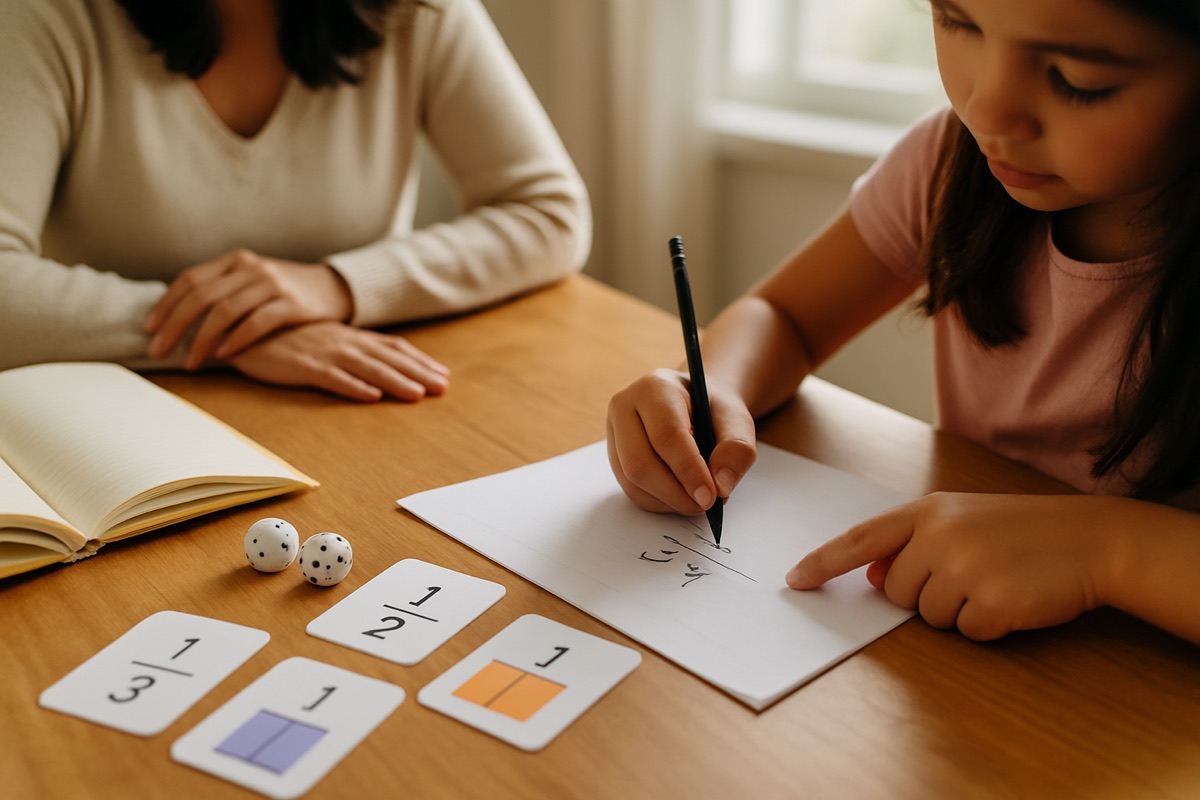
The year it clicked for me as a teacher was the year I stopped starting with the numbers. I used to write 1/2 and 1/4 on the board and explain that the bottom number tells you how many pieces, and I'd watch two dozen faces go politely blank. Then one afternoon I brought in a real pizza for a party, cut it into eight slices, and a kid who'd bombed every fraction quiz said, without prompting, "so if I eat two, that's a quarter of the whole thing." He was right. He just needed to hold it. That's the whole secret behind fraction games for kids: the fraction has to be a thing you can touch before it's a thing you can write.
Here are the games and setups that actually moved kids, most of them using stuff you already have.
Pizza and pie: the fraction everybody already understands
Kids come pre-loaded with strong feelings about fair shares of food. Use that.
You don't need real pizza every time. Cut a paper circle, or use an actual quesadilla at lunch. The game is simple: "There are four of us and one pizza. Cut it so everyone gets the same." Then push on it. "Now your cousin showed up. Cut it for five." The kid discovers on his own that more people means smaller pieces, which is the exact reason 1/5 is smaller than 1/4, a fact that confuses kids endlessly when it's just two symbols on a page.
The move that makes it stick is asking the kid to name the piece every time. Not "cut it in four," but "each piece is one-fourth, and if you eat two, how much did you eat?" Say the words while the pieces are in his hands. The vocabulary and the object glue together.
LEGO or building blocks for the parts of a whole
This one is my favorite for the kid who thinks in objects, and I've never met a kid who didn't have a bucket of these somewhere.
Grab a stack of blocks, a mix of colors. Snap eight together in a row. Now you've got a whole made of eight parts, and every fraction game falls out of it naturally:
- Three of the eight blocks are red, so 3/8 of the tower is red.
- Trade blocks around and ask what fraction is blue now.
- Build two towers of different heights and ask which one is more than half.
The reason this works better than drawings is that the kid can physically break the whole into parts and put it back together. He can see that four of the eight blocks is the same as half the tower, which is equivalent fractions (1/2 = 4/8) happening in his hands before anyone ever uses that scary phrase. When the phrase shows up later, he's already met the idea.
The measuring cup game in the kitchen
Baking is a fraction workshop that happens to end in cookies, so motivation is not a problem.
Give a kid the 1/2 cup and the 1/4 cup and a recipe that needs 3/4 of a cup of something. Don't tell him how. Let him figure out that a half plus a quarter gets him there. That's adding fractions with unlike denominators, the thing that makes eighth graders groan, and a seven-year-old will solve it with measuring cups and flour because he wants the muffins.
A few kitchen prompts that carry a lot of math:
- "I need 3/4 cup but I only have the 1/4 cup. How many scoops?"
- "The recipe makes twelve. We want six. What do we do to every amount?"
- "Two half-cups of milk. How much is that total?"
The kid isn't doing worksheets. He's negotiating with a recipe, and the recipe is a stricter and more interesting teacher than any drill.
A quick card game for comparing fractions
When you want a fast, repeatable game with no cleanup, this one earns its keep. It works like the old game of War.
Deal a deck between two players. Each player flips two cards. The smaller number is the top of the fraction, the bigger number is the bottom, so a 3 and an 8 make 3/8. Both players make their fraction, and whoever made the bigger fraction takes all four cards. The catch is you have to prove yours is bigger.
That "prove it" step is where the learning lives. A kid has to argue that 3/4 beats 2/5, and to argue it he has to picture the pieces or find a common ground between the two. You'll hear real reasoning come out: "three-fourths is almost the whole thing but two-fifths is less than half." That's the goal. Not speed, not a hundred right answers, but a kid who can look at two fractions and actually think about their sizes instead of guessing.
Why the games beat the drill sheets
I want to be honest about what these games are and aren't. They're not a shortcut to make fractions painless and then never do any real math. They're the on-ramp. They build the mental picture that makes the eventual pencil-and-paper work make sense instead of feeling like memorized rules.
A kid who has cut a lot of pizzas and stacked a lot of blocks brings a picture with him when he finally sees 1/2 + 1/4 written on a page. He's not manipulating meaningless symbols. He's writing down something he's done with his hands a dozen times. That's the difference between a kid who understands fractions and a kid who has memorized just enough to survive Friday's quiz and forget it by Monday.
You don't have to run all of these. Pick one, play it a few times this week, and pay attention to the moment the kid says something you didn't teach him. That moment, the unprompted "oh, so this is a quarter," is the click. Everything after it gets easier.