Talking to Your Child's Teacher About Math Struggles: What To Ask
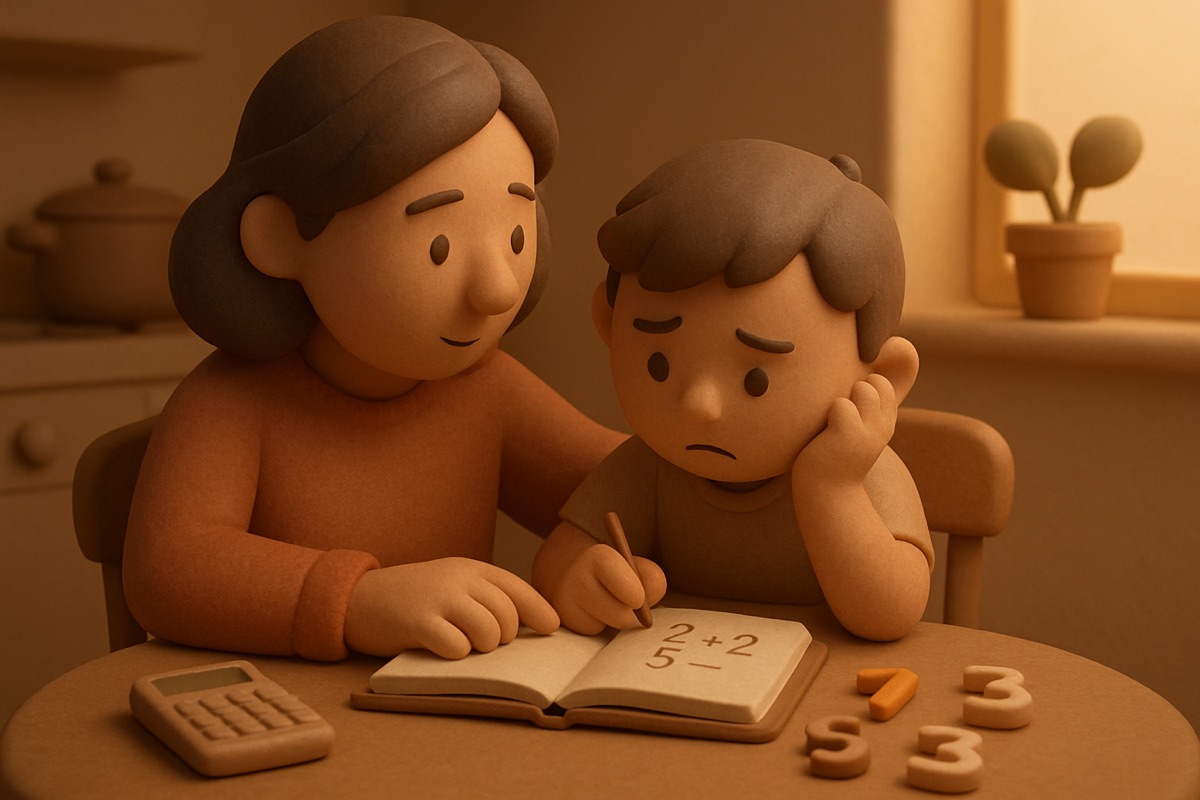
A dad sat down across from me at a fall conference, slid a crumpled math test onto the table, and said "just tell me if he's stupid." His son wasn't. His son had a gap in place value from a move mid-year that nobody had caught. But I only found that out because the dad asked a real question, even a blunt one, instead of nodding along while I said "he's doing fine." I taught for sixteen years, and the difference between a useful conference and a wasted one is almost always the questions the parent brings.
If you want to talk to your child's teacher about math struggles and actually leave with something you can use, the trick is to skip the vague ones. "Is he behind?" gets you a vague answer, because "behind" means twelve different things and the teacher doesn't know which one you mean. Specific questions get specific answers. Here's what to ask.
Ask what specifically, not whether
The single most useful question is some version of: "What exact skill is my kid stuck on right now?"
"Math" is not a skill. "Behind" is not a diagnosis. Kids get stuck on specific, nameable things: they haven't got their multiplication facts automatic, they lose the steps in long subtraction, they don't understand what a fraction actually is, they can do the procedure but can't tell you what it means. A good teacher can name it in one sentence. If yours can't, that's worth noticing too.
Follow it with "Is this a facts problem, a concept problem, or a confidence problem?" These need completely different fixes. A facts gap needs practice. A concept gap needs reteaching in a new way, not more of the same worksheets. A confidence gap needs the kid to feel a win before anything else will stick. Lumping them together as "struggling in math" guarantees you'll try the wrong fix.
Get the picture the test scores hide
Grades and test scores are a blurry photo. Ask questions that fill in what they leave out.
- "What does he do when he gets stuck?" This tells you everything. A kid who tries a different approach is in fine shape. A kid who freezes, shuts down, or copies a neighbor has a different problem than the grade suggests.
- "How is he in class versus on tests?" A kid who understands it in the moment but bombs the test may have test anxiety or a working-memory issue, not a math gap.
- "Is this new, or has it been building?" A sudden drop in a kid who used to be fine is a flag worth chasing. A long slow slide is a different story with a different fix.
- "Where does he land compared to where he needs to be by June?" This is the honest version of "is he behind," and it gives the teacher something concrete to answer.
I always had more to say about the kid whose parent asked "what does she do when she's stuck" than the one who asked "what's her grade." The first question is about learning. The second is about a number.
Make a real plan, then split the work
Once you know the specific gap, the conversation should turn into a plan. Ask directly: "What are you doing about it at school, and what's the one thing that would help most at home?"
The "one thing" matters. Teachers, if you let us, will hand you a stack of resources you'll never use. Push for a single, specific action. Ten minutes of multiplication practice four nights a week. A particular kind of problem to work on. Reading a word problem out loud together before he tries it. One clear thing that a real family can actually keep beats a binder of good intentions.
And ask how you'll know it's working. "When should we check back in, and what would progress look like?" A month is usually enough time to see movement on a specific skill. Set the date before you leave, so it doesn't become a thing you both mean to do and never do.
Watch the words, on both sides
A few things worth doing in the room itself.
Don't call your kid lazy or stupid in front of the teacher, even as a joke, even out of frustration. Kids hear about it, and it colors how everyone treats the problem. That dad who asked if his son was "stupid" meant it as a plea, and I heard it that way, but it's a risky opener. Say "I'm worried and I don't know what's wrong" instead. It's the same thing without the label that sticks.
Listen for whether the teacher talks about your kid specifically or in generic phrases. "He's a sweet kid, he'll get there" is a kind sentence that contains no information. Gently push for detail: "What makes you say that? What have you seen?" A teacher who knows your child can always get specific when asked.
After the conference
The conversation is worth nothing if it dies in the parking lot. Write down the specific skill, the one home action, and the check-in date before you forget them, which will be by dinner. Then actually do the small thing, consistently, and treat the check-in as a real appointment.
Most math struggles at this age are ordinary and fixable. A gap in place value, facts that never got automatic, a concept that got taught once and didn't land. None of that means a kid is bad at math. It means one specific thing needs attention, and the fastest way to find out which thing is to sit down with the person who watches your child do math thirty hours a week and ask them the questions that actually have answers.