Summer Lemonade Stand Math: Profit, Pricing, and Change
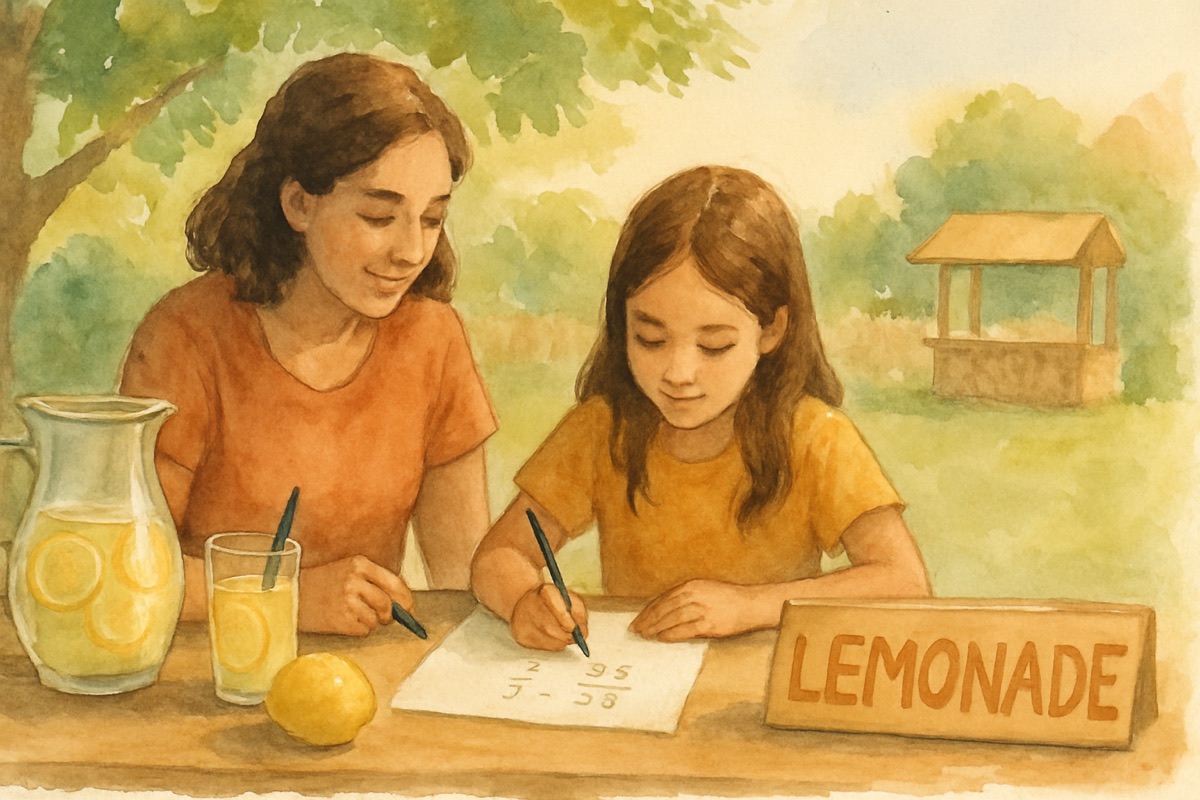
My neighbor's daughter ran a lemonade stand two summers ago and came inside at the end of the day thrilled that she'd made twelve dollars. Her dad, gently, asked how much the lemonade mix and cups had cost. Her face did a whole journey. That one question, cost versus what you took in, is the beginning of real lemonade stand math, and it teaches more about money in an afternoon than a stack of worksheets does in a month. The stuff is real, the quarters are real, and a kid cares about the answer in a way they never care about problem number seven on a page.
You don't need to turn it into a lesson with a capital L. The math is already baked into running the stand. You just have to ask the right questions at the right moments and let your kid do the figuring instead of doing it for them. Here's where the good math is hiding.
Start with cost, before a single cup is sold
Before the stand opens, sit down and add up what it takes to make the lemonade. This is where profit begins, and it's the piece kids almost always skip.
Walk through the actual items:
- Lemonade mix or lemons
- Sugar
- Cups
- Maybe a sign, ice, a folding table
Add it up together. Say the mix was 3 dollars, cups were 2 dollars, and ice was 1 dollar. That's 6 dollars just to open the doors. Now here's the number that makes it click: if a batch makes 20 cups and it cost 6 dollars, each cup cost about 30 cents to make before anyone's paid a nickel of profit. A kid who works that out, 6 dollars divided by 20 cups, has just done real division for a reason that matters to them. That per-cup cost is the floor. Sell below it and you lose money on every cup, which is a genuinely surprising and useful thing for a seven year old to discover.
Set a price and figure out profit
Now the fun part, which is also the math part. If it costs 30 cents to make a cup, what should they charge? Let your kid float a number. If they say 25 cents, great, ask what happens: they'd lose a nickel per cup, and the more they sell the more they lose. That's a real lesson wearing a lemonade costume.
If they say a dollar, ask whether the neighbors will pay a dollar for a small cup. Pricing is a negotiation between what you'd like and what people will actually hand over, and there's no clean right answer, which is exactly why it's good thinking.
Once they land on a price, the profit math opens up:
- Price minus cost per cup is the profit per cup. At 50 cents a cup with a 30 cent cost, that's 20 cents each.
- Profit per cup times cups sold is the profit for the day. Twenty cents times 20 cups is 4 dollars.
Notice the difference between the 10 dollars they collected and the 4 dollars they actually kept. Kids conflate those two constantly, and honestly a lot of grown-ups do too. Teaching profit to children really just means teaching the gap between money in and money kept. The lemonade stand makes that gap physical.
Making change is the sneaky skill
Here's the part that surprises parents: making change is often the hardest and most valuable math of the whole day. A customer buys a 50 cent cup and hands over a dollar. How much change? A customer buys two cups, a dollar total, and pays with a five. Now what?
This is subtraction under mild pressure with a real person waiting, and it exercises a skill that's fading fast in a tap-to-pay world. Let your kid run the cash box. They'll fumble the first few and that's fine. A couple of tips that help:
- Have them count up rather than subtract. For a dollar paid on a 50 cent cup, count "50, 75, a dollar," handing over a quarter and a quarter. Counting up is how cashiers used to do it, and it's less error-prone for kids than borrowing.
- Keep the coins sorted in the box so they're not digging.
- Let them make small mistakes and catch them. Overpaying a customer once is a memorable, cheap lesson.
The kid who's run a cash box for an afternoon understands quarters, dimes, and nickels in a way that no coin worksheet delivers, because they felt the stakes of getting it wrong.
Track the day and do the reckoning
At the end, do what my neighbor did, but turn it into the kid's job. Count the cash. Subtract what the supplies cost. What's left is the real profit. Write it down: took in this much, spent this much, kept this much.
Then push one layer further if they're into it. How much did they make per hour? If they ran the stand for two hours and kept 4 dollars, that's 2 dollars an hour, which leads to genuinely interesting kid questions like "would it be worth staying open longer?" or "what if I charged more?" or "what if I bought a bigger bag of cups so each one cost less?" Those are optimization questions, and a kid asking them on their own is worth ten assigned problems.
Keep the reward tied to the real thing
The best part of a lemonade stand is that the payoff is honest. The kid did actual math and there's actual money in the box to show for it. That's the whole spirit worth protecting in how kids learn math generally: the reward should track real understanding and real effort, not just going through motions. A kid who priced, sold, made change, and did the end-of-day reckoning earned that pile of coins with genuine thinking, not busywork.
You can extend it however far your kid's interest goes. Some kids want to graph sales by hour. Some want to test two prices on two days and compare. Some are done after they've counted the money once, and that's completely fine. The math was in the doing.
The honest takeaway
Lemonade stand math works because none of it is pretend. The costs are real, the price is a real decision, the change has to be right or a neighbor gets shorted, and the profit is money a kid can actually spend. Ask the cost question first, let them wrestle with pricing, hand them the cash box, and do the reckoning at the end. My neighbor's daughter ran the stand again the next summer. This time she asked about supply costs before she opened. That's the math sticking.