Birthday Party Math: Planning the Party Is the Lesson
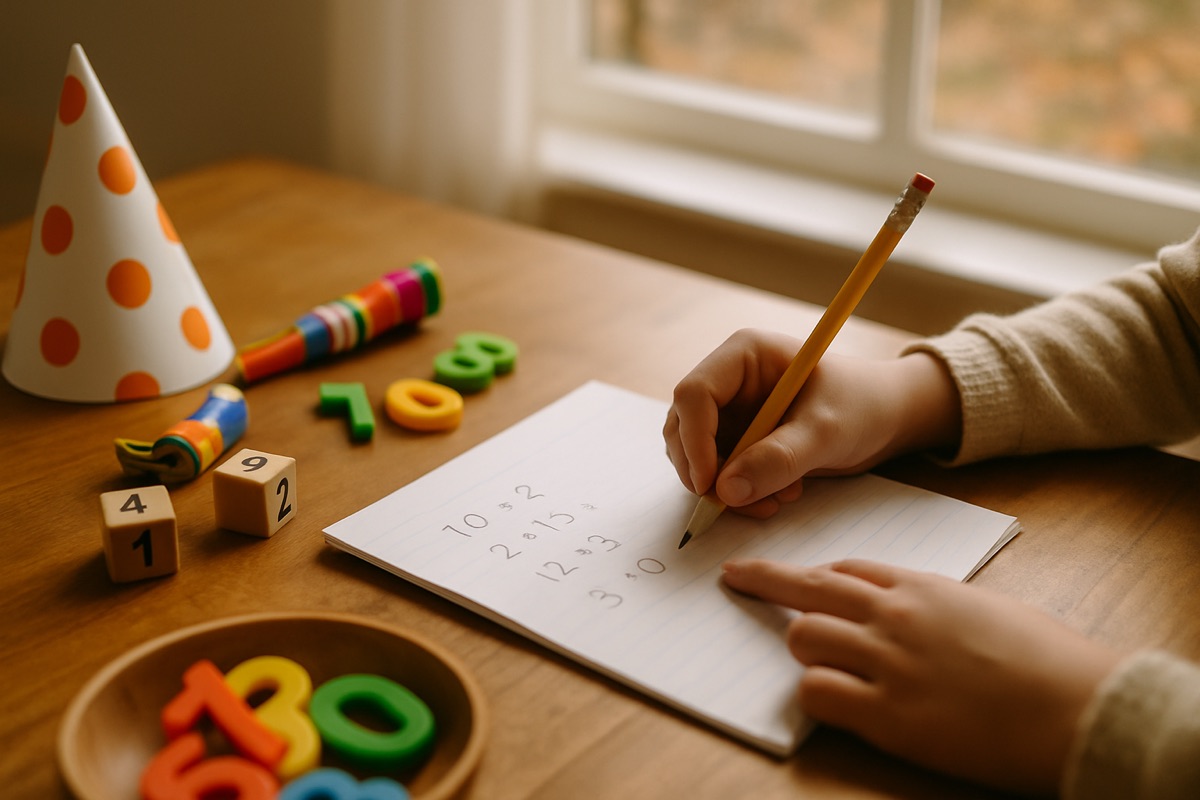
My niece turned eight last month and spent two weeks running the numbers on her own party. She wanted ten friends, a piñata, and enough pizza that nobody went home hungry. Her mom handed her a budget of sixty dollars and, without meaning to, taught her more useful math than I could pack into a week of lessons. That's the thing about birthday party math activities. The best ones aren't games you run during the party. They're the planning itself, and a kid will happily do arithmetic they'd normally fight you on if it's in service of their own celebration.
I spent sixteen years watching kids light up over math the moment it stopped feeling like math. A birthday is one of the cleanest chances you'll get all year to make numbers matter. Here's how to hand the planning over and let the learning happen on its own.
Let them own the guest list and the food
Start with a real question: how many people, and how much do we need to feed them? If your kid wants twelve guests and a pizza feeds four people, that's a division problem they actually care about the answer to. Twelve divided by four is three pizzas, and suddenly a concept that felt abstract on a worksheet has a slice of pepperoni attached to it.
Then push it a little. If each pizza costs eleven dollars, what do three cost? Now they're multiplying. If the budget is sixty, how much is left for everything else? Now they're subtracting to find what's remaining. None of this feels like a lesson because there's a piñata riding on getting it right.
The party favor problem is division in disguise
Here's a scenario every kid understands and every kid gets wrong at least once. You buy a big bag of forty small toys and you have ten guests. How many does each kid get, and are there any left over?
- Forty toys, ten kids, so four each and none left over. Clean division.
- Now say you have forty-two. Four each with two left over. That leftover is a remainder, and kids grasp remainders instantly when the remainder is two extra bouncy balls sitting on the counter.
- Change it to twelve guests. Forty-two doesn't split evenly, and now your kid is genuinely wrestling with a problem, deciding whether to buy more, hand out three each, or keep some as backup.
This is the kind of problem that shows up on a state test in a much drier form. Your kid has already solved the real version at the kitchen table with a bag of junk from the party store.
Estimation is the sneaky useful one
Grown-ups estimate constantly and kids almost never get to practice it. A party is full of estimation. About how many cups do we need if everyone drinks two sodas? Roughly how long will the piñata take so we know when to start? If the cake serves sixteen and there are ten kids plus some adults, is that enough?
Ask these out loud and let your kid take a swing before you check. Being close matters more than being exact here, and that's a genuinely different skill than the precise arithmetic they do in school. A kid who can look at a situation and say "we'll need about twenty cups" is doing real math, the kind adults use every day and rarely learned in a classroom.
Keep it real, not a worksheet in a party hat
Here's my one warning. The second your kid smells a lesson, the magic dies. Don't stop the fun to quiz them. Don't say "and THAT, sweetie, is multiplication." Just ask the natural questions a person planning a party would ask, and let them work it out because they want the party to go well.
The point isn't to grind through a set of problems. It's that real understanding comes from math that has a reason to exist. Your kid figuring out that three pizzas won't feed twelve hungry eight-year-olds is worth more than a page of division problems, because they'll remember the miss and the fix. That's mastery, the kind that sticks, and it happens because the numbers mattered to them and not because somebody assigned it.
A few low-effort ideas that carry real math
If you want a couple of concrete things to try without turning the day into school:
- Have your kid make the shopping list and add up the running total in their head or on paper, then compare it to the receipt.
- Let them figure out the timeline. If the party is two hours and there are four activities, roughly how long is each?
- For the cake, ask how to cut it so everyone gets a fair share. Cutting a round cake into equal pieces is fractions, geometry, and negotiation all at once.
- Put them in charge of the piñata payout, splitting the candy as evenly as they can and dealing with whatever's left over.
My niece came in five dollars under budget and was prouder of that than of anything else about her party. She'd done real division, multiplication, and budgeting for two weeks and never once called it math. When the day came, she watched her friends eat exactly the amount of pizza she'd planned for and looked like a general whose battle plan had worked. That's the whole idea. Let the party be the lesson, and get out of the way.