Thanksgiving Math: Cooking a Feast Is a Story Problem
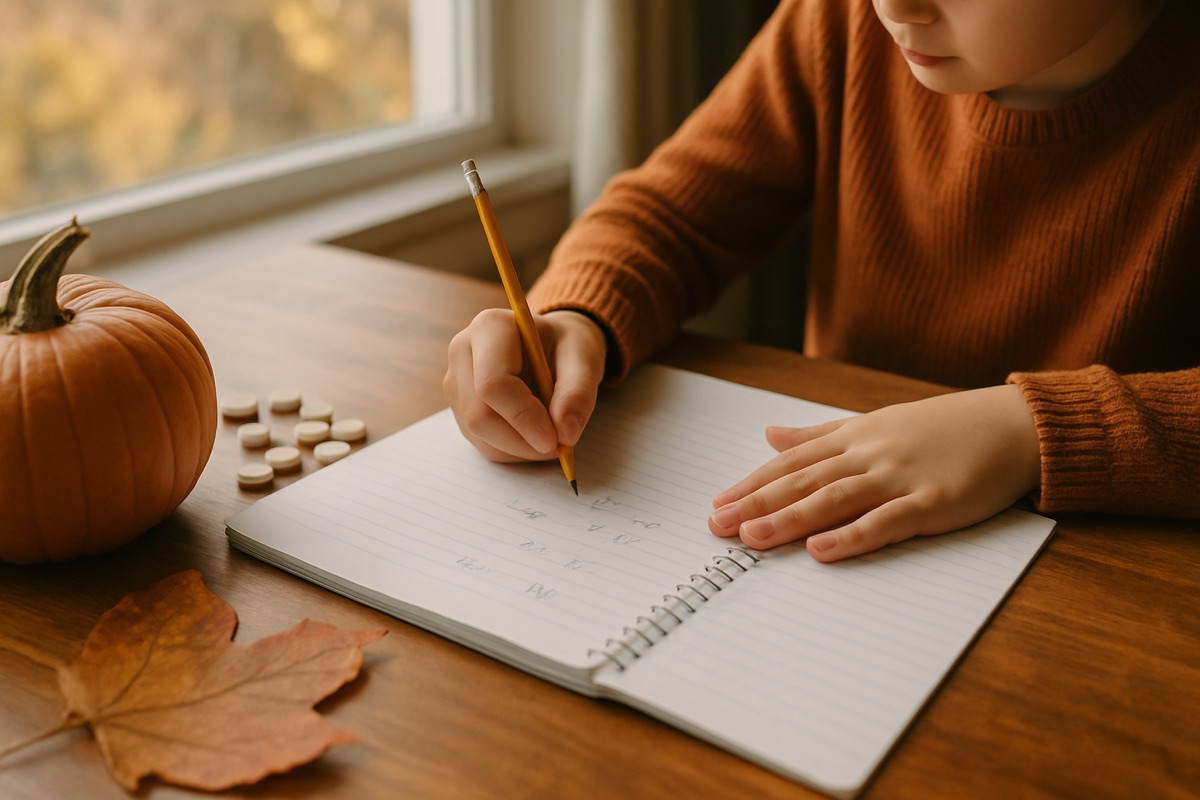
The best word problem I ever assigned wasn't on paper. It was a fourteen-pound turkey, a recipe card that said "roast 15 minutes per pound," and a kid who wanted to know when we'd eat. Fourteen times fifteen is 210 minutes, which is three and a half hours, and if you want the bird out by four you have to put it in by twelve-thirty. He did that math standing on a step stool, and he cared about the answer in a way no worksheet has ever produced. That's the whole idea behind Thanksgiving math activities. The holiday is already full of real problems. You just hand them over.
Kids do arithmetic differently when the answer matters to their own stomach. Here's how to turn the actual work of the day into the kind of math that sticks, sorted by roughly what age it fits.
The turkey is a multiplication and time problem
Start with the bird, because it's the marquee calculation and it has a real deadline. Give your child the weight and the "minutes per pound" from the recipe and let them find the total roasting time. For a younger kid, keep the weight round (a ten-pound turkey at 15 minutes a pound is a cleaner 150 minutes). For an older one, use the actual number and make them convert minutes to hours and minutes, then count backward from dinnertime.
This one problem quietly touches multiplication, division, and elapsed time, which is a skill kids are notoriously weak on because clocks don't behave like the number line. If your fourth grader can figure out that the turkey needs to go in at 12:30 to be done by 4:00, they've done more meaningful time math than a page of "what time is it if the clock reads..." questions.
Doubling the recipe is fractions with a reason
Almost every holiday recipe needs scaling. You're cooking for twelve, the mashed potatoes serve four, so you're tripling it. Hand your kid the original recipe and the multiplier and let them rewrite every line.
That means multiplying fractions on purpose. Two-thirds of a cup, tripled, is two cups. Three-quarters of a teaspoon, doubled, is a teaspoon and a half. These are exactly the fraction operations that feel abstract on a worksheet and suddenly make sense when there's a measuring cup in the other hand.
A few ways to size the task to your kid:
- Second or third grade: double a recipe with whole-number and half-cup amounts
- Fourth grade: triple a recipe that uses thirds and quarters
- Fifth grade and up: scale a recipe to an odd number of servings, so they hit fractions like 3/4 times 2.5
Let them use the real measuring cups to check. Filling the 1/3 cup three times to prove it makes a whole cup is a fraction lesson no textbook can match.
Dividing the pie is fair-share division
Dessert is where division gets emotional, which makes it stick. You've got two pumpkin pies and eleven people. How big is each slice, and is that even fair? Now you're dividing a whole into equal parts, and the remainder actually means something (somebody's getting a thinner slice, or you're cutting into the second pie).
For little kids, this is straight sharing: eight rolls, four people, everybody gets two. For older kids, push into remainders and fractions. Three pies cut into eighths make 24 slices for 15 guests, so everyone gets one with nine left over, which is where seconds come from. Ask what happens if two more people show up. That's the kind of "what if" that turns a single problem into real reasoning.
Setting the table is early number sense
Don't skip the youngest kids. Setting the table is a genuine one-to-one counting task, which is a real kindergarten and first-grade standard. Twelve people means twelve plates, twelve forks, twelve napkins. Let a five-year-old count out the forks and figure out whether there are enough, then match each fork to a plate.
Then stretch it. If each place needs a fork, a knife, and a spoon, how many pieces of silverware total for the table? A first grader can skip-count by threes or add it up. A kid who's ready can multiply. Same table, three different levels of math, depending on who you hand it to.
The grocery run is money and estimation
If you're doing the shopping with a kid along, that's a live budgeting problem. Give them a running total to keep in their head, or a rough budget and a calculator, and let them decide whether the fancy cranberries fit. Estimation matters more than exactness here. Rounding each item to the nearest dollar and adding as you go is a skill adults use constantly and kids almost never practice with real stakes.
One honest caution. Don't narrate every single number as a "math problem" or you'll drain the fun right out of the day and your kid will start hiding in the living room. Pick one or two of these, hand them over cleanly, and then let them cook. The point of Thanksgiving math activities isn't to run a class in the kitchen. It's to let a kid notice, once, that the math they've been doing on paper was describing the real world the whole time.
When my step-stool kid finally announced that dinner would be ready at four, he wasn't proud of his multiplication. He was proud that he'd figured out something the grown-ups needed to know. That's the version of math worth handing your child this year, right alongside the mashed potatoes.