Regrouping and Borrowing: Where Kids Get Stuck and How To Unstick Them
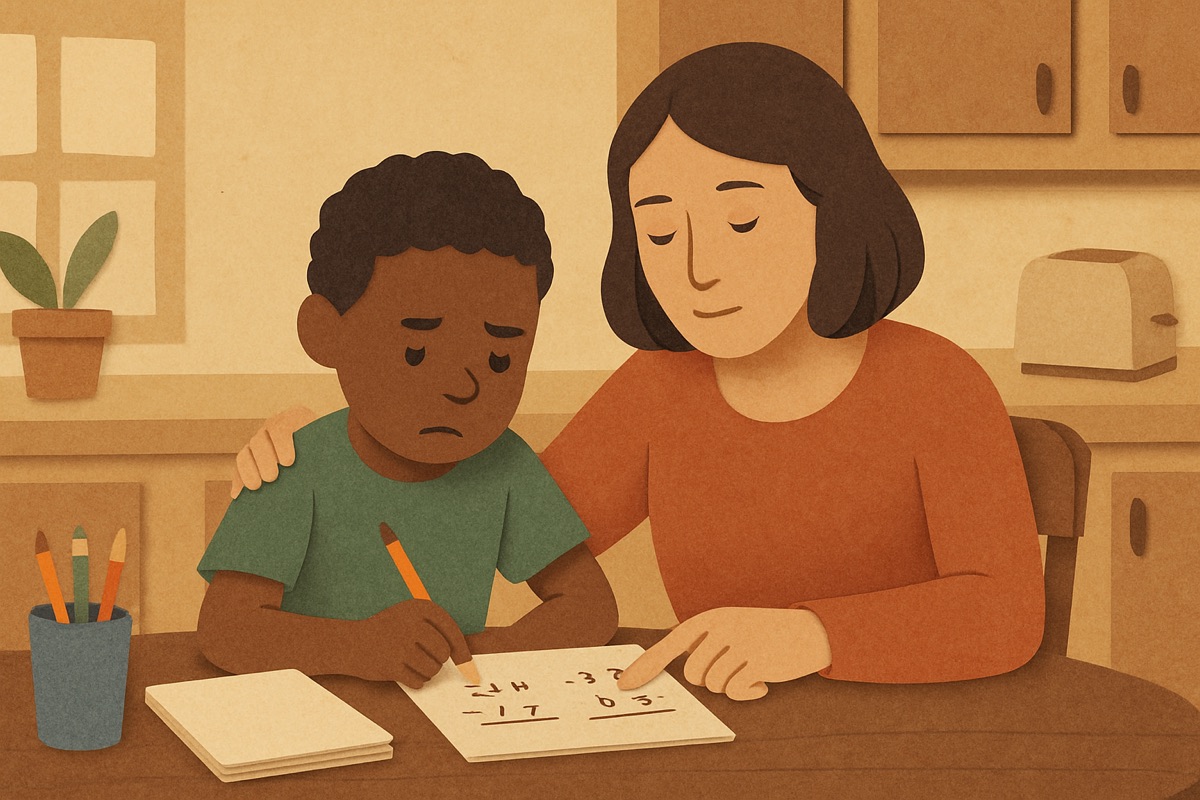
I had a second grader named Ava who could do 45 minus 23 in her sleep and completely fell apart on 45 minus 27. Same numbers, almost. But in the second one, the ones column asks for 5 minus 7, and 5 isn't big enough. That's the wall. When a child struggles with regrouping subtraction, this is almost always the exact spot: the moment the top number is smaller than the bottom one, and they don't know that's allowed, let alone what to do about it.
Regrouping (the thing a lot of us grew up calling borrowing) is where a huge number of kids hit their first real math roadblock. Up to this point, subtraction was just take-away, column by column. Now suddenly there's a step that reaches into the next column over, and it breaks their whole model of how this works.
Why this particular skill is so hard
For a couple of years, subtraction has one rule: line up the numbers, subtract each column. That rule works great until it doesn't. The first time a kid sees 5 on top and 7 on the bottom, the old rule breaks, and most kids do one of two things. They either subtract the small from the big anyway (writing 2, because 7 minus 5 is 2, ignoring which one is on top) or they freeze.
Neither is stupidity. Both are logical. The kid learned a rule and is applying it. The trouble is that regrouping requires understanding that the numbers in those columns aren't really 5 and 7. They're 5 ones sitting next to some tens, and you're allowed to trade one of those tens for ten ones. That's a big conceptual jump, and worksheets usually just show the trick without ever explaining the trade.
The two places kids actually get stuck
When a child struggles with regrouping subtraction, it's almost always one of two specific breakdowns. Figuring out which one your kid has is most of the fix.
- They don't recognize when to regroup at all. They see 45 minus 27, subtract 5 from 7 to get 2, and hand you 22. They missed the signal entirely.
- They know they need to regroup but botch the mechanics. They cross out the 4, put a little 3, but forget to add the ten to the ones column, or they add it and then subtract wrong.
These need different help. The first kid needs to understand the trade so they can spot when it's required. The second kid gets the idea but is drowning in the steps. Watch your kid do three or four problems and you'll see which one you've got fast.
Go back to actual objects
Here's the thing that fixes the concept, and it's almost too simple. Put the pencil down and get physical objects. Dimes and pennies are perfect, but so are bundled and loose popsicle sticks, or those little linking cubes if you have them. You want something where ten of the small thing equals one of the big thing.
Set up 45 minus 27 with ten dimes and five pennies for the 45. Now try to take away 7 pennies. You've only got 5. Your kid will immediately feel the problem in their hands, which is completely different from seeing it on paper. Then show the trade: cash in one dime for ten pennies. Now you've got 3 dimes and 15 pennies. Take away 7 pennies, easy. Take away 2 dimes, easy. What's left is 18, and your kid just did the entire regrouping process with their fingers before they ever wrote a digit.
Do this five or six times with real objects. The paper version stops being a magic trick and starts being a picture of something they've physically done. That connection is the whole thing. Kids who only ever learn the paper steps forget them by summer. Kids who traded actual pennies remember why the little crossed-out numbers mean what they mean.
Then connect the objects to the paper
Once the trade makes sense with objects, bridge it to the written form slowly. Do a problem with the dimes and pennies right there on the table, and write each step on paper as you do it physically.
- Reach for the ones column, notice 5 isn't enough, say it out loud
- Trade one dime for ten pennies with your hands, and cross out the 4, write 3
- Watch the 5 pennies become 15, and write the little 1 in front of the 5
- Now subtract each column with both the objects and the pencil
Saying it out loud matters more than it looks. "Five isn't enough, so I trade a ten" is the sentence that has to become automatic. When a kid can narrate the trade, they understand it. When they can only do the crossing-out silently, they've memorized a dance and will forget the steps under pressure.
Practice small, and don't rush the drill
Once your kid can regroup with objects and narrate the steps, then you practice, but keep it short. Fifteen minutes a day of three or four problems beats a whole page in one sitting. A page of regrouping problems for a kid who's still shaky is just a page of chances to reinforce the wrong move. You want a few problems done carefully, with the narration, until the trade feels normal.
Resist the urge to pile on repetition before the understanding is solid. Drilling a skill the kid doesn't grasp yet doesn't build the skill. It builds dread. Get the concept locked in with the pennies first, confirm they can talk through the trade, and only then lean into practice to make it fast. Understanding first, speed second. That order is not negotiable, and it's where most struggling kids got shortchanged the first time around.
Ava, the second grader, got unstuck in about a week. Not with more worksheets. With a handful of dimes and pennies and a few short sessions where she traded coins and said the trade out loud until it stopped feeling like cheating. The wall was never subtraction. It was one small idea, that you're allowed to trade, and once she had it in her hands, the paper made sense on its own.