Regrouping and Borrowing: What the 'Little 1' Actually Means
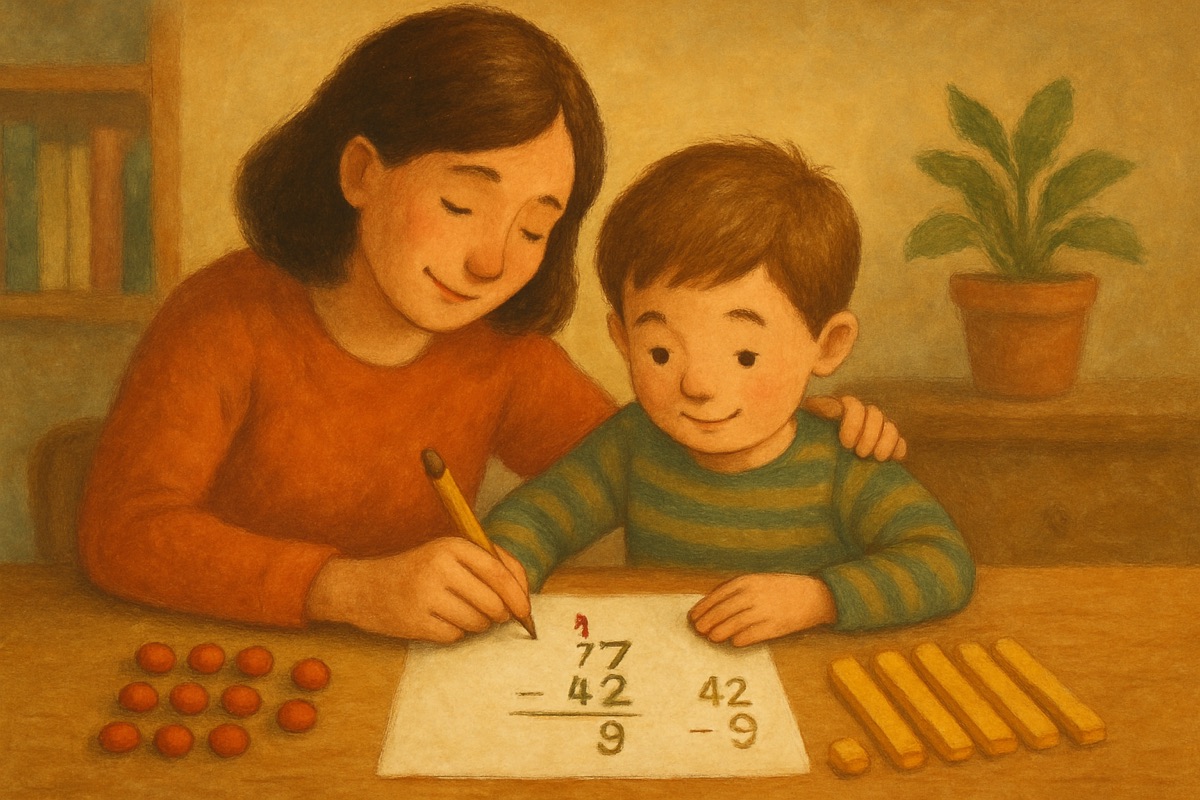
A fourth grader named Priya once showed me her subtraction homework and every problem had a tidy little 1 crossed out and rewritten above the next column. Perfect form. Then I asked her what that little 1 was. She looked at me like I'd asked what color Tuesday is. "It's just what you do," she said. She had learned the dance and had no idea what song it was set to.
That is the whole problem with how we usually teach regrouping subtraction. We teach the hand motions. Cross this out, make it a smaller number, put a 1 next door, carry on. Kids can do it for months and still not know what actually happened. And the day the problem gets a little weird, like subtracting across a zero, the dance falls apart because they were never standing on anything solid.
The little 1 is a trade, not a rule
Here is what the little 1 actually is. It is ten of something turning into one of something bigger, or one of something bigger breaking back into ten smaller pieces. That's it. That's the entire idea behind both carrying and borrowing.
When you add 27 and 15 and "carry the 1," you added the ones (7 and 5 make 12), and 12 is one ten and two ones. So the two ones stay put and the one ten goes to live with the other tens. The little 1 you write above the tens column is a ten. It is not a 1. It has never been a 1. We just write it small and call it 1 and then act surprised when kids are confused.
Borrowing is the same trade running backward. If you're doing 52 minus 8 and you don't have enough ones (you've got 2, you need to take away 8), you walk next door to the tens, grab one ten, and break it into ten ones. Now those 2 ones become 12 ones. The 5 tens become 4 tens. Nothing got created or destroyed. You just made change, like breaking a ten dollar bill into ten singles because the vending machine won't take the ten.
Once a kid hears it as making change, something relaxes in their face. They've made change before. They get that a ten dollar bill and ten ones are the same money.
Money and blocks beat the algorithm every time
You cannot explain a trade with words alone. The kid needs to do the trade with their hands before the paper version means anything.
I use base ten blocks in class, but at home you don't need them. Money works even better because kids already believe in money.
- Set out the number as bills and coins. For 52, that's five ten dollar bills and two ones.
- The problem says take away 8. Try to take 8 ones. You can't, you've only got 2.
- So trade. Hand over one of the tens and get ten ones back. Now you have four tens and twelve ones, and it is still 52. Count it and prove that to them.
- Now take 8 ones away. You're left with four tens and four ones. Forty four.
Do that three or four times with real objects and the little 1 stops being a mystery. The kid has physically watched a ten become ten ones. When they see it written on paper, they know what the crossed out 5 and the little 1 are doing, because they just did it with dimes and pennies on the kitchen table.
Pennies and dimes are perfect for this, by the way. Ten pennies for a dime, one dime for ten pennies. That is regrouping in your palm.
Subtracting across a zero is where the fakers get caught
The problem that separates kids who understand from kids who memorized is something like 300 minus 176.
A kid who learned the dance stares at that middle zero and freezes. You can't borrow from a zero, there's nothing there. Some of them just make up an answer. Some write 176 and hope.
A kid who understands the trade handles it fine, though it takes two steps. You need ones, but the tens column is a zero too, so you can't get a ten to break. So you go one more door down. You break one of the three hundreds into ten tens. Now the hundreds are 2 and the tens are 10. Then you break one of those tens into ten ones. Now the tens are 9 and the ones are 10. Now you can subtract.
This is not a special harder rule. It is the exact same trade, done twice, because the first neighbor was also broke. A kid who gets the concept can reason their way through it. A kid who only got the steps hits the zero and has nowhere to go.
If your child can do plain regrouping but falls apart on problems with zeros in the middle, that's your signal. They memorized the motion. They don't own the idea yet. Back to the pennies.
Language matters more than you'd think
The word "borrow" is a little bit of a lie, and I've come around to not loving it. When you borrow something you give it back. Nobody gives the ten back. That's why a lot of teachers, me included, say "regroup" or "trade" now. The number 52 gets regrouped into four tens and twelve ones. Same number, grouped a different way.
You don't have to police the vocabulary at home. But if your kid learned "borrow" and it's tripping them up, try saying "trade" or "make change" instead and watch whether it lands better. For a lot of kids it does, because trading is a thing they understand from real life and borrowing (in the give-it-back sense) makes the math feel dishonest.
Also, when you're helping, say the digits the honest way. Not "cross out the 5 and make it a 4." Say "we're taking one ten out of the fifty, so now we've got forty and ten extra ones." It's clunkier. It's also true, and the truth is the part they're missing.
Don't reward the neat handwriting, reward the understanding
Here's the trap I see parents and honestly some teachers fall into. A worksheet of twenty subtraction problems comes back with neat little 1s all over it and mostly right answers, and everybody's happy. But that page tells you almost nothing about whether the kid understands the trade. It might just mean they've gotten fast at the dance.
Twenty problems done by rote teach a kid almost nothing. One problem where they had to figure out, out loud, why they were breaking a hundred into tens, that's worth the whole page. When I check for real understanding, I don't count how many they finished. I ask one question: "Why did you cross that out? What did it turn into?" If they can tell me, they've got it, even if they only did three problems. If they can't, thirty more problems won't help, because they'll do all thirty the same empty way.
This is the thing I keep coming back to with math practice in general, and it's built into how we set up Math Prizes too. Real progress is understanding the trade, not filling in boxes. A kid who finally sees that the little 1 is a ten did something genuinely hard. Celebrate that, not the tidy margins.
Priya, the girl with the perfect crossed out 1s, spent about ten minutes trading dimes for pennies with me one afternoon. That was it. The next week she did a subtract-across-zero problem I hadn't taught her yet, talked her way through it, and got it right. She wasn't smarter than before. She'd just finally learned that the little 1 was never a 1 at all. It was ten, waiting to be traded.