Place Value Is the Foundation Everything Else Sits On
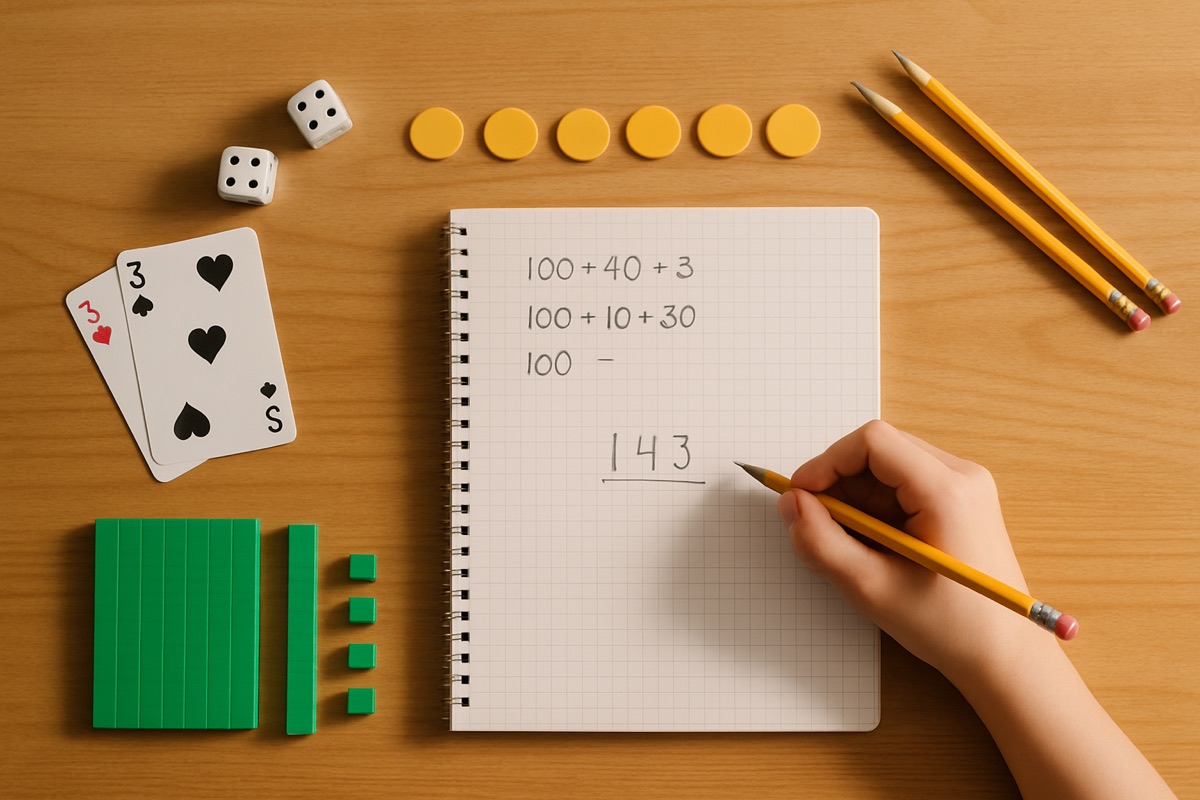
I had a second grader named Marcus who could add 8 and 5 in his sleep but wrote 47 plus 30 as 77 one day and 4,730 the next, depending on his mood. Nobody had taught him that the 4 in 47 is not really a 4. It is 40. Once that clicked for him, half his "careless mistakes" disappeared in a week. They were never careless. He just didn't know what the digits meant.
That is the thing about place value. It looks small, like a warmup topic you get past quickly, and it is quietly holding up everything a kid does with numbers for the next ten years.
Why place value is the whole ballgame
Teaching place value in elementary school is not one skill among many. It is the skill the others stand on. Regrouping in addition, borrowing in subtraction, lining up a long multiplication problem, understanding decimals, moving a decimal point when you multiply by ten, reading 1,000,000 without counting the zeros out loud. Every one of those depends on a kid understanding that where a digit sits changes what it is worth.
A 3 is a 3 until you put it in the hundreds spot. Then it is 300. We say this to kids like it is obvious. It is not obvious. It is one of the more abstract ideas we hand a six year old, and we tend to hand it over fast and move on.
When a kid doesn't have it, the symptoms show up much later and look like something else:
- They add 25 and 25 and get 410 (they added the 5s to make 10, wrote it, then added the 2s and wrote that too).
- They can't estimate at all, because they don't feel the difference between 300 and 30.
- Decimals wreck them in fourth and fifth grade.
- Word problems with big numbers make them freeze, because the numbers are just shapes to them.
Teachers spend a lot of time treating these as separate problems. Usually they are one problem wearing different hats.
Make it a real quantity, not a worksheet
You cannot teach place value with a definition. I have tried. "The tens place is the second digit from the right" is a true sentence that means nothing to a kid. They need to touch it.
Base ten blocks are the classic tool for a reason. The little cubes are ones, the sticks are tens, the flats are hundreds. When a kid physically trades ten small cubes for one stick, regrouping stops being a rule they forget and becomes a thing they did with their hands. If you don't have blocks at home, this works fine with stuff in your kitchen. Ten pennies for a dime. Bundles of ten popsicle sticks held with a rubber band. Straws in cups of ten.
The move that matters is the trade. Ten ones become one ten. One ten breaks back into ten ones. A kid who has done that trade fifty times with their hands will understand borrowing in subtraction without you ever having to say the word "borrow."
The question I ask over and over
There is one question I ask so much my students start rolling their eyes, and I keep asking it anyway: "How many tens are in that number?"
Not "what's the tens digit." How many tens are in the whole thing.
In 47, there are 4 tens. Easy. But then I ask, how many tens are in 470? Most kids will say 7, because they are looking at the digit in the tens spot. The answer is 47. There are 47 tens in 470. When a kid gets that, really gets it, they have understood something deep about how our number system stacks. It also happens to be exactly what they need for division and for decimals later.
Try it at dinner tonight. Pick a number off a cereal box. Ask how many tens are in it. Then how many hundreds. You will find out fast whether the idea is solid or whether it is a memorized digit position.
Say the number the honest way
Here is a small habit that pays off big. When you read a number out loud with a young kid, say it the long way sometimes. 236 is "two hundreds, three tens, and six ones." Not always. That would be exhausting and weird. But often enough that the structure gets into their ear.
We rush kids to say "two thirty six" because that is how grownups talk, and then we wonder why they don't understand what the number is made of. The formal reading is clunky, but it is honest about the structure, and the structure is the part they are missing.
I do this with the number of the day, whatever it is. How many kids are absent, what page we are on, the date. It takes three seconds and it does more than a worksheet.
Watch out for the tricks that skip understanding
A lot of what passes for place value practice is really just pattern matching. Fill in the blank: the 5 in 456 is in the ____ place. A kid can learn to answer that correctly by counting spaces from the right, never once thinking about quantity. They look like they get it. They do not.
This is the trap with a lot of math practice, and it is worth naming. Grinding through pages of place value worksheets can produce a kid who scores fine on the place value quiz and still writes 77 for 47 plus 30. The worksheet measured whether they can name a position. It never checked whether they know what the position is worth.
So push past the naming. After a kid tells you the 5 in 456 is in the tens place, ask the follow up. "So what is it worth?" You want to hear "fifty," not "tens." If they can only say the name and not the value, the understanding isn't there yet, and no amount of the same worksheet will put it there. They need to go back and trade blocks.
This is also why I care so much about rewarding real progress instead of pages completed. A kid who did thirty problems by counting spaces learned nothing and should not be treated like they did. A kid who finally understood that 470 has 47 tens in it did something huge, even if it took them ten minutes and one problem. That is the win worth celebrating.
A few things that actually help at home
None of this requires being a teacher. If you want to shore up place value without it turning into a fight:
- Trade real objects in groups of ten. Pennies, beans, whatever. Let the kid do the trading, not you.
- Ask "how many tens are in this number" about numbers you run into anyway.
- Read numbers the long honest way now and then.
- When they make a "silly" mistake with big numbers, don't just correct it. Ask them to tell you what each digit is worth. The mistake usually explains itself.
Marcus, the boy who wrote 4,730, ended that year as one of the stronger math kids in my class. Nothing magic happened. He just finally learned that a 4 in the tens place is worth 40, and everything he built after that had something solid to stand on. Give a kid a real feel for place value and you have handed them the floor under the rest of the math they will ever do.