Order of Operations at Home: More Than Just PEMDAS
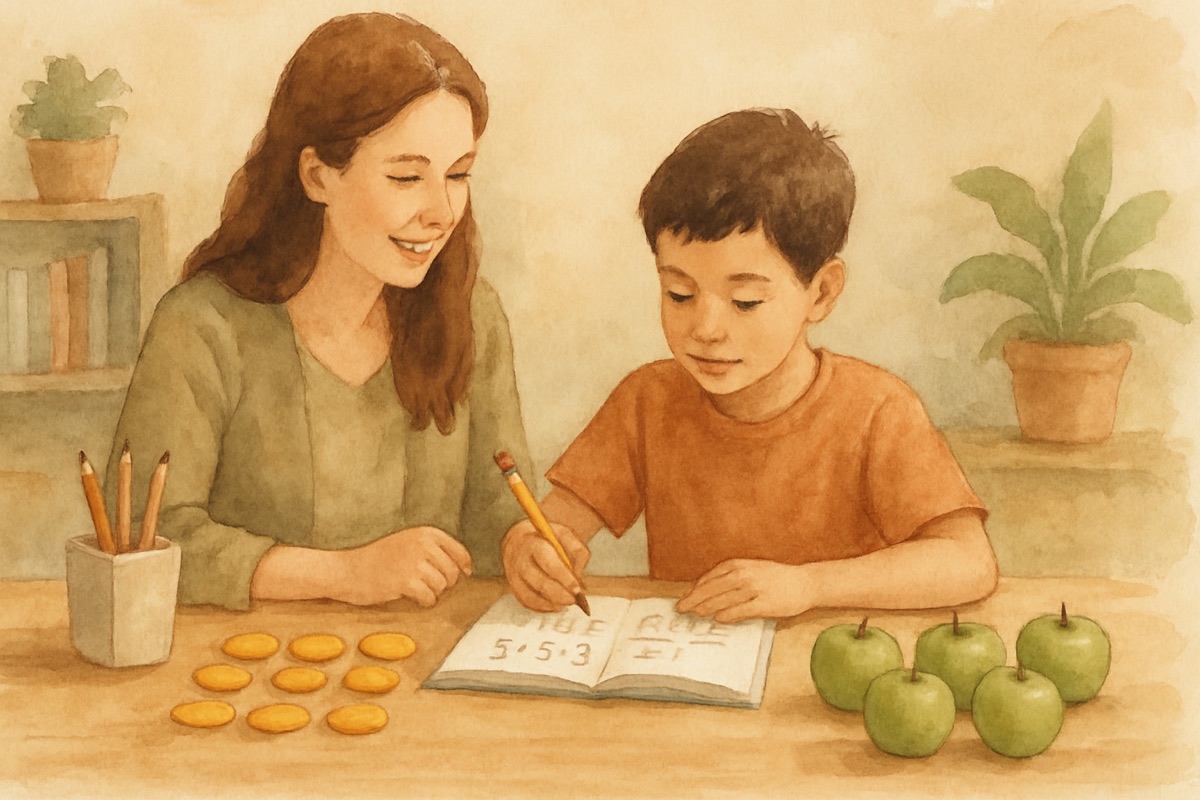
Two fifth graders, same worksheet, same problem: 6 + 2 x 3. One wrote 24. One wrote 12. The kid who wrote 24 was so confident, because he'd done it "left to right, like reading." The kid who wrote 12 got it right but couldn't tell me why, other than "the P thing." Neither of them actually understood order of operations. One had a wrong rule and one had a mnemonic he didn't trust. That morning is why I've come to think PEMDAS does more harm than good.
Order of operations for kids gets taught as a spelling word. Parentheses, Exponents, Multiplication, Division, Addition, Subtraction. Kids chant "Please Excuse My Dear Aunt Sally" and we move on. The trouble is that the mnemonic sneaks in two flat-out wrong ideas, and a kid who memorizes it without understanding will trip over both.
The two lies PEMDAS tells
Here are the problems, and they're worth knowing even if you loved PEMDAS growing up.
- It looks like multiplication always comes before division. It doesn't. They're equal in rank, and you do them left to right. In 8 divided by 2 x 4, you divide first because it comes first, giving 16. A kid who thinks "M before D" will do 2 x 4 first and get 1. Wrong.
- It looks like addition always comes before subtraction. Same trap. They're equal, done left to right. 10 minus 3 plus 2 is 9, not 5.
So the six letters imply six ranks when there are really only four levels, with ties inside two of them. That gap between "six steps" and "four levels with ties" is exactly where kids go wrong, and no amount of chanting Aunt Sally fixes it.
What the rule is actually for
Step back and ask why the rule exists at all. It's not arbitrary teacher cruelty. It exists so that everyone on earth reads the same expression the same way.
Here's the concrete version I use. Imagine you buy 3 packs of gum at 2 dollars each, plus a 1 dollar candy bar. That's 3 x 2 + 1. The multiplication has to happen first, because the 3 x 2 is a single chunk (the cost of the gum) before you add the candy. It would be nonsense to add the candy bar into one pack of gum first. The order isn't a rule to memorize. It matches how the quantities actually group in real life.
Once a kid sees that multiplication builds a group that has to be finished before it joins the addition, the whole thing stops feeling like a magic spell. Multiplication and division are "grouping" operations, so they get handled before the "combining" operations of addition and subtraction. That's the real idea underneath the letters.
Make the grouping visible
The best home tool here is a set of parentheses and a willingness to be silly.
Take 6 + 2 x 3 and physically draw a loop around the 2 x 3. Say, "this part is one thing, it equals 6, and now we have 6 plus 6." Then draw the wrong loop, around the 6 + 2, and compute that version too. You get 24. Now ask your kid which one matches a real situation. Give them the gum story. They'll see that only one loop makes sense.
Doing it wrong on purpose is powerful. When a kid computes both interpretations and sees they give different answers, they finally understand why we need an agreed order at all. The rule stops being a hoop and becomes the thing that keeps math from being ambiguous.
Parentheses are the escape hatch
Here's a freeing idea for anxious kids. If you're ever unsure, add parentheses to say exactly what you mean. That's what they're for.
If your child wants 6 and 2 added first, they can write (6 + 2) x 3 and it's completely legitimate. The parentheses are a tool for being clear, not just an obstacle in someone else's problem. I've watched kids relax enormously once they realize they're allowed to use parentheses to organize their own thinking. It turns the topic from a memory test into a communication tool.
Practice that isn't grinding
You don't need a packet of forty expressions. You need a handful of good ones and real conversation.
- Give one problem a day and ask your kid to explain each step out loud, not just get the answer.
- Slip in the sneaky ones with division before multiplication, or subtraction before addition, so the left-to-right rule gets tested.
- Use money and food stories so the grouping stays concrete.
- When they make an error, don't correct it. Ask, "what did you group first, and does that match the situation?"
That last habit matters most. A kid who can catch their own grouping mistake understands order of operations better than one who can recite PEMDAS in their sleep. The recitation is the booby prize. The understanding is the thing.
The next time your child brings home 6 + 2 x 3, don't ask for the answer. Ask them to draw a loop around the part that's really one thing. If they loop the multiplication, they get it. If they loop the left side, you've found a great five minute conversation, and it'll do more good than a whole worksheet of Aunt Sally.