Multiplying by 10, 100, and 1000: The Pattern Behind the Zeros
The rule that quietly breaks
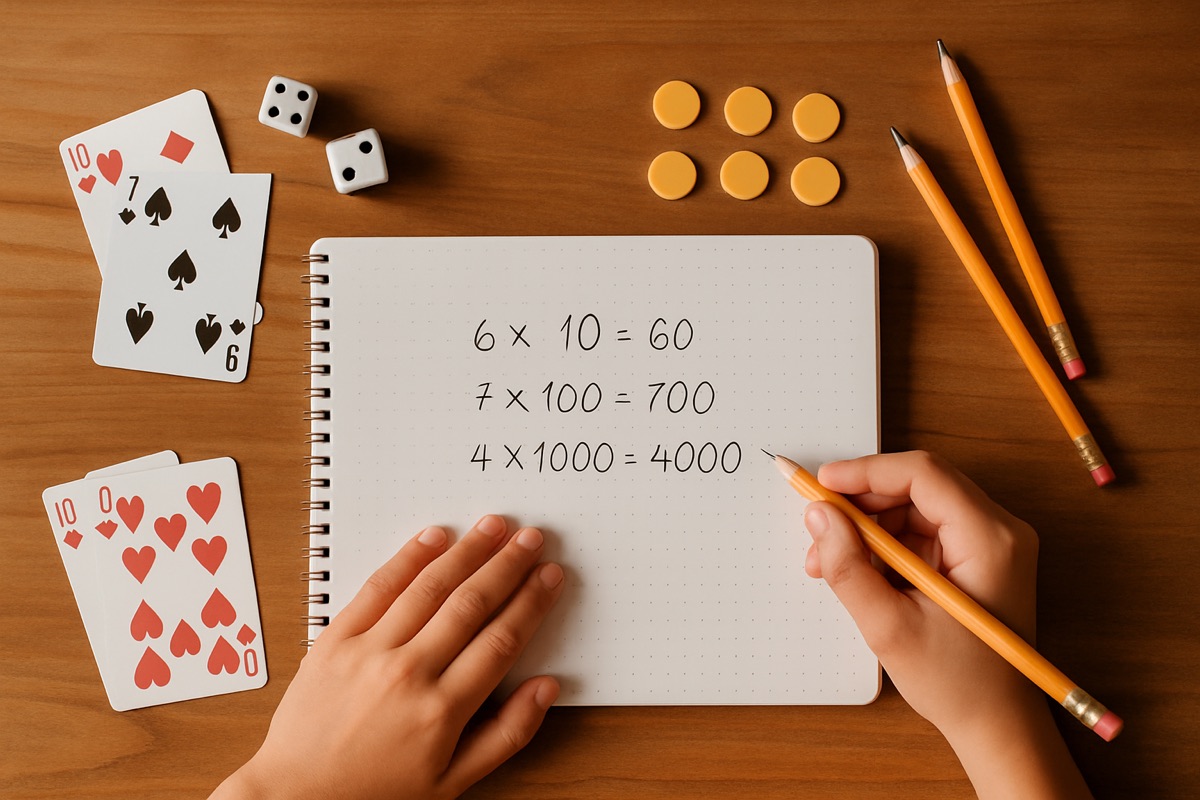
"Just add a zero." Nearly every kid learns to multiply by 10 that way, and for a while it works great. 6 times 10 is 60. 45 times 10 is 450. Then one day the kid meets 3.5 times 10, dutifully adds a zero, writes 3.50, and announces that 3.5 times 10 is 3.5. Because 3.50 and 3.5 are the same number. The trick just fell on its face. This is why multiplying by powers of ten is worth teaching as a real pattern instead of a zero-tacking shortcut, because the shortcut has an expiration date and place value doesn't.
Here's the honest version. When you multiply by 10, every digit slides one place to the left, into a spot worth ten times as much. The zeros a kid sees are a side effect of that slide, not the cause. Teach the cause and the kid never gets ambushed by decimals.
What "ten times bigger" actually does
Our number system is built on tens. Each place is worth ten times the place to its right. Ones, then tens, then hundreds, then thousands, each one a tenfold jump. That structure is the entire reason multiplying by 10 is easy in the first place.
So when you multiply a number by 10, you're making every part of it ten times bigger. A 6 in the ones place is worth 6. Make it ten times bigger and it's worth 60, which means that 6 now belongs in the tens place. The digit didn't change. It moved to a bigger-value seat. With whole numbers, the ones seat it left behind has to be filled with something, and that something is a 0. That's where the "extra zero" comes from. It's a vacancy sign, not a magic ingredient.
I explain it to kids as everybody moving up one seat in the stadium. Better seats, worth ten times as much, and the cheap seat down front gets a zero because nobody's sitting there anymore.
The pattern for 10, 100, and 1000
Once a kid sees it as sliding, the pattern is obvious and it scales.
- Times 10: every digit slides one place left. 7 becomes 70. One jump.
- Times 100: every digit slides two places left, because 100 is ten tens. 7 becomes 700. Two jumps.
- Times 1000: three places left. 7 becomes 7000. Three jumps.
The number of zeros in what you're multiplying by is just the number of seats everybody moves up. Times 100 has two zeros, so two jumps. That's a pattern a kid can see and predict, not a random rule. And unlike "add zeros," this framing tells them exactly how many, and why.
Try it with a bigger number. 34 times 100. The 3 and the 4 each jump two places. The 3 lands in the thousands, the 4 in the hundreds, and the two empty seats behind them, tens and ones, get zeros. 3400. Same reasoning every time.
Why this survives decimals when the trick doesn't
Now for the payoff, the exact spot where "add a zero" dies and place value keeps going.
Take 3.5 times 10. Don't add anything. Just slide every digit one place left. The 3 in the ones jumps to the tens. The 5 in the tenths jumps to the ones. So 3.5 becomes 35. No zero involved, and it's correct. A kid who learned the sliding rule handles this without blinking. A kid who learned "add a zero" writes 3.50 and gets it wrong.
Do 0.06 times 100. Two jumps left. The 6 climbs from the hundredths to the ones. 0.06 becomes 6. Try telling a kid to "add two zeros" to 0.06 and watch the confusion. The slide, on the other hand, just works. This is the whole reason I refuse to teach the zero trick as the rule. It's a special case dressed up as a law, and it strands kids the second decimals show up.
Ten minutes at the table
You can build this with a pencil and a piece of paper ruled into place value columns. Label them, from the right: ones, tens, hundreds. Add a decimal point and tenths, hundredths if your kid's ready.
Write a digit in a column, say a 4 in the ones. Now physically move it one column left and ask what it's worth now. Forty. You just multiplied by 10, and the kid watched the digit move rather than watching you conjure a zero. Do it again to get 400. Then start with 4 in the ones and slide it two columns at once for times 100. The movement is the lesson.
When they're steady with whole numbers, put a 5 in the tenths column. Slide it one place left, into the ones. It went from 0.5 to 5. Ask what you multiplied by. Ten. Same move, decimals and all. A kid who does this a few times owns the actual rule, and the "add a zero" shortcut becomes something they understand well enough to use safely, because now they know when it applies and when it lies.
Understanding beats the shortcut
It's tempting to just hand a kid "add a zero" because it's fast and it gets right answers on the whole-number worksheet. But a shortcut with a hidden failure point isn't a gift. It's a debt that comes due the first time a decimal shows up, and it usually comes due right when the math is getting harder anyway.
Teach the slide instead. Every digit moves left, one place per zero in what you're multiplying by, into a seat worth ten times more. That's the pattern behind the zeros, and it holds for 10, 100, 1000, for whole numbers, for decimals, and for the big numbers your kid hasn't met yet. A kid who gets that isn't memorizing a trick. They're seeing how the number system is put together, and that's the kind of understanding that keeps paying off long after the zeros stop being simple.