Mental Math Strategies Kids Can Actually Do in Their Heads
A third grader I taught could rattle off 8 plus 7 the second I asked. When I asked how she knew, she said she took 2 from the 7, gave it to the 8 to make 10, and 10 plus 5 is 15. She wasn't faster because she'd drilled harder. She was faster because she had a strategy, and that's the whole secret behind mental math strategies for kids. The children who calculate in their heads aren't carrying a bigger stack of memorized facts. They're bending numbers into shapes that are easy to work with.
Finger counting isn't the enemy here. It's a fine bridge. But if a kid is still counting up from 8 one finger at a time in fourth grade, the counting has become the ceiling. Mental math lifts that ceiling, and it does it without a single worksheet.
Make a ten first
This is the one I teach before anything else, because almost every other strategy leans on it. Our whole number system is built on tens, so getting to a ten is like finding a landmark on a map.
Take 9 plus 6. Nine is one away from ten. Borrow that one from the six, and you have 10 plus 5, which is 15. Kids who see this stop dreading the "hard" facts, because 9 plus anything becomes 10 plus one less.
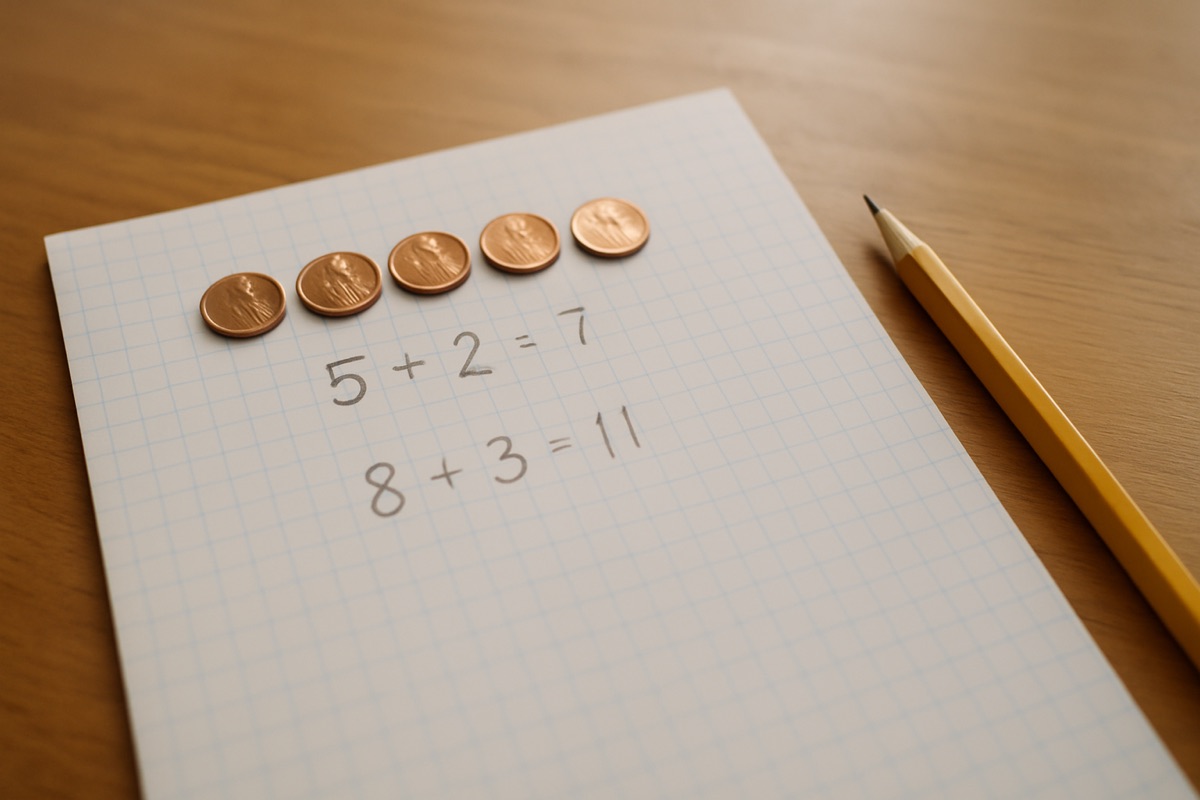
You can practice this with the change jar. Dump out some pennies, group them into tens, and see what's left over. When 10 becomes the number they reach for automatically, addition speeds up on its own.
Break numbers apart
Older kids hit two-digit problems and freeze. Something like 34 plus 28 looks like a lot until you split it. Add the tens: 30 plus 20 is 50. Add the ones: 4 plus 8 is 12. Put them together: 62.
This is called decomposing, and it's exactly how the mental math adults do at a register works. Nobody stacks 34 over 28 in their head and carries a one. They chop the numbers into friendly pieces.
A few things that help kids get comfortable with it:
- Start with problems that don't need regrouping (like 32 plus 25) so the method feels easy before it gets hard.
- Say the steps out loud together the first ten or twenty times. The talking becomes thinking.
- Let them write the two partial answers down at first. Dropping the pencil comes later.
Round and adjust
When a number is close to a ten or a hundred, treat it like the round number and fix it after. This one feels like a magic trick to kids, and it's genuinely useful for the rest of their lives.
Say you're at the store and something costs $1.99. Nobody wants to add 199 cents. Round it to $2.00, add that, then take a penny back. My son figured out our grocery total to the dollar this way once, and he was more impressed with himself than I was.
Same with 48 plus 35. Bump the 48 up to 50, add to get 85, then subtract the 2 you added back. You land on 83. The adjustment step is where kids stumble, so go slow on remembering to give back what you borrowed.
Turn subtraction into addition
Subtraction scares kids more than it should. A quiet fix is to stop subtracting and start counting up. Instead of 13 minus 8, ask what you add to 8 to get to 13. Count from 8 to 10 (that's 2), then 10 to 13 (that's 3), so the answer is 5.
This is the same move a cashier makes handing back change. It leans on the make-a-ten idea, and it turns a scary operation into a friendly one. For a kid who groans at minus signs, reframing the question does more than another round of flashcards ever will.
Double it, then nudge
Doubles are some of the first facts kids lock in. Six plus six, seven plus seven, they come fast. So use them as anchors for the facts next door.
Seven plus eight is just seven plus seven with one more, so 14 plus 1 is 15. Six plus seven is six plus six plus one, so 13. These are called near doubles, and once a kid owns their doubles, a whole row of "hard" facts becomes one small step away from something they already know cold.
How to teach these without it feeling like drilling
Here's the part I care about most. You do not need to grind these. Grinding actually works against you, because a kid running the same worksheet fifty times learns to hate the sight of it and often just memorizes the answers to that page without understanding a thing.
Teach one strategy at a time. Live with it for a few days. Notice it out loud when it shows up in real life, splitting a pizza, counting change, figuring out how many minutes until dinner. The goal isn't speed for its own sake. It's a kid who looks at 8 plus 7 and sees a couple of easy moves instead of a wall.
Any tool that supports this, including a well-built app like Math Prizes, should be reinforcing the strategy, not just timing how fast a kid can spit out a memorized answer. When the mental math clicks, the speed follows. It almost always does, and it sticks in a way that pure memorization never quite manages.
The girl who made a ten out of 8 plus 7 wasn't gifted. She just had a good tool in her head, and she used it. Give your kid three or four of these and you'll watch the same thing happen at your own table.